

- Reducing restrictions on maritime trade could lead to GDP gains of up to 3.4% for national economies, says International Chamber of Shipping.
- Non-tariff restrictions, such as anticompetitive licensing laws and discriminatory treatment of foreign companies, found to be up to five times worse than tariffs themselves.
- Report, co-authored with Professor Craig Van Grasstek of Harvard Kennedy School of Government, will be presented to an influential G20 taskforce.
Countries around the world could boost their prospects of economic recovery from COVID-19 by reducing restrictive maritime trade policies, the International Chamber of Shipping (ICS) has found.
An ICS report, entitled ‘Protectionism in Maritime Economies’ and co-authored with Professor Craig Van Grasstek of the Harvard Kennedy School of Government, found that reducing trade protectionism could see GDP gains for national economies increase by up to 3.4%.
The report found that high-income countries could see an average increase of 4.5% in their goods exports if they were to loosen tariff and non-tariff restrictions on trade. Developing economies would experience an even greater increase, of 7%, if they reduced their restrictions in a ‘modest and equal’ way.
Trade barriers are making it more difficult for national economies to recover from the effects of the COVID-19 pandemic. According to the World Trade Organization US$1.7 trillion of world imports have been affected by constraints like these since 2009. The value of global maritime trade was estimated at US$14 trillion in 2019.
The report lays out four scenarios for potential reform, ranging from ‘highly ambitious’ (where countries reduce tariff and non-tariff measures by 50%), through ‘modest and equal’ (a 10% reduction), ‘modest and unequal’ (wealthy countries reduce by 10%, developing economies by 5%), to ‘tariffs and trade agreements only’ (whereby all countries make a reduction of 10%, based only on traditional trade tariffs and commitments in trade agreements).
46 maritime nations, accounting for the vast majority of the global economy, were analysed and given a ‘Protectionism in Maritime Economies’ (PRIME) score according to how restrictive their trade policies are, based on factors such as management and licensing rules, government integrity, and tariffs. The PRIME score is a single number that allows general comparison by aggregating the different measures of a country’s trade policies.
The economic impact of the pandemic is being compounded by the knock-on effects of growing trade protectionism. ICS’s report found that decades of progress toward open markets has begun to reverse in recent years, with damaging restrictions imposed as weapons in trade wars or in response to the pandemic. Factors such as overzealous anticompetitive licensing laws, or discriminatory treatment of foreign companies, were found to be up to five times as harmful to an economy as traditional tariffs.
Esben Poulsson, chairman of the ICS, commented:
“Removing tariff and non-tariff barriers are quick and easy tools available to policymakers to increase levels of GDP, making this a win-win situation in catalysing economic recovery from Covid-19.
“Countries at all levels of economic development would be better off, and none would be worse off, if even modest reductions were made to the existing barriers. To ensure a robust world economy, and to ensure people reap the rewards of more efficient maritime trade, countries should seize the opportunities this report has highlighted. These issues must be addressed at both national and international levels if we are to bounce back from the impacts of the pandemic. Our report shows that economic nationalism is not the way to go.”
The UK International Trade Minister, Ranil Jayawardena said:
“As the world recovers from coronavirus, it is critical we support the free flow of goods and the shipping sector, which plays an essential role in keeping global supply chains strong.
“Global Britain will continue to work with partners across the world to bring down barriers to international trade wherever we find them. Using our Presidency of the G7 this year to drive global economic recovery, we will be able to build back better here at home too.”
The most restrictive nations included Egypt, Kenya, Thailand and Argentina. The best performing country was Latvia, while other high performers included Hong Kong (Ch.), the Netherlands and Canada. The 46 nations have been ranked for the first time in the PRIME index: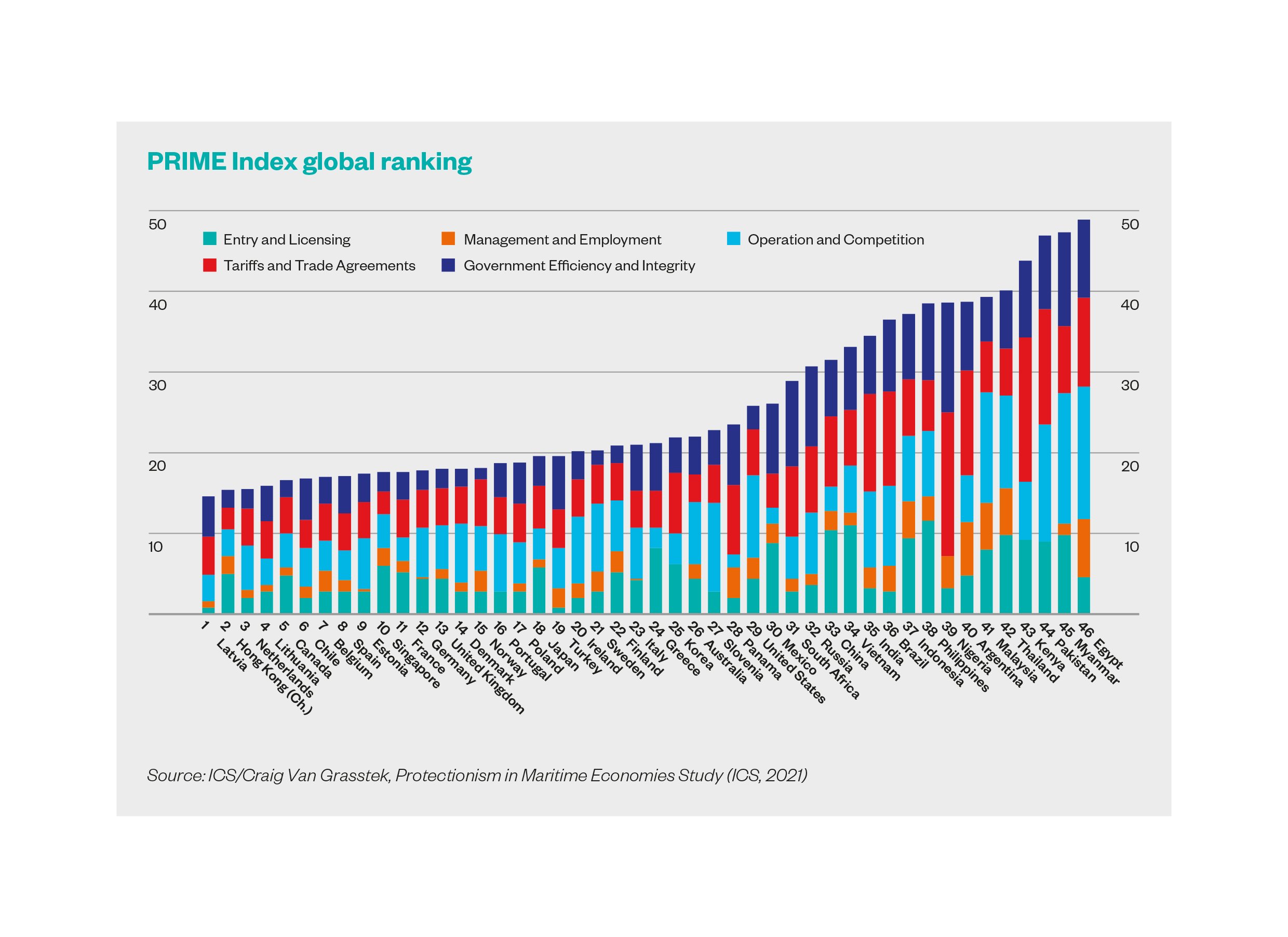
Countries in the ASEAN trade bloc could increase GDP by 1.8% by reducing their PRIME score by 50%. The South American trade bloc Mercosur could make gains of 0.8% through similar measures, while the African Union bloc could gain 1% of GDP. Kenya and Egypt, two of the PRIME index’s worst scorers, stood to add more than 40% to total export gains if they engaged fully with removing restrictions, the report suggested.
Ralf Nagel, Chairman of the ICS Shipping Policy Committee and CEO of the German Shipowners’ Association, commented:
“Identifying the trade restrictive policies that countries have in place is a sensible first step towards meaningful reform and the new report by ICS is an excellent starting point to identify these barriers.
“Equally important is to have a clear plan of action to significantly reduce the impact of these policies or remove them altogether, depending on the level of ambition. The lower the level of restrictiveness, the greater the degree of GDP gains is likely to be.”
ICS will present its report to the WTO Services Council and the B20 Taskforce on Trade & Investment (which makes direct recommendations to the G20), as well as various regional trade blocs, such as the AU, EU and APEC.



Related News.

Cyprus Maritime Innovation takes Centre Stage at SMM Hamburg 2026
Underscoring its expanding role as a premier international hub for cutting-edge maritime technology and sustainable shipping, the Republic of Cyprus…
Trump seeks to refill US oil reserve with Venezuela deal but faces long delay
U.S. President Donald Trump said on the 30th (local time) that he would refill the U.S. Strategic Petroleum Reserve, which has been depleted with…

US Navy Official visits South Korean Shipyards in private
With U.S. President Donald Trump pushing a plan to allow overseas construction of U.S. warships, attention is focusing on whether the building of…
SES and De Boer Marine expand collaboration with FlexMaritime deployment across Global Markets
SES, a leading space solutions company, and De Boer Marine, a leading provider of top-quality marine equipment and maritime connectivity services,…

New ESG guidance to help maritime industry turn sustainability into commercial advantage
New framework helps shipowners and ports align ESG strategy with access to capital, charterer expectations and long-term asset value. Maritime…

Britannia P&I Club analysis finds four in five crew deaths linked to illness rather than accidents
New report highlights cardiovascular disease as leading cause of fatalities and raises concerns over mental health risks among younger seafarers.…

The Swedish Club launches new Loss Prevention podcast, Knot Another Lesson
The Swedish Club has launched Knot Another Lesson, a new podcast exploring the practical lessons, emerging risks and operational challenges shaping…

Lloyd’s Register appoints Jens Grunenberg as Senior Representative for Germany
Lloyd’s Register has appointed Jens Grunenberg as its Senior Representative for Germany, effective 1 September. Based in Hamburg, Grunenberg will…

Indian Register of Shipping sets sights on Hamburg for European Expansion
Indian Register of Shipping, a leading international classification society and full member of the International Association of Classification…

MOL completes Merger of 6 Ship Management Companies
Unifying Management of Over 200 Vessels and Strengthening Safety Mitsui O.S.K. Lines, announced that it has completed the integration of the MOL…
Subscribe to our newsletter!
if you dont want to swim alone in the ocean of news, sign up for the newsletter, and you will receive daily all the important news of world shipping!
