What are command-and-control (C2) callbacks?


Malicious hacker attacks have been on the rise in the last couple of years. One of the most damaging attacks, often executed over DNS, is accomplished through command and control, also called C2 or C&C callbacks. Let’s have a look at how the hackers use this technique to infect their victims.
What is a C2 server?
A command-and-control server is a computer that is controlled by a cybercriminal. Command-and-control servers are used by attackers to maintain communications and send commands to systems inside a target network compromised by malware. These systems can include computers, smartphones, and even IoT devices connected to the network.
How are C2 servers used?
C2 servers act as command centres from where malware receives their commands. They are also used to collect and store stolen data. Establishing C2 communications is a vital step for attackers to access network resources.
The attacker starts by infecting a computer, which may sit behind a firewall. This can be achieved in several ways:
- Via a phishing email that tricks an unsuspected employee into clicking a link to a malicious website or opening an attachment that executes malicious code.
- Through security holes in browser plugins.
- By downloading malicious apps.
- With malicious code brought in on external devices, e.g. USB sticks.
- Via other infected software.
Once a machine is compromised, the hacker will ping the infected computer or device for a callback to test the new connection. The infected computer will then carry out the commands from the attacker’s C2 server and may install additional software. The attacker now has complete control of the victim’s computer and can execute any code. The malicious code will typically spread to more computers, creating a botnet – a network of infected machines. In this way, an attacker who is not authorised to access a company’s network can obtain full control of that network.
What Can Hackers Accomplish Through Command and Control?
C2 attacks pose real dangers to shipping companies, with potentially severe operational, financial and reputational risks. Typically, attackers want to achieve the following:
- Data exfiltration. Sensitive data, such as credentials, operational documents, financial data, employee records, and other sensitive information, can be copied or transferred to an attacker’s server.
- Shutdown. An attacker can shut down one or several machines, or even bring down a company’s network, ultimately bringing normal operations to a halt.
- Distributed denial of service. DDoS attacks disrupt or shut down web servers as well as entire networks. DDoS attacks overwhelm server or networks by flooding them with internet traffic. Once a botnet is established, an attacker can instruct each bot to send a request to the targeted IP address, creating a jam of requests for the targeted server. Legitimate traffic to the attacked IP address is denied.
Source: Dualog by Rune Larsen, Service Mark



Related News.

5th CSN Greece ICT Conference, Athens 19th November 2026 “Intelligent Skies, Secure Seas: The AI Impact on ICT” – Save the date
About the Conference The 5th CSN Greece Shipping ICT Conference, titled “Intelligent Skies, Secure Seas: The AI Impact on ICT”, will take place on…
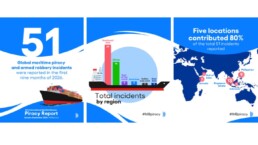
Maritime piracy incidents remain at historic lows despite Somali piracy concerns
The ICC International Maritime Bureau (IMB) has reported the lowest level (51) of piracy and armed robbery incidents since 1992 in the first nine…
Piraeus Port Authority main sponsor of Ferry Shipping Summit 2026
With the participation of more than 200 delegates from several European countries, the Ferry Shipping Summit 2026 took place on 8–9 October 2026 in…

EuroDry announces order for the construction of a third modern 82,000 DWT Kamsarmax Bulk Carrier
EuroDry , an owner and operator of drybulk vessels and provider of seaborne transportation for drybulk cargoes, announced that it has signed a…

India urges Russia, Ukraine to protect Black Sea shipping
India has urged both Russia and Ukraine to ensure safe passage for commercial shipping through the Black Sea as attacks on merchant vessels put…

PD Ports strengthens its commitment to the River Tees with multi-million pound Marine investment
PD Ports has officially opened a new multi-million-pound Marine facility on the banks of the River Tees, reinforcing its long-term commitment to the…

Maritime leaders head to Shanghai for the Annual Summit 2026
Shared seas, shifting horizons Maritime trade stands at a turning point. The rules-based order on which shipping has long depended is under…
Indian Register of Shipping grants type approval to Medha Energy’s 92 kWh LTO Lithium-Ion battery system
Indian Register of Shippinghas successfully completed the Type Approval process for the 92 kWh Lithium-Ion Battery System developed by M/s Medha…

KLine opens a Singapore New Hub for Consolidated Ship Management and Maritime Talenτ
Three Companies, One Roof — Singapore's New Hub for Consolidated Ship Management and Maritime Talenτ A ceremony for around 280 guests sets the stage…
ASA explores measures to Safeguard Free and Safe Navigation at Critical International Maritime Chokepoints
The Asian Shipowners’ Association which accounts for 56% of the world’s fleet capacity and consists of China, Cook Islands, Hong Kong, Japan, Korea…
Subscribe to our newsletter!
if you dont want to swim alone in the ocean of news, sign up for the newsletter, and you will receive daily all the important news of world shipping!
