Rotterdam presents ambitious shore-based power strategy for sea-going vessels
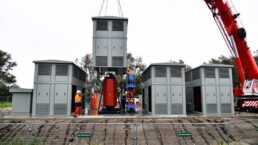

The Municipality of Rotterdam and the Port of Rotterdam Authority are working together on the joint rollout of shore-based power for sea-going vessels in Rotterdam. By 2030, they want a significant share of sea-going vessels to ‘plug in’ once they have moored along one of the port’s quays. This will allow them to power down their diesel generators while berthed – good news for local air quality and the vessels’ carbon footprint. Over the next five years, the partners will be initiating a series of projects that are intended to accelerate and scale up the adoption of shore-based power. Depending on the experiences gained in these projects, the Municipality and the Port Authority may adapt their targets in this area in 2025.
According to Arno Bonte, Rotterdam’s Vice Mayor for Sustainability, Clean Air and Energy Transition, the plan is a major step forward for sustainability in the port. ‘Shore-based power allows us to connect vessels to a clean source of power. This prevents both air pollution and noise nuisance – which will improve conditions for local residents and for the surrounding nature areas. Our port will once again become a bit greener.’
Allard Castelein, CEO of the Port of Rotterdam Authority: ‘Our vision combines ambition and pragmatism. We will be setting up eight to ten shore-based power projects for a variety of sea-going vessel types. We will be doing this in partnership with companies in the port area and with the shipping companies that use our port. We will continually monitor the results of these projects to learn whether we can speed up the process or need to take a bit more time.’
Sea-going vessels
Ships require electric power for a variety of processes on board, including lighting, running all manner of equipment as well as keeping containers with food products at the right temperature, for example. This power generally comes from diesel generators, which release pollutants, carbon emissions and noise. In principle, you could also hook a vessel up to the power grid on shore while it is berthed. However, this does require the ship itself, the terminal quays and the power grid to be suited to this solution.
Every year, sea-going vessels moored along Rotterdam’s quays consume as much electric power as 250,000 to 300,000 households. And in the process, they release various harmful emissions into the atmosphere, including 600,000 tonnes of CO2 and 8,000 tonnes of nitrogen. By 2030, Rotterdam’s shore-based strategy could result in carbon savings of approximately 200,000 tonnes per year.
Over the past few years, virtually every public berth for inland shipping in Rotterdam has been fitted with a shore-based power point. Inland vessels consume far less power than their sea-going counterparts. To limit nuisance for the surrounding area, Stena Line’s ferry at Hoek van Holland has been using shore-based power for some time now. And Eneco and the Port Authority are currently working on a shore-based power facility near Rozenburg for Heerema’s offshore vessels, which regularly moor at this location.
Three pillars
In view of the variety of vessel types and mooring locations involved, the partners have based their shore-based strategy on three different pillars. The first pillar mainly centres on the quality of the surrounding social environment, ensuring that all public quays in built-up areas will ultimately be fitted with shore-based power points. The objective is for 90% of these connections to be used by ships calling on the port by 2030. In addition, Rotterdam is also examining opportunities to realise shore-based power along private quays near built-up areas.
The second pillar is characterised by ‘big steps forward wherever possible’. The objective is to construct new shore-based power capacity for ferries, ro/ro ships, offshore vessels and cruise liners, which should once again have an utilisation rate of 90% by 2030. In the case of container vessels, the ambition has been set at a 50% adoption of shore-based power by large vessels (10,000+ TEU) as of 2030. And finally, the third pillar focuses on the development of innovations for special vessel categories like e.g. liquid bulk carriers, which are difficult to accommodate with the existing shore-based power facilities.
In the years ahead, the aim is to realise eight to ten concrete shore-based projects, which will be divided between the programme’s three main pillars. This programme is expected to require a total investment of some EUR 125 million. The majority of this budget will be contributed by the companies involved, the Municipality and the Port Authority. Nevertheless, around EUR 50 million will need to be covered by public funding.



Related News.

OL Shipping Group in Tokyo: Capt. Eberhard Koch calls for realistic solutions to Maritime Decarbonisation
An intensive and engaging couple of days in Tokyo brought together leading figures from the international maritime community, providing a valuable…
Regatta for Peace one of the largest ever in Cyprus
Cyprus will host the first European stop on a global sailing journey leading up to the 2027 America’s Cup in Naples. More than 120 sailors…
The propulsion technology powering the marine energy transition
The marine industry is under increasing pressure to future-proof fleets, balancing the need to reduce emissions and improve efficiency. Propulsion…
Signal Ocean acquires Lgmar
Signal Ocean announced the acquisition of Lgmar, the Athens-based company behind Telix, a maritime email and communication platform in daily use…

Canada clean power push challenged by interprovincial grid limits, says GlobalData
Canada is entering a pivotal phase of power-sector expansion as federal tax credits, the phase-out of coal-fired generation, and accelerating…

Maritime safety depends on human factors and leadership, not procedures alone
Interim survey findings point to a gap between seafarers’ perceptions of risk and injury data Seafarers may misjudge when and where they are most at…

New BIMCO contracts tackle ship recycling and energy-saving retrofits
BIMCO adopted two new contractual solutions designed to help you manage important operational and regulatory challenges: the revised…
Stena Line to acquire vessel and make changes to its network
Stena Line has reached an agreement to acquire the RoRo vessel Somerset from CLdN. Subject to closure and transfer, the vessel would begin operating…

DORIC WEEKLY INSIGHT 16 OCTOBER 2026
Please find below the DORIC Market Insight for the week ending 16th October 2026. Weekly Report 16.10.2026
Important information for port clients and freight carriers effective November 1, a new traffic overpass and port checkpoint will open for traffic to the Port of Riga on Kundziņsala
Starting November 1 of this year, a new traffic overpass connecting Tvaika Street to Kundziņsala will open to facilitate traffic to and from the Port…
Subscribe to our newsletter!
if you dont want to swim alone in the ocean of news, sign up for the newsletter, and you will receive daily all the important news of world shipping!
