The digital future of the product tanker industry. Are autonomous smart ships a pending reality?

Digitalization has introduced the product tanker industry to previously unimaginable levels of information. With the dawn of widespread sensor technology, virtually limitless data can be captured and used to not only optimize but revolutionize shipping. In an interview with Executive Vice President and Technical Director of Hafnia, Ralph Juhl, we learn about three of Hafnia’s digital initiatives and his reflections on the potentiality of fully autonomous smart ships.
Positivity breeds possibility
Hafnia has been keen to embrace digitalization for both its own benefit and the benefit it is set to bring the product tanker industry. Digital initiatives have enabled increased safety of personnel, more sustainable shipping practices, enhanced security of cargo and not least, had a significant impact on the bottom line. With this in mind it shouldn’t be a surprise that investment in digitalization and how the resulting data can be applied is high on everyone’s agenda.
Efficiency through simplification
Hafnia is in the process of launching a new ship administrative system called ShipPalm, with Alpha Ori Technologies, where HSEQ, Crewing, Purchase and PMS systems data are all centrally located. Collecting data sets in this way and cross referencing them will create systems that automatically advise on preventative maintenance and operational efficiency. For an industry traditionally offline and set in its ways, systems like ShipPalm are a breath of fresh air and lay the foundation for many more broad-reaching digital initiatives.
An eye on the future – SMARTShip
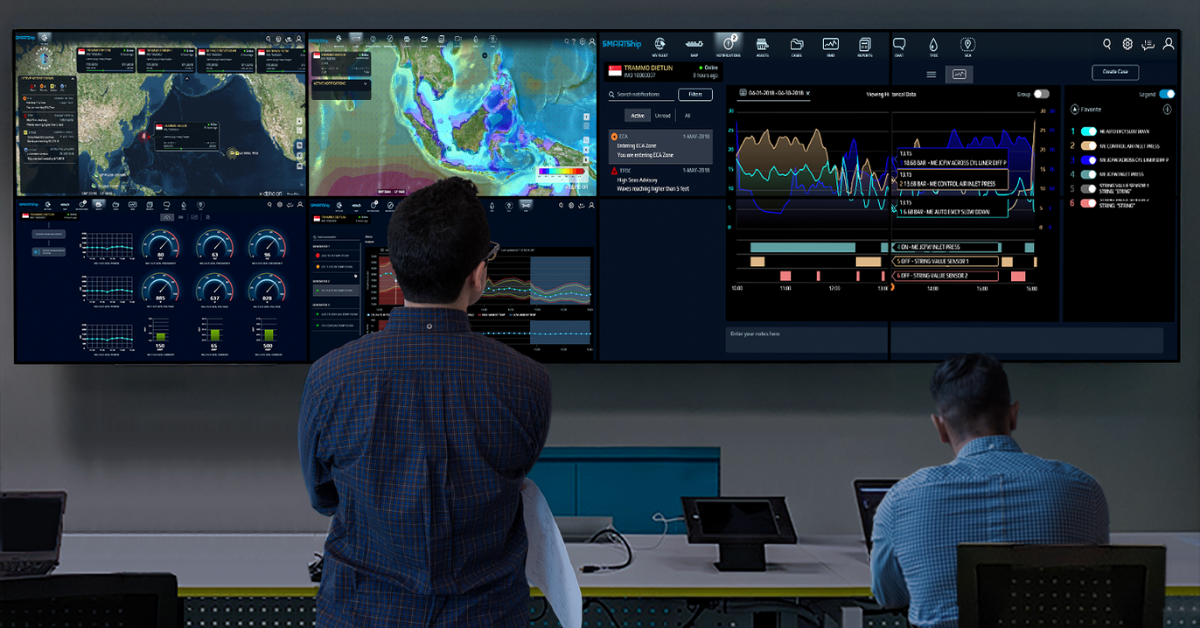
One such pioneering initiative is SMARTShip – a sensor-driven system that aims to harvest as much data as possible from all ships across the fleet. Whether monitoring fuel consumption, speed, pumps, purifiers, emissions or ballast water, SMARTShip’s objective is to understand each aspect of individual vessel performance while also creating a holistic, bigger picture of the fleet. A system like this also allows Hafnia to evaluate the specific impact of new operational initiatives rolled out by management. It is data-rich decision making and innovation such as this that will guide Hafnia’s fleet safely into 2030 – enabling it to reach the CO2 requirements set by the International Maritime Organization and the United Nations. Performance can be compared between vessels and knowledge shared among the fleet.
Measuring performance and sustainability with COACH
The COACH performance program is another digital tool that Hafnia is using, in this case to objectively determine vessel pool points and the distribution of earnings among the pool members. By collecting and analyzing many different types of data, these earnings are determined accurately and reliably. COACH is also used to record oil consumption, hull and propeller condition and the efficacy of different sustainability initiatives (through the measurement of CO2/GHG levels of individual ships). Furthermore, the lessons from our digitalization journey are constant. COACH was initially instigated to determine performance, pool points and earnings distribution, yet it was soon discovered that propeller maintenance and antifouling upgrades could be run via the same system. Starting small in this way and building big has often proved the best method for Hafnia’s digitalization projects. Clearly understanding objectives before investing in a project has been critical to success. It is important to remember that digitalization is a means to an end, not the end in itself.
“The purpose of Hafnia’s digitalization initiatives is to improve safety, environmental performance, asset value and earnings. Our process has already brought immense results in each of these areas, but we’re excited that there is still much benefit to be realized.”
Ralph Juhl, EVP & Technical Director, Hafnia
Is autonomous shipping poised to follow initiatives like SMARTShip?
SMARTShip is a high priority for Hafnia and solid results are already evident from this initiative, but the full potential of automating specific processes on vessels has yet to be realized. Looking towards the future, it doesn’t seem a far cry to ask whether the comprehensive monitoring of vessels could lead to a global network of fully autonomous ships. With increasingly reliable ship-to-shore connections and constantly improving navigational and operational technologies, it’s reasonable to speculate on how long autonomous ships will remain science fiction.

The drivers and drawbacks of autonomy
The safety aspects of autonomous shipping are complex and hard to guarantee. On top of that, the cost for the industry to accommodate and empower self-sufficient vessels is still astronomical. The savings created by no longer having a crew pale in comparison to the expense of building a state-of-the-art autonomous ship. This is true without even considering the substantial modifications required for ports in order for such ships to be able to dock and launch. Add the gargantuan political task of agreeing upon regulatory legislation and responsibility – as the ships pass through many different international waters – and the notion of autonomous ships seems a long way off, if not virtually impossible within our lifetime. Though autonomous shipping may not be the immediate upshot of digitalization, Juhl is convinced of the growing presence and effect of digital initiatives in the product tanker industry,
“Autonomous ships may not be seen sailing over the horizon quite yet, but one thing is certain – digitalization is being embraced and encouraged by many within the product tanker industry and the results are both real and motivating when it comes to improved safety, efficiency and reliability.”
Ralph Juhl, EVP & Technical Director, Hafnia
Source: Hafnia



Related News.

OL Shipping Group in Tokyo: Capt. Eberhard Koch calls for realistic solutions to Maritime Decarbonisation
An intensive and engaging couple of days in Tokyo brought together leading figures from the international maritime community, providing a valuable…
Regatta for Peace one of the largest ever in Cyprus
Cyprus will host the first European stop on a global sailing journey leading up to the 2027 America’s Cup in Naples. More than 120 sailors…
The propulsion technology powering the marine energy transition
The marine industry is under increasing pressure to future-proof fleets, balancing the need to reduce emissions and improve efficiency. Propulsion…
Signal Ocean acquires Lgmar
Signal Ocean announced the acquisition of Lgmar, the Athens-based company behind Telix, a maritime email and communication platform in daily use…

Canada clean power push challenged by interprovincial grid limits, says GlobalData
Canada is entering a pivotal phase of power-sector expansion as federal tax credits, the phase-out of coal-fired generation, and accelerating…

Maritime safety depends on human factors and leadership, not procedures alone
Interim survey findings point to a gap between seafarers’ perceptions of risk and injury data Seafarers may misjudge when and where they are most at…

New BIMCO contracts tackle ship recycling and energy-saving retrofits
BIMCO adopted two new contractual solutions designed to help you manage important operational and regulatory challenges: the revised…
Stena Line to acquire vessel and make changes to its network
Stena Line has reached an agreement to acquire the RoRo vessel Somerset from CLdN. Subject to closure and transfer, the vessel would begin operating…

DORIC WEEKLY INSIGHT 16 OCTOBER 2026
Please find below the DORIC Market Insight for the week ending 16th October 2026. Weekly Report 16.10.2026
Important information for port clients and freight carriers effective November 1, a new traffic overpass and port checkpoint will open for traffic to the Port of Riga on Kundziņsala
Starting November 1 of this year, a new traffic overpass connecting Tvaika Street to Kundziņsala will open to facilitate traffic to and from the Port…
Subscribe to our newsletter!
if you dont want to swim alone in the ocean of news, sign up for the newsletter, and you will receive daily all the important news of world shipping!
