Covid-19 accelerates maritime insecurity in the Asia–Pacific
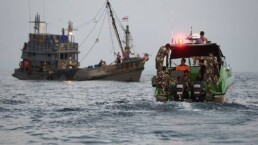

Covid-19 is showing the world how a health crisis can exert disproportionate pressure on existing social and political fissures. The Asia–Pacific maritime environment is no exception, with hybrid challenges persisting and non-conventional incidents on the rise. As state budgets adjust to accommodate the health crisis, non-state actors are escalating violence on land that is spilling over into the maritime domain.
Before the onset of the pandemic, illegal, unreported and unregulated fishing incidents were gaining recognition as a serious security issue. Known as hybrid challenges, these incidents are characterised by the combination of regular and irregular tactics used by adversaries to exploit non-conventional concerns in order to gain an asymmetric advantage. These tactics include the use of criminal behaviour, subversion, sponsorship of proxy forces and even military expansionism.
Covid-19 is not hindering state and non-state actors from posing maritime hybrid threats despite national budgets being diverted to crisis response. The sinking of a Vietnamese fishing boat near the Paracel Islands, harassment of supply ships off Sarawak, and China’s annual announcement of a fishing ban are some of the irregular hybrid tactics that persist alongside the global pandemic.
Non-state actors are also exploiting the health crisis and perceived weakening of state capacity to heighten internal violence, with negative consequences for the Asia–Pacific’s maritime domain. Organised violence in Myanmar’s Rakhine and Chin states increased by 74% from January to April 2020 compared with the year before. The increased violence is causing mounting civilian fatalities, displacing villagers and pushing migrants out to the Andaman Sea—a maritime route into other regional countries. As countries reject migrants for fear of spreading unidentified infections, the exodus under pandemic conditions could trigger a repeat of the 2015 migration crisis.
There has also been a marked increase in piracy and armed robbery during this period. The Regional Cooperation Agreement on Combating Piracy and Armed Robbery against Ships in Asia (ReCAAP) Information Sharing Centre reported a two-fold increase in the number of piracy and armed robbery incidents from January to June 2020 as compared to 2019. Security arrangements such as the Eastern Sabah Security Command were also on high alert after receiving information of a raised risk of armed Abu Sayyaf Group members targeting vessels in the Sulu and Sulawesi seas.
The heightened risk of instability at sea is accompanied by related reports of clashes between government forces and militants on land. In Sultan Kudarat province, Philippine government forces targeted Bangsamoro Islamic Freedom Fighters militants that are associated with a kidnap-for-ransom group. Violent clashes with Abu Sayyaf Group members were also reported in Sulu.
While these maritime challenges demand an immediate security response, Asia–Pacific countries are preoccupied with battling Covid-19 infections within their own borders. By redirecting more resources towards containing the spread of Covid-19, regional countries are experiencing corresponding budget cuts to other state functions—including defence. For example, Indonesia’s defence budget has been lowered by 7% and Thailand’s budget will shrink by 8%. For Thailand, this has translated into a standstill on military procurement purchases including two Chinese-made submarines.
Despite these restrained national resources, regional governments are still adopting strategies to compensate for any shortfall in state capacity. To maintain a coordinated and balanced response to both domestic and external threats, Malaysia is implementing the integrated ‘Ops Benteng’ to enhance enforcement along maritime and land borders. In the Philippines, a controversial bill designed to strengthen the country’s counterterrorism authorities came into effect on 18 July. Meanwhile, annual multilateral naval exercises such as Southeast Asia Cooperation and Training, or SEACAT, have shifted to virtual platforms to maintain active levels of information sharing and multilateral coordination among naval forces in the region.
Covid-19 is placing intense pressure on pre-existing political and social fissures in the Asia–Pacific. Non-state and state actors are taking advantage of a perceived reduction in state capacity to pursue activities that result in maritime instability. An extended pandemic period threatens to exert further pressure on national budgets and state capacity to protect exclusive economic zones. Although Covid-19 began as a threat to public health, it is slowly evolving into a threat to maritime security too.
Source: East Asia Forum by Asyura Salleh



Related News.

OL Shipping Group in Tokyo: Capt. Eberhard Koch calls for realistic solutions to Maritime Decarbonisation
An intensive and engaging couple of days in Tokyo brought together leading figures from the international maritime community, providing a valuable…

Regatta for Peace one of the largest ever in Cyprus
Cyprus will host the first European stop on a global sailing journey leading up to the 2027 America’s Cup in Naples. More than 120 sailors…
The propulsion technology powering the marine energy transition
The marine industry is under increasing pressure to future-proof fleets, balancing the need to reduce emissions and improve efficiency. Propulsion…
Signal Ocean acquires Lgmar
Signal Ocean announced the acquisition of Lgmar, the Athens-based company behind Telix, a maritime email and communication platform in daily use…

Canada clean power push challenged by interprovincial grid limits, says GlobalData
Canada is entering a pivotal phase of power-sector expansion as federal tax credits, the phase-out of coal-fired generation, and accelerating…

Maritime safety depends on human factors and leadership, not procedures alone
Interim survey findings point to a gap between seafarers’ perceptions of risk and injury data Seafarers may misjudge when and where they are most at…

New BIMCO contracts tackle ship recycling and energy-saving retrofits
BIMCO adopted two new contractual solutions designed to help you manage important operational and regulatory challenges: the revised…
Stena Line to acquire vessel and make changes to its network
Stena Line has reached an agreement to acquire the RoRo vessel Somerset from CLdN. Subject to closure and transfer, the vessel would begin operating…

DORIC WEEKLY INSIGHT 16 OCTOBER 2026
Please find below the DORIC Market Insight for the week ending 16th October 2026. Weekly Report 16.10.2026

Important information for port clients and freight carriers effective November 1, a new traffic overpass and port checkpoint will open for traffic to the Port of Riga on Kundziņsala
Starting November 1 of this year, a new traffic overpass connecting Tvaika Street to Kundziņsala will open to facilitate traffic to and from the Port…
Subscribe to our newsletter!
if you dont want to swim alone in the ocean of news, sign up for the newsletter, and you will receive daily all the important news of world shipping!
