Eni remains committed to its decarbonization strategy, revises long-term prices assumptions, having assessed the disruptions in the trading environment due to COVID-19


- Strategy and implementation actions to reduce the Company’s carbon footprint confirmed, and possibly speeded up;
- Long-term prices assumptions for Brent crude oil set at $60 /barrel (from 2023 onwards, in real terms), compared to $70/barrel previously
Claudio Descalzi, Eni’s CEO, commented:
“We confirm our strategy to become a leader in the decarbonization process, notwithstanding the enduring impacts of the COVID-19 pandemic on the global economy and the Company. We are assessing how to speed up our plans. This ongoing evolution will allow the Company to achieve a better balanced portfolio, reducing the exposure to the volatility of hydrocarbon prices, while progressing towards our targets of sustainability and profitability. Our changed long-term assumptions, reached four months after the outbreak of the COVID-19 pandemic, reflect our current expectations about future prices and will be incorporated in our processes of capital allocation.”
Following the assessment of the disruptions in the trading environment due to Covid-19 pandemic, Eni confirms the long-term strategy presented at the end of February 2020 setting out the evolution of the Company in the next 30 years that will allow Eni to be a leader in the market supplying decarbonised products and actively contributing to the energy transition process, thus combining targets of returns and environmental sustainability. The market developments linked to the spread of the COVID-19 pandemic have made even more compelling the robustness of our strategic path and of our long-term choices.
The distinctive element of this strategy – as Eni already announced to the market – is the fixed 2050 absolute emissions reduction target of 80% covering all of the Company’s products, which is well above the 70% threshold indicated by the IEA in the Sustainable Development Scenario that tracks the reduction of emissions compatible with the Paris Agreement. The even more sustainable evolution of Eni’s business model is underpinned by maintaining rigorous financial discipline in capital allocation and a robust capital structure.
Having considered the prospect of the pandemic having an enduring impact on the global economy and the energy scenario, Eni has revised its view of market fundamentals to factor in certain emerging trends. In Particular, the Company has revised its forecast for hydrocarbon prices, which are the main driver of capital allocation decisions and of the recoverability assessment of the book values of Eni’s non-current assets.
Revision of the 2020-2024 and long-term pricing scenario
The revised scenario adopted by Eni foresees a long-term price of the marker Brent of 60 $/barrel in 2023 real terms compared to the previous assumption of 70 $/barrel. For the years 2020-2022, Brent prices are expected respectively at 40, 48 and 55 $/barrel (compared to the previous assumptions of 45, 55 and 70 $/barrel).
The price of natural gas at the Italian spot market “PSV” is estimated at 5.5 $/mmBTU in real terms 2023 compared to the previous assumption of 7.8 $/mmBTU. For the years 2020-2022 it is expected respectively at 3.0, 4.6 e 5.2 $/mmBTU (previously 3.9, 5.1 and 7.3 $/mmBTU). Long-term refining margins in the Mediterranean area are confirmed slightly lower than 5 $/barrel.
Impact on the Group’s financial statements
Eni’s impairment assessments are in progress and it is not possible at this time to precisely determine the impact of the revised impairment testing price assumptions on the group’s financial statements.
Based on information available to management and on the current progress of assessments, Eni currently expects to record in the results of the second quarter 2020 estimated non-cash, post-tax impairment charges against non-current assets, including a devaluation of tax credits recorded in connection with tax-losses carryforwards, of € 3.5 billion, plus/minus 20%. At its mid-point, this estimation represents a limited decrease of around 4% in the value of non-current assets.
Pre-tax impairment charges estimated at € 2.8 billion relate for € 2 billion to upstream assets, with the remaining charges to be recorded in the refining business. Management does not expect any impairment charge against the value of explorations assets triggered by the revision of the pricing scenario.
The reduction in tax credits of € 0.7 billion is due to an impairment loss recorded at tax-losses carryforwards net of the tax effects associated with the charges recorded against the book values of property, plant and equipment.
The ultimate amount of the above mentioned estimated impairment losses are expected to be recorded in Eni’s consolidated results for the second-quarter 2020 due to be released on July 30, 2020 and in Eni’s interim consolidated financial report for the first half of 2020 due to be published by the first week of August upon completion of a limited review by the Group’s Independent external Auditors.



Related News.

Navigating the Multi-Orbit Era: In Conversation with Intellian’s Jon Harrison at SMM 2026
At SMM 2026 in Hamburg, the rapid evolution of maritime satellite communications took centre stage. Across the exhibition halls, discussions among…
Cyprus ports need joint energy and investment strategy, shipping agents chief says
Cyprus needs a coordinated strategy for shipping, energy and environmental protection to support port investment and modernisation, Cyprus shipping…

MASO Public Affairs introduces MASO Regulatory Intelligence
A new subscription service helping businesses understand what is changing and what it means for them MASO Public Affairs introduces MASO Regulatory…

Anglo-Eastern helps turn CMBTECH’s ammonia ambition into an operational reality
From early feasibility study and risk-based design to newbuilding supervision, crew readiness and technical management, Anglo-Eastern drew on its…

Escalation of attacks threatens to derail recovery in Middle East oil exports
World oil demand is forecast to fall by 2.5 mb/d y-o-y in 4Q26 and 2.6 mb/d on average in 2026. As the Iran war manifests itself through restricted…

New study finds shipping pays twice its share to EU ETS earmarked revenues should triple to help build market for sustainable fuels and technologies
Shipping is responsible for around 10% of EU ETS emissions but pays almost 20% of the ETS bill. Unlike other sectors, it has never received free…

MSARC strengthens maritime mass rescue readiness through training and national live exercise off Dakar, Senegal
Joint MSARC–FHAS programme combines three days of SAR training with a national multi-agency live exercise The Maritime Search and Rescue Council ,…
Sogese report deliveries are still being delayed as container freight rates fluctuate
FOR IMPORTERS Spot rates into the Mediterranean are back at January levels, Far East to Europe reliability sits at pandemic lows, and nearly…

Glencore begins trading on Australian Securities Exchange
Glencore has begun trading on the Australian Securities Exchange under the ASX code GLC. Gary Nagle, Glencore’s CEO, said it was an exciting day for…
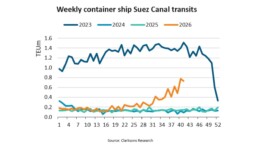
BIMCO Shipping Number of the Week
Suez Canal container ship transits exceed 50% of pre-disruption levels "During the first two weeks of October, weekly container ship capacity…
Subscribe to our newsletter!
if you dont want to swim alone in the ocean of news, sign up for the newsletter, and you will receive daily all the important news of world shipping!
