BIMCO: Shipbuilding orders spiral down

What is more, the demolition activity, which has been pretty dynamic over the recent period, has also ground to a halt amid lockdowns across South Asia aimed at curbing the spread of the pandemic.
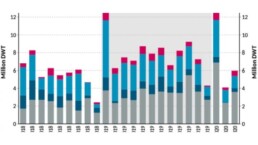
In the first quarter of the year, contracting activity dropped 55% from the first quarter of 2019, with only 6.6 million deadweight tonnes (DWT) ordered across the three major shipping segments, down from 14.7 million DWT last year, data from BIMCO shows.
“Uncertainty about future environmental regulations, as well as lower demand growth outlook in the coming years, already had many think twice before ordering a new ship. The very sharp decrease in market sentiment and global shipping demand has only lowered contracting activity further,” says Peter Sand.
BIMCO’s data shows that the most affected sector was dry bulk shipping, falling from 6.9 million DWT in Q1 2019 to 1.6 million DWT in Q1, 2020. These orders include two Capesizes (totalling 420,000 DWT), one Panamax (82,000 DWT) with the rest being Handymax ships (1 million DWT).
The product tanker segment has seen the smallest fall in new orders placed in the first quarter of this year compared to last, with orders down 17.8% to 806,500 DWT.
On the crude oil tanker side, contracting activity has halved from the first two months in 2019 (-53%) with new orders totalling 2 million DWT. Three VLCC orders have been recorded, with the remaining new orders being for Suezmax and Aframax ships.
There were very few orders for new container ships in the first two months of the year, totalling only 48,519 TEU. This was dwarfed by an order for five 23,000 TEU ships in March, adding to an already large orderbook for Ultra Large Container Ships (≥14,500 TEU).
With the latest orders, there are now 76 ULCSs totalling 1.5 million TEU set to enter the market between now and 2023, including 39 ships of 23,000 TEU or more.
Demolition set to slow as major yards close the doors
Due to higher fuel prices and poor market conditions, many ships headed for demolition in the first quarter of the year, totaling 6.1 million DWT, up 62% from Q1 2019.
However, with restrictions aimed at containing the virus spreading further around the world, finding demolition availability is becoming increasingly challenging.
All three of the major demolishing countries in the Indian sub-continent, namely Bangladesh, India and Pakistan, have announced the closure of their yards, and ships heading towards them will be denied entry. This will halt all scheduled activity for at least the next few weeks.
“As demolition yards now close their doors, many owners of container and dry bulk ships will be left with unwanted tonnage in an already difficult situation.”
“As long as freight rates hold up for tankers, owners will be less likely to scrap their ships, but even in this market, demand has evaporated and the current high freight rates are not sustainable,” says Peter Sand.
Chinese shipyards are delayed by six weeks on average
One of the short term and direct impacts of the coronavirus on the shipping fleet are the delays of newbuilt ships in China and across the Far East. In February, there was only 398,712 DWT delivered by Chinese yards, a quarter of what was delivered in February 2019. Deliveries in March this year were half of those seen in March 2019. Currently, Chinese shipyards are delayed by between four to eight weeks.
Overall, deliveries fell 16.7% in the first quarter of this year compared to the same period last year. Contrary to the rest of the shipping markets, where deliveries have fallen compared to last year, the dry bulk market has had more deliveries in the first quarter of this year than last. A total of 12.9 million DWT was delivered in the first quarter, 3.9 million DWT more than Q1 deliveries last year, BIMCO’s data shows.
Deliveries of dry bulk vessels accounted for 60% of the total 21.5 million DWT delivered in the first quarter the year.
Both segments of the tanker shipping industries have seen deliveries fall by just under half compared to the first quarter of 2019; -49% and -43% for crude oil and product tankers respectively. A total of 5.7 million DWT of crude oil tankers was delivered in the first quarter of the year, of which 4 million comes from the delivery of 13 VLCCs.
In the container shipping market, one ULCS has been delivered as well as three neo-panamax, while 14 feeder vessels between 1,162 and 2,806 TEU made up the rest of deliveries. In total deliveries were down 58.6% to 102,435 TEU combined, compared with the first quarter of last year.
“These new vessels are entering the market at a time of increasing uncertainty. Although new tankers are entering the market at a time when freight rates are high, given the prevailing market conditions, it is likely only a matter of time before they join the container and dry bulk ships in trying to navigate a struggling market,” Sand concludes.



Related News.

Navigating the Multi-Orbit Era: In Conversation with Intellian’s Jon Harrison at SMM 2026
At SMM 2026 in Hamburg, the rapid evolution of maritime satellite communications took centre stage. Across the exhibition halls, discussions among…
Cyprus ports need joint energy and investment strategy, shipping agents chief says
Cyprus needs a coordinated strategy for shipping, energy and environmental protection to support port investment and modernisation, Cyprus shipping…

MASO Public Affairs introduces MASO Regulatory Intelligence
A new subscription service helping businesses understand what is changing and what it means for them MASO Public Affairs introduces MASO Regulatory…
Anglo-Eastern helps turn CMBTECH’s ammonia ambition into an operational reality
From early feasibility study and risk-based design to newbuilding supervision, crew readiness and technical management, Anglo-Eastern drew on its…

Escalation of attacks threatens to derail recovery in Middle East oil exports
World oil demand is forecast to fall by 2.5 mb/d y-o-y in 4Q26 and 2.6 mb/d on average in 2026. As the Iran war manifests itself through restricted…

New study finds shipping pays twice its share to EU ETS earmarked revenues should triple to help build market for sustainable fuels and technologies
Shipping is responsible for around 10% of EU ETS emissions but pays almost 20% of the ETS bill. Unlike other sectors, it has never received free…

MSARC strengthens maritime mass rescue readiness through training and national live exercise off Dakar, Senegal
Joint MSARC–FHAS programme combines three days of SAR training with a national multi-agency live exercise The Maritime Search and Rescue Council ,…

Sogese report deliveries are still being delayed as container freight rates fluctuate
FOR IMPORTERS Spot rates into the Mediterranean are back at January levels, Far East to Europe reliability sits at pandemic lows, and nearly…

Glencore begins trading on Australian Securities Exchange
Glencore has begun trading on the Australian Securities Exchange under the ASX code GLC. Gary Nagle, Glencore’s CEO, said it was an exciting day for…
BIMCO Shipping Number of the Week
Suez Canal container ship transits exceed 50% of pre-disruption levels "During the first two weeks of October, weekly container ship capacity…
Subscribe to our newsletter!
if you dont want to swim alone in the ocean of news, sign up for the newsletter, and you will receive daily all the important news of world shipping!
