SpaceX launches second batch of Starlink broadband satellites
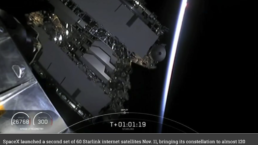

SpaceX completed its second launch of 60 Starlink satellites Nov. 11, making its own system the largest commercial telecommunications satellite constellation in orbit.
SpaceX launched the satellites on a Falcon 9 rocket at 9:56 a.m. Eastern, from Cape Canaveral Air Force Station in Florida. The satellites separated just over one hour later into a 280-kilometer low Earth orbit.
SpaceX now has around 120 broadband satellites in low Earth orbit, surpassing the 75-satellite Iridium Next constellation as the largest telecommunications system in space. SpaceX estimates it needs at least six Starlink launches, presumably of 60 satellites each, to have a sufficient number to start offering internet access at high latitudes, such as Canada and the Northern United States. After 24 launches, SpaceX projects reaching global coverage — a milestone anticipated in 2020.
SpaceX included several upgrades to its second set of Starlink satellites. Lauren Lyons, an engineer on SpaceX’s Starlink team, said during the launch webcast that the satellites have 400% more throughput, can generate twice as many phased array broadband beams, and sport a new Ka-band antenna system.
SpaceX said one of the new 60 satellites may not complete orbit raising after separating from the rocket, in which case that one satellite will burn up in the Earth’s atmosphere. The company says Starlink components are “100% demisable,” meaning none should reach Earth’s surface.
Of the 60 Starlink satellites SpaceX launched in May, three lost contact and two were selected for intentional de-orbiting. SpaceX officials have acknowledged the company’s early satellites may fail, but have sought to compensate for that by launching them to low orbits where atmospheric drag will sweep up malfunctioning spacecraft in 25 years or less.
SpaceX launched the second batch of Starlink satellites into an altitude 160 kilometers lower than those in its May launch, meaning defunct satellites will deorbit more rapidly. Starlink satellites use Krypton-fueled electric thrusters to reach their target orbit after leaving their rocket.
The U.S. Federal Communications Commission on Nov. 7 approved a SpaceX request to test its new satellites at a 350-kilometer orbit. While SpaceX’s early constellation deployment is focused on deploying satellites at 550 kilometers, the company has FCC approval for around 7,500 satellites near 350 kilometers.
SpaceX’s first two Starlink launches are for a constellation that could grow to 12,000 satellites, though the company’s recent filings with the International Telecommunication Union request spectrum for an additional 30,000 satellites. Elon Musk, SpaceX’s founder and CEO, said in May that Starlink would be “economically viable” at 1,000 satellites, with additional spacecraft supporting customer demand.
SpaceX’s. Nov. 11 Starlink launch was the first to reuse a payload fairing from an earlier mission. SpaceX previously used the same payload fairing on the Arabsat-6A Falcon Heavy launch in April.
The Nov. 11 launch was also the first time SpaceX flew the same booster for a fourth time. The same rocket booster launched 10 Iridium Next satellites in July 2018, the Argentine space agency CONAE’s Saocom-1A satellite in October 2018, and Indonesian satellite operator PSN’s Nusantara Satu satellite this past February.
SpaceX landed the booster on the drone ship Of Course I Still Love You in the Atlantic Ocean. The company’s Block 5 Falcon 9 rockets are designed for 10 flights of the first stage. The rocket’s second stage is single-use.
Gwynne Shotwell, SpaceX’s president and chief operating officer, said in September that the company might launch a total of five Starlink missions this year, and hopes to launch 24 Starlink missions in 2020.
SpaceX has demonstrated speeds of 610 megabits per second using Starlink satellites with the U.S. military. Musk has also tweeted through the satellites. SpaceX anticipates starting regional service with Starlink next year.
“We still have a ways to go from tweets to 4K cat videos, but we are on our way,” Lyons said.
SpaceX is competing with several other companies, notably Amazon, OneWeb and Telesat, that are also seeking to deploy hundreds or thousands of satellites to bring global internet access from space.
Source: Spacenews



Related News.

Navigating the Multi-Orbit Era: In Conversation with Intellian’s Jon Harrison at SMM 2026
At SMM 2026 in Hamburg, the rapid evolution of maritime satellite communications took centre stage. Across the exhibition halls, discussions among…

Cyprus ports need joint energy and investment strategy, shipping agents chief says
Cyprus needs a coordinated strategy for shipping, energy and environmental protection to support port investment and modernisation, Cyprus shipping…

MASO Public Affairs introduces MASO Regulatory Intelligence
A new subscription service helping businesses understand what is changing and what it means for them MASO Public Affairs introduces MASO Regulatory…

Anglo-Eastern helps turn CMBTECH’s ammonia ambition into an operational reality
From early feasibility study and risk-based design to newbuilding supervision, crew readiness and technical management, Anglo-Eastern drew on its…

Escalation of attacks threatens to derail recovery in Middle East oil exports
World oil demand is forecast to fall by 2.5 mb/d y-o-y in 4Q26 and 2.6 mb/d on average in 2026. As the Iran war manifests itself through restricted…

New study finds shipping pays twice its share to EU ETS earmarked revenues should triple to help build market for sustainable fuels and technologies
Shipping is responsible for around 10% of EU ETS emissions but pays almost 20% of the ETS bill. Unlike other sectors, it has never received free…

MSARC strengthens maritime mass rescue readiness through training and national live exercise off Dakar, Senegal
Joint MSARC–FHAS programme combines three days of SAR training with a national multi-agency live exercise The Maritime Search and Rescue Council ,…

Sogese report deliveries are still being delayed as container freight rates fluctuate
FOR IMPORTERS Spot rates into the Mediterranean are back at January levels, Far East to Europe reliability sits at pandemic lows, and nearly…

Glencore begins trading on Australian Securities Exchange
Glencore has begun trading on the Australian Securities Exchange under the ASX code GLC. Gary Nagle, Glencore’s CEO, said it was an exciting day for…

BIMCO Shipping Number of the Week
Suez Canal container ship transits exceed 50% of pre-disruption levels "During the first two weeks of October, weekly container ship capacity…
Subscribe to our newsletter!
if you dont want to swim alone in the ocean of news, sign up for the newsletter, and you will receive daily all the important news of world shipping!
