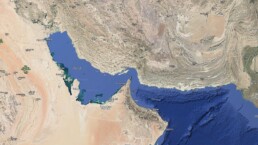

LNG exporters are looking for ways around the disruption in Hormuz, with three Gulf cargoes recently moved using ship-to-ship transfers (STS) as Qatar and UAE exports remain far below pre-war levels.
Qatar and the UAE are rerouting damaged LNG tankers via ship-to-ship transfers to keep gas flowing to buyers worldwide, in emergency operations that add more than $1 million per transfer and up to 35 hours of additional sailing time as the ongoing war continues to affect traffic through the blockaded Strait of Hormuz.
Three LNG cargoes loaded in Qatar and the UAE were transferred between vessels off Oman and the UAE in August before continuing to buyers in Asia, according to ship-tracking data from Kpler and Vortexa.
Two of the three transfers involved vessels that had previously been damaged or involved in incidents.
The QatarEnergy-run Al Rekayyat, which was struck by a projectile near Hormuz in July, transferred its cargo to the Qatari tanker Tembek off the UAE coast. Tembek later delivered the LNG to India.
GasLog Shanghai, which was involved in an incident while leaving Hormuz in late July, later transferred its cargo to GasLog Savannah off Oman.
A third operation involved ADNOC-controlled Mraweh, which transferred LNG loaded at Das Island to LNG Enugu off Oman. The cargo then continued towards Japan.
A costly way around the disruption
Ship-to-ship LNG transfers are technically complex and rarely used outside emergencies.
Unlike crude oil, which can be transferred between vessels relatively quickly, LNG must be kept at minus 162 degrees Celsius to remain liquid.
The transfer requires specialist cryogenic equipment, fenders, tugboats and trained personnel on both ships.
For these reasons, STS transfers are standard practice in the crude oil industry but remain exceptional in the LNG trade, where they are typically reserved for situations where a vessel cannot complete its voyage.
Bogdan Ratiu, commercial and shipping director at LNG Synergy, said most of the recent operations were emergency transfers rather than routine commercial transfers.
“This is a constraint, they have no choice in certain situations,” Ratiu told Euronews.
Ratiu said an LNG ship-to-ship transfer can take around 30 to 35 hours and requires specialist equipment, tugboats, fenders and specialist personnel.
“It will easily add over $1 million (€860,600) if STS is involved,” he said.
Once LNG is loaded onto a tanker at Ras Laffan, the vessel is normally sent to the customer as quickly as possible. Keeping LNG on board for long periods ties up ships and can lead to losses through boil-off, when some of the gas naturally evaporates.
Newer vessels can turn some of that gas back into liquid LNG, while older ships have fewer options to recover it.
Ratiu said QatarEnergy has traditionally tried to minimise the time LNG remains on board after loading, while Ras Laffan was designed for rapid ship turnaround.
“Desperate times require desperate solutions,” he said.
Qatar’s Ras Laffan Industrial City, the loading terminal for Qatargas and QatarEnergy LNG exports, is the world’s largest LNG production and export complex.
Before the war it loaded between 140 and 150 LNG cargoes per month, making it the single most important point of origin for global LNG supply.
All of its output must transit the Strait of Hormuz to reach international markets. No pipeline or alternative route exists.
Gulf LNG shortfall remains severe
Between March and June, LNG loadings from Qatar and the UAE fell by 35 billion cubic metres compared with the same period a year earlier, according to the International Energy Agency (IEA).
Qatar exported just 18 LNG cargoes during the first six months of the Iran war, compared with 509 during the same period a year earlier, a decline of around 96%.
Qatar is estimated to have lost around $24 billion (€20.7 billion) in gas sales over the period, while QatarEnergy remains under force majeure on some deliveries, with cancellations extending into early November.
Much of the missing Gulf supply, however, has been replaced elsewhere.
The IEA said non-Gulf LNG production rose by almost 18%, or around 27 bcm, between March and June, offsetting around three-quarters of the fall in Qatar and UAE deliveries. Overall global LNG production fell by around 4% during the period.
North America and Africa were among the regions adding supply, supported by new LNG projects and improved gas availability for existing plants.
The additional supply has offset part of the shortfall, while gas prices remain well above pre-war levels.
Hormuz remains the main problem
The UAE can bypass Hormuz for some oil exports through a pipeline to Fujairah, but no similar large-scale route exists for LNG.
Diplomatic efforts are also under way to restore some shipping through the strait. Qatar and Iran discussed a proposed temporary shipping corridor through Hormuz and a joint project to clear mines from the waterway during talks in Tehran in late August.
Qatar has said the proposal is part of wider efforts to restore freedom of navigation through the strait.
Fitch Ratings removed Qatar from Rating Watch Negative on Friday and affirmed its AA sovereign rating, saying the immediate risks to the country’s LNG facilities had eased.
It maintained a negative outlook because of continued uncertainty over LNG exports through the key waterway, which usually sees one-fifth of the world’s oil and gas travel through.
Source: Euronews



Related News.
Hong Kong Global Maritime Trade Summit to return for third edition
The International Chamber of Shipping, in collaboration with the Transport and Logistics Bureau of the Government of Hong Kong and the Hong Kong…

Appetite for US crude oil exports climbs despite high freight
South Korea tops US crude destinations at 568,600 b/d VLCC rates to Asia double, closing arbitrage window European refining margins…
Shipping stocks Rally as Hormuz Traffic plunges 75%
Ship traffic through the Strait of Hormuz — a critical chokepoint handling about 20% of global crude oil and liquefied natural gas shipments — has…
Diana Shipping announces Time Charter Contract for m/v G P Zafirakis with Classic Maritime
Diana Shipping, a global shipping company specializing in the ownership and bareboat charter-in of dry bulk vessels, announced that, through a…
New IMO ESP Code framework for Remote Inspection Techniques
The International Maritime Organisation, through Resolution MSC.584(111) , has adopted amendments to the International Code on the Enhanced…

ABS opens Offshore & Marine Support Center in Bergen
ABS has expanded its capabilities in the Norwegian maritime market with the opening of a cutting-edge support center in Bergen, bringing advanced…

MOL holds giant step memorial ceremony and beach cleanup at Kashima Coast
Memorial and Reflection 20 Years After the Accident: Learning from the Past to Foster an Even Stronger Safety Culture Mitsui O.S.K. Lines, announced…

KEZAD-based Arabian Gulf Steel Industries achieves lowest verified Carbon Footprint for Rebar
CARES UK verified Environmental Product Declaration confirms 139 kg CO₂e per tonne for rebar produced at AGSI’s KEZAD Abu Dhabi facility Arabian…
Indian Register of Shipping announces launch of first fleet support ship INS Surya
Indian Register of Shipping continues to strengthen its role in supporting the Indian Navy and India’s naval shipbuilding capabilities through the…

VLCCs Climbing the Record Charts
LR2 The TC1 75kt MEG/Japan index decreased by only a single point this week to WS928. The corresponding Baltic round-trip TCE fell by $2,000 to…
Subscribe to our newsletter!
if you dont want to swim alone in the ocean of news, sign up for the newsletter, and you will receive daily all the important news of world shipping!
