

South Korea tops US crude destinations at 568,600 b/d
VLCC rates to Asia double, closing arbitrage window
European refining margins widen gap over Singapore
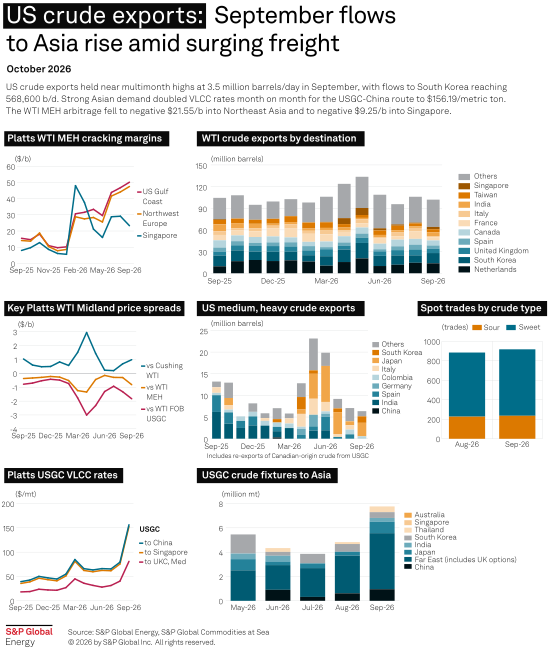
US crude exports remained elevated at 3.5 million b/d in September, edging up from 3.4 million b/d in August, according to S&P Global Commodities at Sea data, but well below the May peak of 4.4 million b/d. South Korea was the largest single destination at 568,600 b/d, followed by the Netherlands at 459,000 b/d, with Japan, France, Canada and the UK also among the top receivers.
Volumes into Asia climbed across the region, including Northeast Asia, where US exports rose from 793,000 b/d in August to 1.1 million b/d. Exports into Southeast Asia climbed from 292,000 b/d to 528,000 b/d, while volumes into the Indian subcontinent climbed from 68,000 b/d to 220,000 b/d over the same period.
Asian volumes in September largely reflect cargoes fixed before VLCC freight on USGC-Asia routes roughly doubled. The Hormuz disruption initially drove Asian refiners toward US crude as an alternative supply source, but its knock-on effect on tanker markets has since eroded the economics of those trade flows.
Fixtures to Asia, including some UKC options, climbed to 7.8 million metric tons in September compared to 4.8 million in August.
Surging tanker rates have effectively closed the spot eastbound arbitrage for US crude exports to Asia. Arbitrage calculations favor WTI Midland barrels going to Northwest Europe, where refining margins have strengthened and the freight burden remains comparatively manageable.
The arbitrage for WTI MEH into Rotterdam was $19.99/b as of Oct. 8, while the equivalent incentive into Singapore had fallen to minus $17.01/b and into Northeast Asia at minus $19.77/b, according to S&P Global Energy CERA.
VLCC rates on the USGC-China route surged from an average of $79.21/mt in August to a $156.19/mt average in September, while the USGC-Singapore route averages rose from $75.51/mt to $152.49/mt over the same period, according to Platts assessments.
The USGC-UK Continent and Mediterranean route also roughly doubled, climbing from $40.26/mt to $80.82/mt. While the percentage increases were broadly similar across all three routes, approximately 97% to 102%, the economic impact is far more severe on Asian voyages because of the greater distance involved, higher bunker consumption and the longer period a vessel is tied up in transit.
South Korean and Japanese refiners, in particular, may continue to lift WTI cargoes under term supply arrangements or for crude diversification, regardless of whether the prompt spot arbitrage is open.
The Netherlands’ 459,000 b/d intake is consistent with the strongly positive Rotterdam arbitrage and reflects the country’s dual role as both a refining center and a transshipment hub for the broader Northwest European market.
With the WTI MEH-versus-Forties incentive at $14.72/b, Europe is the economic clearing destination for incremental US barrels, and transatlantic flows are likely to remain supported even after the climb in freight costs.
Asia vs Europe
The result is a widening of the refining economics gap between the Atlantic Basin and Asia. Platts WTI MEH cracking margins into Northwest Europe climbed from $44.13/b in August to $47.47/b in September, and into the US Gulf Coast from $46.75/b to $50.12/b, according to CERA.
By contrast, the equivalent margin into Singapore fell from $29.13/b to $23.09/b over the same period.
All three margins remain dramatically stronger than February levels, when Singapore was at just $5.60/b, NWE at $8.62/b and the USGC at $10.21/b.
Midland’s discount to WTI MEH, the Houston-area coastal marker that most directly captures export optionality, widened from $0.30/b to $0.82/b, while its discount to WTI FOB USGC increased from $1.33/b to $1.83/b.
WTI Midland’s premium to Cushing WTI widened from $0.68/b in August to $0.98/b in September.
The pattern shows that coastal, export-ready barrels attracted a growing premium over inland crude, reflecting competition between domestic refiners and Atlantic Basin exporters for Gulf Coast supply.
Source: Platts



Related News.

Poland’s additional national requirements distort competition says Danish Shipping
Poland has introduced a national survey requirement for smaller foreign-flagged vessels operating in Polish waters. This creates significant…

Battery Vessels could help electrify most of Global Shipping Emissions
Battery-electric ships are economical only if the pack is cycled frequently, so they have been confined to short-sea, ferry and harbour vessels…

Mintra and Ledgid explore collaboration to connect Maritime digital identity, learning and workforce development
Mintra® and LEDGID are exploring opportunities to bring together complementary capabilities in digital learning, maritime training, professional…

World Shipping Council calls for global agreement on shipping emissions as industry investment surpasses $200 billion USD
The World Shipping Council (WSC) is calling on governments to agree on binding global greenhouse gas regulations for international shipping without…

What happened to the ITF whistleblower’s complaint?
In January 2026, a whistleblower complained that International Transport Workers’ Federation (ITF) General Secretary Stephen Cotton had manipulated…

Growing regulatory scrutiny puts seafarer wellbeing firmly on maritime safety agenda, VIKAND warns
Seafarer wellbeing is coming under greater regulatory scrutiny as international rules and guidance increasingly recognise crew health and welfare as…

Good Times Bad Times the Premium Stays with the Strait
In October, we wrote that if the transfer network off Oman kept pace, Gulf crude would carry China's refill and keep drawing tonnage east,…

Allied Weekly Market Review Week 47
Pls find below the Allied - Weekly Market Review - Week 47 ALLIED - Weekly Market Report- Week 47


Climate TRACE releases September 2026 Emissions Data
Climate TRACE reported that global greenhouse gas (GHG) emissions for the month of September 2026 totaled 4.7 billion tonnes CO₂e. This remains…
Subscribe to our newsletter!
if you dont want to swim alone in the ocean of news, sign up for the newsletter, and you will receive daily all the important news of world shipping!
