Moving past the waiting game: John Cooper of BAR Technologies on why shipping must embrace Wind Propulsion today
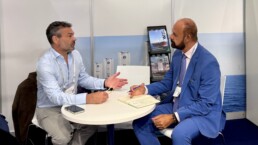

In the maritime industry’s race toward decarbonisation, a dangerous mindset has taken hold: waiting for the perfect future fuel infrastructure before taking meaningful action. Speaking with Cyprus Shipping News at the recent SMM exhibition in Hamburg, John Cooper of BAR Technologies warned that shipowners can no longer afford to let regulatory fragmentation and fuel uncertainty become excuses for delay.
With the company’s pioneering WindWings® technology already proving its worth at sea—delivering verified daily savings of up to 1.5 tonnes of fuel and 4.7 tonnes of CO₂ per wing, the conversation has firmly shifted from technological viability to commercial execution.
In this exclusive CSN interview, we strip away the fluff surrounding maritime decarbonisation to focus on hard commercial realities. John Cooper dives deep into the strategic advantages of pairing wind propulsion with dual-fuel tankers, the urgent need to restructure charterparty agreements to overcome the ‘split incentive’ barrier, and the launch of the new 20m and 24m WindWings® designed to make wind assistance accessible across the broader merchant fleet.
As Cooper rightly points out, while the future fuel mix remains uncertain, the wind is free at source. The technology is ready; the opportunity now lies in deploying it.
Moving Past the “Future Fuel” Waiting Game John, you recently stated that shipping needs to stop treating decarbonisation as something that only begins when future fuels arrive. You warned that the industry cannot allow the absence of perfect policy certainty to become an excuse for inaction. As you speak with fleet directors here at SMM Hamburg, how are you shifting their mindset from waiting on alternative fuel infrastructure to capitalising on the wind propulsion technologies that are available right now?
Wind propulsion has already passed the technology test. The challenge now is creating the wider conditions that allow proven solutions to be deployed at scale.
Shipping is operating in an increasingly fragmented regulatory environment, with different carbon pricing mechanisms and regional requirements creating uncertainty for investment. The EU ETS, Fuel EU Maritime and CBAM are all shaping the market, but they also form part of a complex regulatory picture with different rules and cost implications. Fragmentation creates uncertainty, and uncertainty often slows investment.
This makes the next IMO meetings particularly important. The industry needs greater clarity over the global framework that will shape investment decisions for decades to come, and the meetings leading into MEPC 85 and the resumed extraordinary session in December are a critical opportunity to provide it. But there is no guarantee that agreement will be reached, and shipowners making investment decisions today cannot assume that December will resolve the uncertainty. Vessels ordered now will still be operating well into the late 2040s and 2050s, so the ability to reduce their energy requirements, regardless of how the regulatory framework or future fuel markets develop, has real value.
What we can be sure of is that there will be considerable carbon taxing throughout the world, so energy efficiency is of paramount importance whether the carbon tax rules are finalised or not.
In the meantime, what we are seeing from shipowners is pragmatism. They are balancing long-term ambition with short-term commercial reality, but they are also increasingly willing to examine the options already available to them. Technologies such as WindWings® have to be part of that consideration because they can deliver reductions without waiting for an entirely new fuel infrastructure to emerge.
There is also a need for clear, standardised ways of evaluating performance. Owners need to be able to compare technologies on a consistent basis and understand what they can realistically deliver. That evidence gives them greater confidence when committing capital. The ITTC have done a wonderful job in proposed methodologies of measuring performance. Owners and consultants should always insist that fuel savings are calculated to ITTC level 4. This is the level that takes into account all the most important aspects and unfortunately many WAPS providers attempt to enhance their perceived performance by not offering this detailed information.
None of these challenges, however, is an argument for waiting. Future fuels will play an important role, but their availability, infrastructure, and cost remain uncertain. Wind is available today, it requires no new fuel supply chain, and it can immediately reduce the amount of energy a vessel needs from whichever fuel it uses.
So, the conversation needs to move from “What are we waiting for?” to “What can we deploy now?” The technology is ready. The opportunity is to start using it.

The LR2 Dual Fuel Tanker Milestone. BAR Technologies has confirmed landmark orders for WindWings® to be installed on LR2 dual fuel tankers, such as the upcoming Suzuka and Long Beach. For technical managers evaluating their newbuild pathways, what is the strategic advantage of pairing wind propulsion with dual fuel systems, and how does it change the commercial risk profile in a volatile energy market?
The strategic advantage is flexibility. Dual-fuel capability allows operators to respond to changes in fuel price, fuel availability and route dynamics, while wind adds another energy source that is not purchased on the bunker market at all. Of course, the wind is free at source and never diminished.
Wind propulsion will not eliminate the need for fuel, but it can materially change the vessel’s exposure to fuel-market risk. A ship dependent on a single fuel remains vulnerable to price swings caused by geopolitics, supply constraints and changing demand. A dual-fuel vessel has greater optionality; combine that with wind propulsion and part of the vessel’s energy requirement effectively comes from a zero-fuel-cost source. Many ship owners are of course picking duel fuel as the newer fuel is not yet readily available but this kind of fuel cost variability will undoubtedly come in the future.
That becomes particularly valuable when volatility is the norm rather than the exception. Even partial substitution of fuel consumption with wind can improve cost stability over the vessel’s operating life.
There is also a longer-term advantage. Nobody can say with certainty today what the dominant marine fuel mix will look like in 10 or 20 years. Combining fuel flexibility with a technology that reduces energy demand regardless of the fuel being consumed is therefore a powerful way of managing that uncertainty.
Tackling the Charterparty Barrier. We often hear that the biggest hurdle for energy saving devices is no longer the technology, but the commercial structure. You have highlighted the split incentive where shipowners finance the emissions reduction equipment, but charterers reap the fuel savings. How can the industry restructure charter agreements to ensure the financial benefits of WindWings are equitably shared?
The industry increasingly understands that it doesn’t have a technology problem here; it has a commercial alignment problem. If the owner pays for an efficiency technology but the charterer receives the fuel saving, there has to be a mechanism that recognises and shares the value being created.
That could mean charter structures that explicitly account for verified fuel savings, agreed mechanisms for sharing the resulting financial benefit, or rates that recognise the improved efficiency of a wind-assisted vessel. The precise model may differ according to vessel, trade and charter arrangement, but the principle should be straightforward: both the party making the investment and the party benefiting from lower fuel consumption need a commercial reason to participate.
Wind propulsion does introduce new considerations into traditional charterparty arrangements, particularly around performance measurement and the allocation of responsibilities. That makes transparent, trusted performance data increasingly important. If owners and charterers can demonstrate what the technology is delivering in operation, they have a much stronger basis on which to agree how that value should be shared.
We cannot allow the search for a perfect contractual model to become another reason for delay. We already know wind propulsion works. The next challenge is making sure the commercial structures reward, rather than discourage, the people investing in it.
Our current owners have found a way merely to prove the savings and persuade the charterer to increase the charter price such that there is an effective saving sharing arrangement.
Broadening the Market: The 20m and 24m WindWings® . While the large 37.5m WindWings have made headlines on major bulkers and tankers, you have recently partnered with OEM partners in China to produce 20m and 24m models. How is the market responding to these smaller units, and what specific vessel classes are you targeting to scale wind propulsion across the broader merchant fleet?
What initially began as a product roadmap focused on maximising fuel savings and emissions reductions with the 37.5m WindWings® has evolved into one centred much more on inclusivity both in terms of vessel size and the different ways owners want to approach wind propulsion.
The 20m and 24m WindWings® allow us to address smaller vessels where the size, weight and CAPEX of the larger system may not be appropriate. But importantly, we are also seeing interest from larger-vessel owners who view the smaller units as an attractive first step into WAPS. For some, it provides an opportunity to validate the technology operationally and commercially before moving towards a higher-CAPEX installation or incorporating wind propulsion more extensively into the next generation of their fleets.
That has been an important part of the market response. These are fully electric systems, with lower weight, lower CAPEX and simpler operation and integration. Those characteristics have proven attractive not just to smaller-vessel operators, but to owners across the merchant fleet looking for a lower-barrier route into wind propulsion.
From a vessel-class perspective, the smaller WindWings® are particularly well suited to bulk carriers below the Handymax segment and, on the tanker side, vessels around MR size and below. They also open opportunities across a much broader range of general cargo and smaller merchant vessels that historically may not have been obvious candidates for WAPS.
The commercial response has therefore been very positive, although the pace of deployment has inevitably been affected by the wider regulatory uncertainty created by recent IMO developments. That has slowed some investment decisions across the market, rather than changing the underlying appetite for the technology. We continue to see the 20m and 24m products as an important step in making wind propulsion accessible to a much broader section of the global fleet.
Trusting the Physics: Validation and Operational Data. With vessels like Brands Hatch and Monza now demonstrating consistent operational profiles, the technology has moved from concept to commercial reality. What have the real world sea trials revealed about the actual fuel savings, and how easily are crews adapting to the fully automated wing adjustments in varying weather conditions?
The significance of the operational data is that we are no longer talking about theoretical performance. WindWings® are operating at sea and demonstrating measurable reductions in fuel consumption and emissions under real-world conditions.
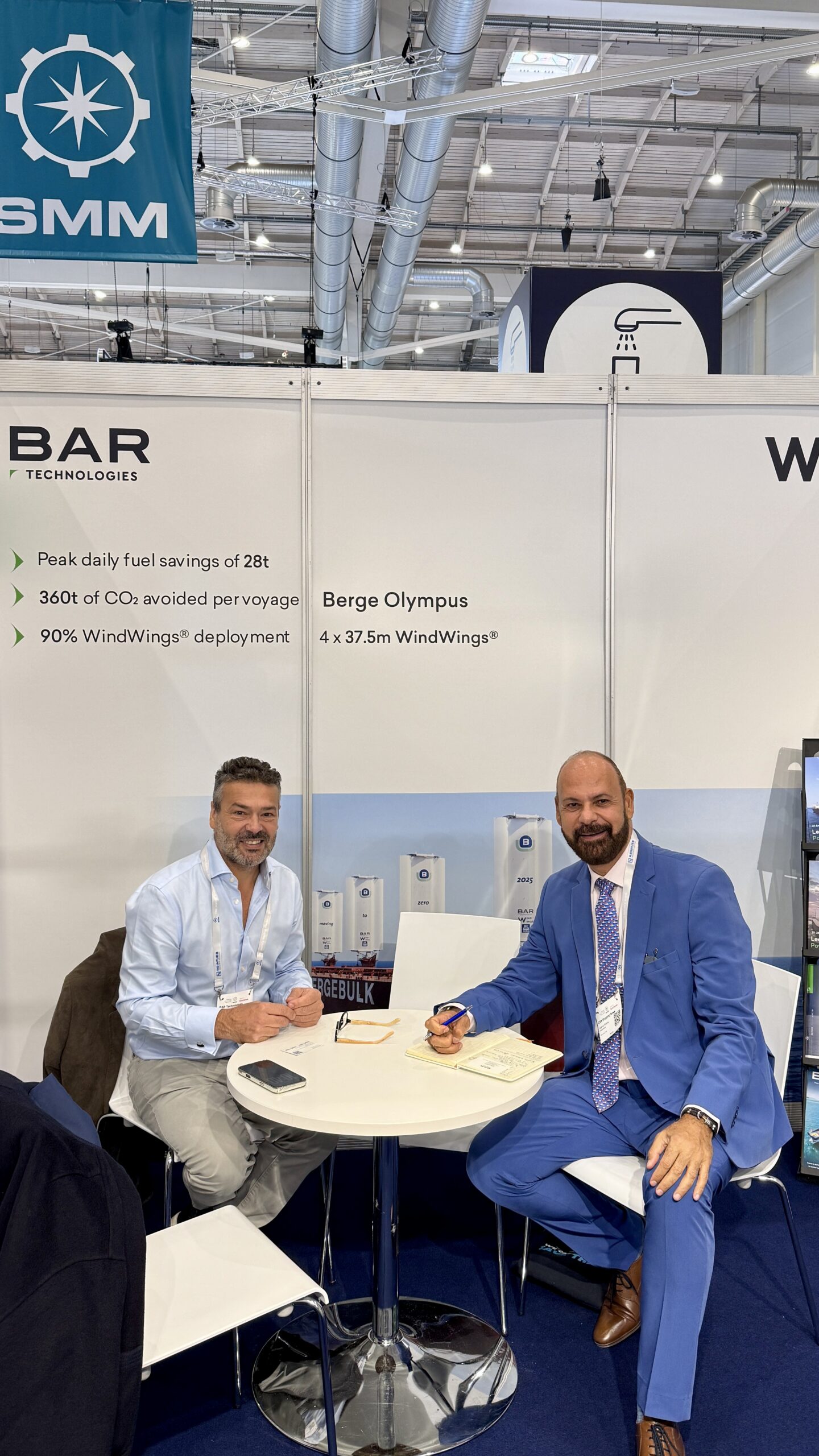
Our operational experience has shown average savings of around 1.5 tonnes of fuel and 4.7 tonnes of CO₂ per wing per day on typical global routes. These figures were exceeded on Berge Olympus, where four 37.5m units delivered a peak saving of 28 tonnes of fuel and 360 tonnes of CO₂ avoided in a single voyage, with WindWings® deployed for 90% of the transit. Naturally, actual performance varies according to factors including route, wind conditions and vessel speed, but those results demonstrate the contribution wind can make as part of a vessel’s everyday operating profile.
Crucially, this does not require crews constantly to manage the wings manually. Once deployed, WindWings® automatically adjust to the optimum configuration using real-time wind measurements. The bridge interface has been designed to be straightforward for crews, including a simple traffic-light display of operating limits with respect to weather conditions, while the automation takes care of the continuous adjustments required to maximise performance.
Independent validation, including work with DNV-Maritime, together with operational experience from vessels such as Pyxis Ocean, has been important because shipowners quite rightly want evidence before committing capital. The industry has moved beyond asking whether large-scale wind propulsion can work. We now have real vessels, real operating data and growing experience of integrating the technology into normal commercial operations.

The 2026 Milestone and Beyond. By the end of this year, you expect 10 vessels to be operating with 23 WindWings installations, delivering combined carbon dioxide savings of around 100 tonnes per day. As we look toward the stringent IMO 2030 targets, what is your primary advice to shipowners regarding early compliance, and what is the next major milestone we can expect from BAR Technologies?
My primary advice is not to make 2030 the date when you start acting. It needs to be the deadline you work backwards from.
Shipowners making investment decisions today are making them against a backdrop of tightening emissions requirements and considerable uncertainty over future fuels, their availability and their cost. That makes technologies capable of reducing energy consumption today particularly valuable. Every tonne of fuel that does not need to be consumed reduces both emissions and exposure to future fuel costs.
Our position on wind propulsion within the regulatory framework is also well established. We strongly support its inclusion in the Greenhouse Gas Fuel Intensity formula, so that the contribution made by wind energy is properly recognised. The forthcoming discussions at the IMO will therefore be extremely important in creating a framework that rewards practical emissions reductions and gives owners greater confidence to invest.
But regulation should not become another waiting game. The vessels operating with WindWings® are demonstrating that reductions can be achieved now. Owners that begin that transition early have more time to understand the technology, build operational experience and develop a measured pathway towards 2030 rather than facing a much more abrupt adjustment later.
Our next major milestone is the first installation of the 24m unit, targeted for 2027. This will represent an important step in demonstrating the scalability of our technology and moving towards wider commercial deployment.
We are also looking to bring on more OEM makers of our WindWings® in Asia and the Middle East. This is to ensure both production in areas local to the shipyards, to ensure there is production to match the future demand and to provide price and cost pressure amongst makers to bring cheaper WindWings® to the customers.



Related News.

Island Oil evolves into Island Energies
A new identity that honours the Island Oil legacy and moves the Group forward with confidence Island Oil Limited introduces its new corporate…

Crewing 5.0: How AI is Rewriting the Rules of Maritime Travel – Exclusive Interview with Crewpoint’s Marko Saul
Crew logistics has long been one of the most complex and manually intensive components of ship management, often reliant on travel systems designed…

WISTA International launches new Associate Membership category
WISTA International has introduced a new Associate Membership category, opening its global network to maritime organisations that are unable to…

Dr. N Reuben Paul meets Indian Ambassador in Athens on Seafarers’ Welfare and Maritime issues
On the occasion of World Maritime Day, 24 September 2026, Dr. N. Reuben Paul, Chairman of the Merchant Navy Welfare Board (India) and…
Iran Says It Won’t Soften Demands as Trump Rejects Hormuz Offer
Iran stuck to its seven-day proposal for reopening the crucial Strait of Hormuz, saying it won’t soften its conditions, while…
xclusiv S&P Report 28th September 2026
Pls find below the [xclusiv] S&P Report 28th September 2026 [xclusiv] 2026_09_28

JINGDONG property establish advanced logistics facility in KEZAD
Company to build a 150,000 square-metre logistics facility that will strengthen Abu Dhabi’s logistics ecosystem Khalifa Economic Zones Abu Dhabi –…
Shipping’s transition being hampered by policy uncertainty
The shipping industry is at greater risk than ever of missing its 2030 zero-emission fuel targets, according to a new report. The latest edition of…
New cargo securing guidance prioritises personnel safety and reduces damage risks
The revised guidelines aim to protect personnel, reduce cargo damage and improve port efficiency. Lloyd’s Register has worked with Jurong Port in…
MSI forecasts firm dry bulk market into 2027, driving further newbuilding orders
Strong and volatile freight earnings are likely to continue into next year, supporting owners’ investment appetite in new tonnage Dry bulk vessel…
Subscribe to our newsletter!
if you dont want to swim alone in the ocean of news, sign up for the newsletter, and you will receive daily all the important news of world shipping!
