Crewing 5.0: How AI is Rewriting the Rules of Maritime Travel – Exclusive Interview with Crewpoint’s Marko Saul


Crew logistics has long been one of the most complex and manually intensive components of ship management, often reliant on travel systems designed for leisure rather than the strict operational demands of the maritime sector. To explore how artificial intelligence is fundamentally changing this dynamic, Adonis Violaris of Cyprus Shipping News sat down with Marko Saul, CEO and Co-Founder of Crewpoint. Ahead of his role as Chairman at the 2nd CSN Northern European Crewing Conference in Hamburg this September, Marko discusses the founding vision behind Crewpoint, the practical deployment of AI in predictive disruption management, and why treating crew travel as a strategic advantage is vital for seafarer wellbeing.
Marko Saul is the CEO and Co-Founder of Crewpoint, the world’s first AI powered marine travel management company. With nearly a decade of experience in the startup sector, Marko has a proven track record of structuring and scaling high growth technology companies. Prior to co-founding Crewpoint, he served as the first Head of Finance at the AI identity verification unicorn Veriff, and later as CFO of the circular economy pioneer Fairown. At Crewpoint, Marko combines his deep expertise in finance and tech execution with purpose built AI to streamline the complex world of maritime crew logistics.
You have a very impressive background in fast growing tech startups, having been the first Head of Finance at the AI unicorn Veriff and CFO at Fairown. What inspired you to pivot into the maritime sector and cofound Crewpoint to tackle crew logistics?
The honest answer is that the maritime sector found me, I did not go looking for it. Toomas had spent nine years in marine crew travel, before our paths crossed at Fairown, where he was a product manager and I was CFO. We stayed in contact afterwards, kept meeting, and kept talking. When he returned to the travel industry, that is when he really started explaining to me how the work in this sector actually gets done.
One moment decided everything. Toomas showed me how a crew ticket is booked in practice. A request arrives by email, the agent copies the details into the cryptic command view of Amadeus, works the terminal, copies the result back out and sends it as an offer. And this is the fastest way it is done, by experienced professionals. I was watching structured data being moved by hand between an inbox and a terminal, and our thought process with Toomas aligned: somebody is going to automate this. It might as well be us.
The timing mattered just as much. This was exactly the period when AI started producing results that were clearly beyond ordinary automation. The maritime industry is traditionally slower to adopt new technology, and AI was brand new for the whole world. We realised that if we built AI-native tooling for this specific vertical, we would not be fighting established players in a red ocean. We would be in a blue ocean, competing against a product that did not exist yet. So in early 2025 we founded Crewpoint and got to work.
My contribution was everything except maritime. I was a complete outsider to shipping, but I brought eight years from fast-growing technology companies: fundraising, building products from zero, and structuring a business for growth. So the founding equation is quite rare. Deep industry and product knowledge from Toomas, and startup, finance and execution experience from me.

Crew travel has traditionally been managed using systems built for leisure travel. How does the purpose-built approach of Crewpoint change the daily reality for maritime operations teams dealing with tight timelines and global complexity?
I would not say it is managed by leisure systems, but it lacked tooling specifically for the maritime industry, mostly just regular B2B tools. The first gap is the obvious one: regular B2B travel providers rarely have seafarer content. Without marine fares you cannot serve this industry properly, full stop.
But the deeper difference is how the system is organised on the inside. We designed Crewpoint so that its core building blocks are the ones a crewing manager actually thinks in: on-signers, off-signers, vessels. Invoicing follows the same logic. In shipping, each vessel is usually its own entity, so we do not simply invoice a client, we invoice the client’s ships. Each of these choices sounds small on its own, but they compound. When a crewing manager logs into Crewpoint, the language, the flows and the reporting make sense from a marine and crewing standpoint from the first minute. Nothing has to be translated in their head.
Then there is the shape of the bookings themselves. Regular business or leisure travel is typically a group going from one place to one place. Crew travel is the opposite: people flying in from all over the world to join one vessel, and off-signers dispersing back across the globe, often on the same day. Our system treats that as the normal case, not an exception, and the reporting side is built for the same reality.
The truth is you can make almost any tool work if you try hard enough. Crewing teams have proven that for years. The real question is how much time and manual effort it costs you every single day, and that is exactly where purpose-built wins.
Crewpoint is described as the world’s first AI powered marine travel management company. Could you explain in practical terms how artificial intelligence is deployed in your platform to optimise routes and manage complex data sets compared to traditional software?
I would slightly reframe the question. It is less about what AI can do that a human cannot, and more about speed, scale and consistency. AI does not get tired. A coordinator in the eighth hour of a shift can miss that a seafarer’s visa expires in the middle of the trip. Most likely it gets caught somewhere later in the process, but for our system it is simply a check that runs every time, on every document, with the same attention at 3 a.m. as at 9 a.m.
The scale argument is easy to show with numbers. A shipping company with around 150 vessels typically buys more than a thousand plane tickets a month. That is 30 to 40 tickets on an average day. A human agent can only search one traveller, one route at a time, so physically checking all the reasonable alternatives for every ticket is impossible. Our AI works in parallel: when a request for ten tickets comes in, the system starts solving all ten simultaneously, testing far more combinations and assembling itineraries in ways a person would never have time to try.
There is also a structural difference. With Crewpoint, it is a machine talking to a machine: our AI works directly against the booking systems. A manual agent is a human hunting for options through an interface, which is never as fast or as thorough.
And AI lets us move from reactive to predictive. We are developing ways to monitor the airports on a crew’s itinerary, watch for weather events and strikes, and check whether the vessel is actually on track to make the port. When a crew change happens inside a 24-hour window, learning about a problem even twelve hours earlier is an enormous advantage.
In our maritime industry, there can sometimes be hesitation towards fully relying on artificial intelligence. How do you ensure that the ultimate decision making remains with experienced human staff while still reaping the tremendous benefits of AI efficiency?
I understand the hesitation completely, because I feel it myself as a user. Nobody wakes up one morning and decides to hand everything over to an AI.
Here is how we resolved it. For routine bookings, the system is very capable, and that is not really where oversight is needed. The place where humans are absolutely non-negotiable is emergencies and complex cases. We have all experienced what happens when large tech companies scale down their support: you get trapped in a robot loop that cannot actually solve your problem. That simply cannot happen in the maritime industry. Our own statistics show that when somebody picks up the phone or writes to us on WhatsApp, the problem they are solving is usually within the next twelve hours. At that moment you need a competent human immediately, and at Crewpoint that human is there.
Trust is built through experience. Clients start by testing the system on everyday cases and discover that the AI genuinely has the answers. And they know that whenever it does not, or whenever there is a real emergency, the case moves to a person. That structure removes the biggest psychological barrier to trying AI at all. You are not trading your trusted travel agent for a chatbot. You are getting AI efficiency for the bulk of the work, with the human safety net always in place. The cost of trying becomes very low, and that is exactly how a conservative industry can adopt new technology with confidence.
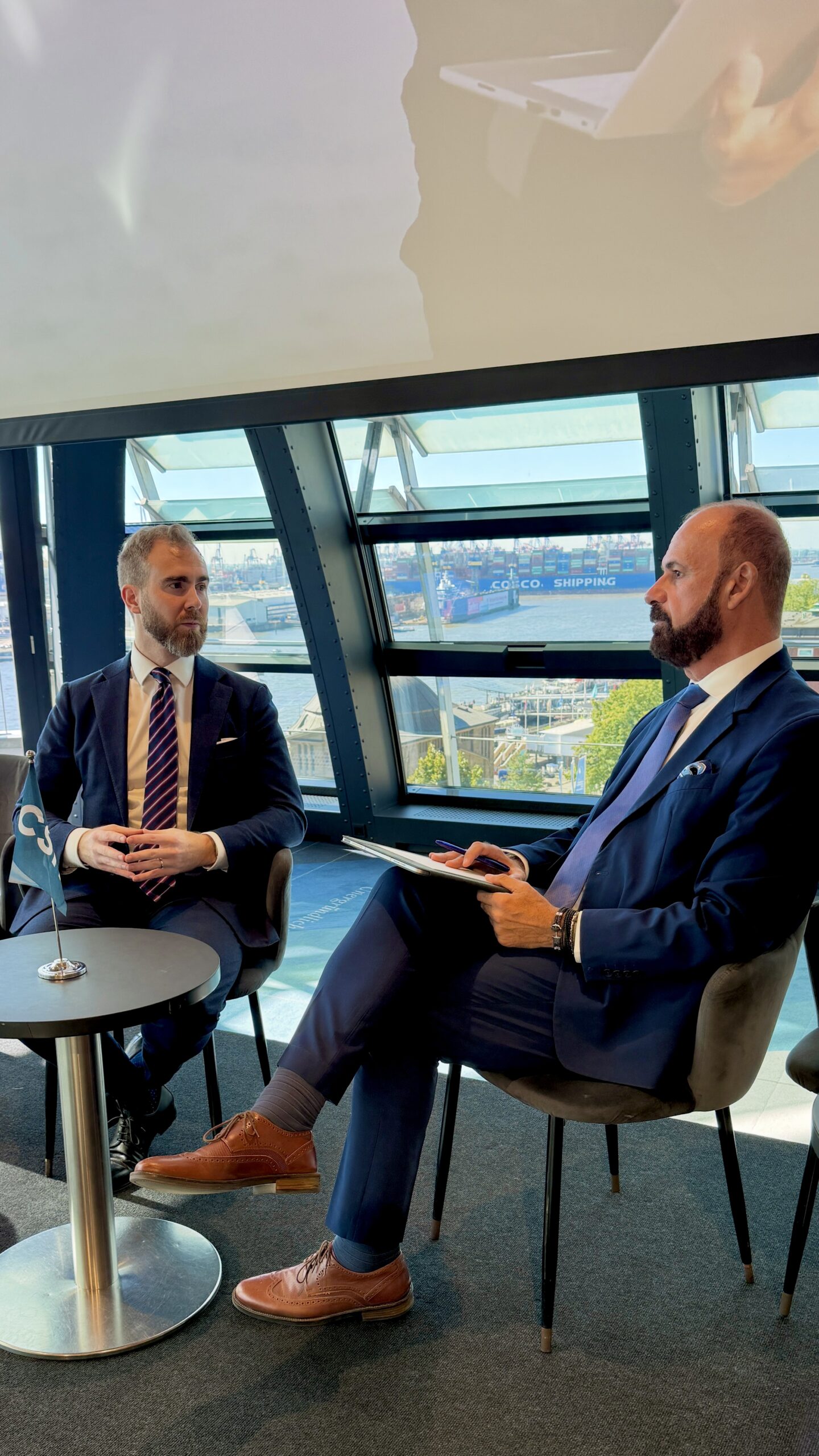
Last minute changes, flight cancellations and severe weather are constant headaches in crew logistics. How does your technology handle emergency reroutes and real time disruption management without adding financial penalties or extra stress for the operators?
Our ambition is to be ahead of the disruption, not just fast at reacting to it. Some events that ruin a crew change are visible in advance if you watch the right signals. Weather forecasts become more accurate as the date approaches. Airline strikes and political disruptions are usually announced beforehand. And vessel movements tell you early whether a ship will actually make the planned port on time.
That is what we are building into the platform: the system monitors the ports and airports involved in your upcoming crew changes, combines those signals and warns the crewing manager. You have a crew change planned here, we are picking up these risk factors, do you want to adjust now or accept the risk? For some flights, rebooking can begin before the disruption even materialises. Even when no decision is taken in advance, the heads-up alone is valuable, because the team can pre-check alternatives instead of starting from zero at three in the morning. If early warning buys you an extra twelve hours inside a 24-hour crew change window, that changes everything about the options available to you.
On the question of financial penalties, let me be honest about how this market really works. Avoiding penalties is a craft. A good travel agent knows how airlines operate and which ticket type fits which situation, and when plans change, that knowledge is what saves the money. Unfortunately, the incentives are often set by the buyers themselves. Most clients look only at the initial ticket price, not the full cost of the journey, and any system optimises to what is measured. So the market has learned to push the visible price down and take the money back later through change fees and penalties. We deliberately take the more holistic view: choose the right fare and the right ticket type for the situation upfront, and a reroute does not have to turn into a penalty. It is the total cost over the whole journey that should be optimised, and in the long run that is exactly what benefits the buyer.
Many shipping companies already have established HR and crewing software in place. How seamless is the integration of Crewpoint into these existing platforms, and how does it enable simple order management directly from the systems they already use?
Our philosophy is simple: you should not have to change your systems to work with us. In this industry, once a company has implemented a crew management or HR system, they are committed to it for years. The rollout took months, sometimes longer, and everyone’s daily workflow is built around it. If our pitch required replacing or reworking that system, we would never close a deal.
So we do the work. When a new client comes on board, the first conversation is about how they want to interact with us. Some prefer our portal. Some want to keep placing orders by email and let our system handle the processing. And some want a direct integration into their existing crewing software. In that case we build towards their system, not the other way around.
What order management from their own systems means in practice is tailored per client. One client may want a button inside their crew management system that initiates the booking directly. Another simply wants passenger data to flow automatically from their crewing system into our portal, so nothing is retyped and the handover between tools is seamless. On the return path, we can push confirmations, itineraries and any travel data back into the client’s system to close the loop. Both directions are a standard part of our flow. The only real limitation is technical: can the client’s system accept incoming data? If it can, we can build it.
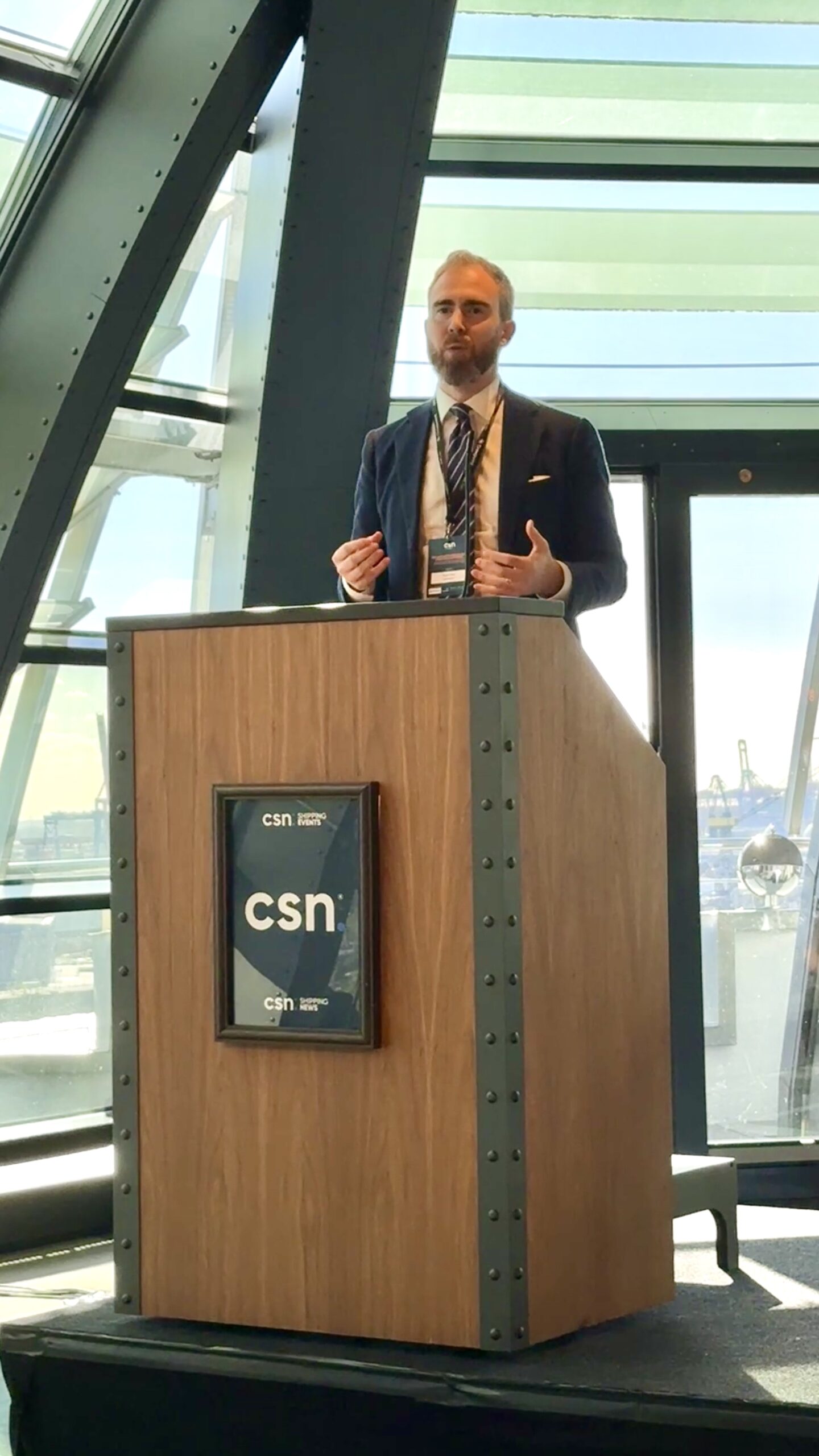
You often mention that crew travel should be viewed as a strategic advantage rather than just a cost centre. Can you elaborate on how your predictive analytics and transparent pricing models help operators achieve this important shift?
There are several layers to this. The first is straightforward cost. Because our work structure is fundamentally different from a manual agency, Crewpoint competes on price with traditional providers. But the more interesting part is the hidden cost. We have seen companies move to self-service booking platforms and celebrate a lower travel invoice, while the work of a travel agency did not disappear. It moved in-house, onto crewing managers who were already overworked, or onto an internal travel desk. The invoice went down, and the true operational cost went up. Transparent pricing and proper per-vessel reporting make that visible, often for the first time.
The second layer is where the word strategic really starts to mean something, and it is about people. Seafarers have always made it to the port on time, because they had to. The question is who absorbed the pain of making that happen, and usually it was the seafarers themselves, through the long layovers and the cheapest possible routings.
Think about the seafarer’s journey with a company. After the contract is signed, travel is the first real experience a new crew member has with you. Do I get a sensible direct flight, or a twelve-hour layover? And when they sign off after months on board, tired and wanting nothing more than to get home to their family, travel is the last physical touchpoint. That experience tells them very clearly whether the company values them or whether every penny is being squeezed at their expense. You cannot put that on a spreadsheet, but it absolutely shows up in retention. Once operators see travel through that lens, cost centre is simply the wrong category for it.
While efficiency is vital for operators, the wellbeing of our seafarers is equally critical. In what ways does a smarter travel management system enhance the actual travel experience and reduce fatigue for the crew members heading to or from their vessels?
The most direct impact is routing quality: fewer layovers, shorter layovers, more direct flights. Very often the better option was always there, it just was never found, either because a human agent had no time to search that deeply, or because a direct flight looked marginally more expensive and nobody weighed that against what a twelve-hour layover actually costs a person in fatigue. Our AI puts those options on the table by default, so the crewing manager can make the humane choice without spending hours finding it.
Reliability matters just as much. Predictive disruption handling means fewer crew members stranded mid-journey, fewer frantic last-minute rebookings, and much less of the stress that comes from uncertainty while in transit.
And I can give a small sneak preview. We are developing a seafarer layer for our platform, in the form of an app. The starting point is practical: seafarers can share their status and location with crewing managers during the journey. But once that channel exists, we can build real convenience on top of it, including additional services that seafarers could access directly through the app while in transit. It is still in development, so I will not promise dates. The direction, though, is clear: the seafarer stops being a passive name on a booking and becomes a user we actively design for.
Following your successful funding round led by Icebreaker vc last year, how has that investment accelerated the development of your software solution, and what exciting new features are you planning to roll out next?
The investment has gone very directly into the product, and that is a structural advantage worth being honest about. Most traditional travel agencies, even the good ones people gravitate towards, simply do not have the profitability to fund serious software development. We do, and we have used that capital to innovate at a pace this vertical has not seen before. And that is continuing. We have since secured significant additional capital to make sure we stay on the innovator’s edge of this market, and there will be more news on that soon.
On the roadmap, three things stand out. First, bringing the predictive capabilities I described earlier into everyday production for every client. Second, going one level higher in crew change planning: instead of only optimising the flights for a given port, helping decide, based on the vessel’s itinerary, where the crew change should happen in the first place. And third, the seafarer app.
But I want to be honest about how our roadmap really works. We are a startup, and we deliberately build what our clients need rather than what looks good on a slide. The seafarer app is a perfect example: it entered the roadmap because a specific client needed it, and we saw we had the capacity to solve it well. For clients who bring volume and want to develop this vertical together with us, our product team is in constant contact with their teams. And we reserve ourselves the right to reshuffle the roadmap whenever a better problem lands on the table.
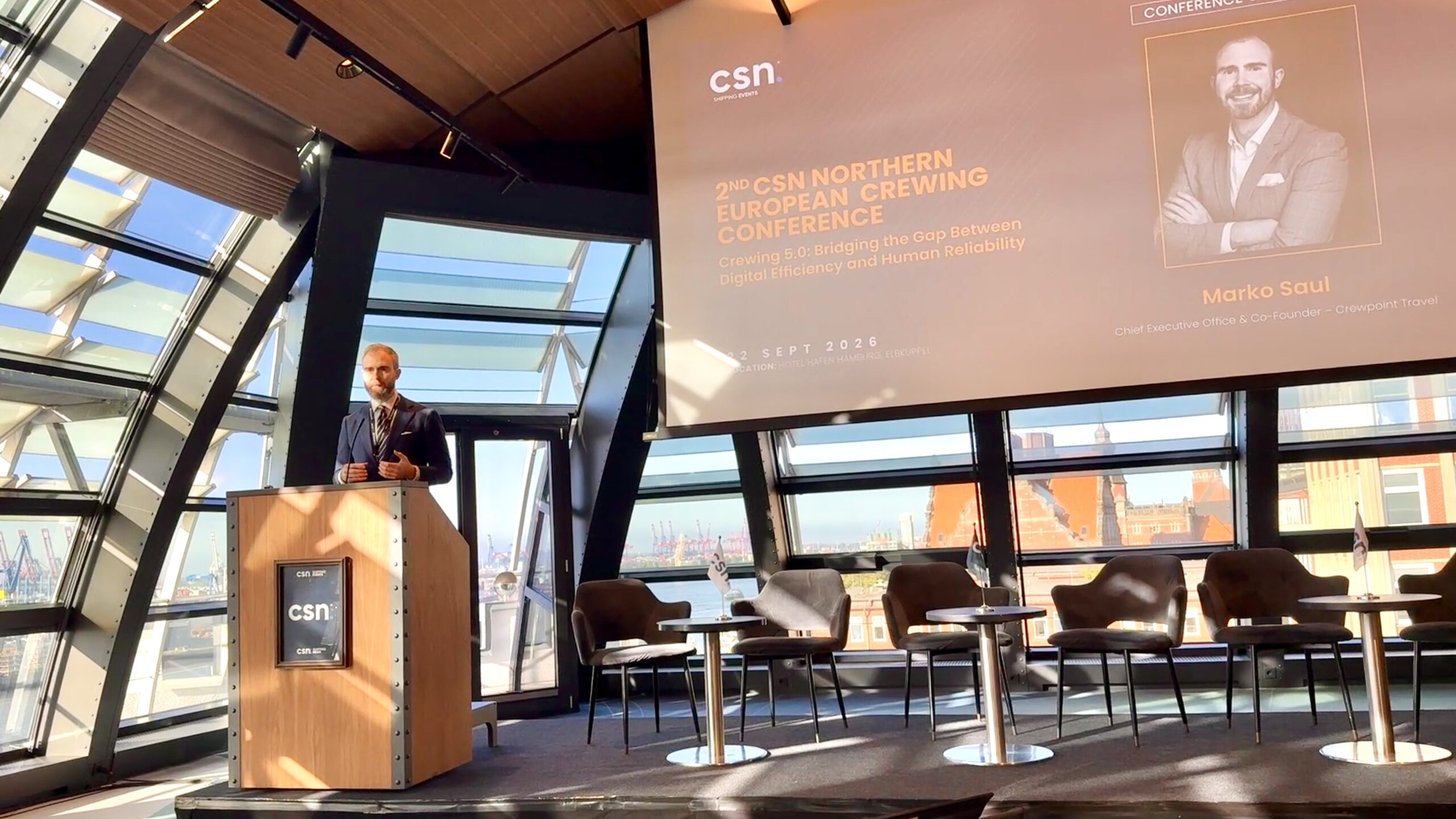
Crewpoint has been a fantastic supporter of CSN events. As we look ahead to the 2nd Northern European Crewing Conference in Hamburg this September, what key messages do you hope to share with the shipowning and shipmanagement community regarding the future of crewing logistics?
First of all, the CSN conferences are exactly the rooms where this industry actually talks to itself, which is why we keep showing up. In Hamburg, I will be continuing the conversation we started in Athens this June.
Look at what has happened with the wider AI narrative. A year or two ago the tone was almost apocalyptic: AI is coming for everyone’s jobs, whole industries will be replaced. Since then there has been a healthy sobering. Many companies have now actually tried AI, and they have learned that adding an AI layer on top of existing systems, without a clear plan, often does not deliver the results they hoped for.
So my first message is about architecture. There is a real difference between AI-native systems and systems with AI bolted on. I have worked in software companies before Crewpoint, and the foundations you need for AI-native products are genuinely different. The question for shipowners and managers is no longer whether AI will affect their business. It is where to invest so that the benefits are tangible.
My second message is about people, and it is not doom and gloom. What AI removes first is the tedious work: parsing data from one system to another, copy-pasting, retyping information from photographed documents into digital systems. That is nobody’s dream job. When those tasks disappear, your people can focus on the work where human judgment actually matters. Maybe you hire fewer people for data entry over time, but more importantly, you raise the quality of your whole organisation. We live this ourselves: we use AI in every part of Crewpoint’s own work, and what we see is people contributing more and enjoying their work more, because the busy work is gone.
AI for the bulk, humans for the judgment. That is the future of crewing logistics I will be arguing for in Hamburg, and I look forward to the discussion.



Related News.

Beyond Technical Skills: WISTA Cyprus explores the human side of leadership
WISTA Cyprus hosted The Art of Leadership & Emotional Mastery, an interactive workshop held on 15 October at the Alasia Hotel in Limassol,…
The human cost of sending merchant mariners into war zones extends far beyond the immediate danger of missiles and drones. It raises a harder question: who is really protecting the seafarer?
Who protects the seafarer? I have spent much of my professional life at sea. I am a Master Mariner. I have stood on the bridge, made decisions…
Loss of bridge control: Human failure is normal – context is key
When bridge control is lost in a functioning system, it can be easy to blame human error. But accidents rarely happen because of one mistake…

Danish Shipping announces the transport of live animals by sea new rules should improve safety for animals, seafarers and the environment
Revised rules on the transport of live animals by sea are being negotiated in the EU. Danish Shipping wants to ensure good animal welfare,…

Japan’s flawed shipping proposal leaves developing countries adrift
A new analysis by Opportunity Green warns governments of the wide-ranging risks posed by Japan’s proposal at the International Maritime Organization…

Intermodal Report Week 42 2026
Pls find below the Intermodal Report - Week 42 2026 Intermodal Report Week 42 2026

Allied Weekly Market Review Week 42
Pls find below the Allied - Weekly Market Review - Week 42 ALLIED - Weekly Market Report- Week 42
EU Arctic Strategy NGOs welcome EU ambition on on cutting shipping’s Arctic Black Carbon Emissions
Responding to today’s publication of the EU’s Arctic Strategy, which definitively states the EU’s intention to support International Maritime…

The final quarter of 2026 is expected to see softer bauxite flows
Chinese front-loading is expected to have run its course, pointing to softer bauxite flows in 2026 Q4. Global bauxite flows increased by 2.8% y/y…

DP World Foundation and Belewan new container terminal mark groundbreaking of AED 3.7 million school project in Indonesia
Classrooms of Hope initiative expands to Belawan, Medan with a new junior high school designed to provide modern learning facilities and greater…
Subscribe to our newsletter!
if you dont want to swim alone in the ocean of news, sign up for the newsletter, and you will receive daily all the important news of world shipping!
