

Venezuela is reportedly weighing whether to leave OPEC, becoming the second member in months to openly consider an exit. As the taboo around key members quitting the group has now been broken, Venezuela’s own trajectory, commercially and politically, points the same way as the UAE’s. But the timing argument doesn’t hold up yet: with output still years away from levels where OPEC’s quota system would bind, and with Caracas gaining little in practice from staying versus leaving, there is no pressing reason for Venezuela to formalise a break right now.
- Venezuela is reportedly in internal deliberations over leaving OPEC, months after the UAE’s withdrawal and amid rising friction from Iraq.
- Though an eventual exit has a real probability, OPEC is unlikely to push for quotas on Venezuela in the near term given its still-modest output, a dynamic that removes urgency.
- Venezuela’s own production recovery argues for patience: although output has significantly risen year to date, it is only back to around 1.3 mbd and guided toward ~1.4 mbd by late-2027. 2027 could see a flurry of deals signed, but the larger impact on production capacity won’t be seen before the end of the decade.
- Domestic politics may end up the bigger swing factor than oil-market logic: acting president Delcy Rodríguez faces internal pressure over her tilt toward Washington, and opposition within Chavismo to that alignment could resurface with knock-on implications for how Caracas handles OPEC.
- In practice, Venezuelan barrels are already moving largely outside OPEC’s supply-management logic: record US-bound flows, a returning Indian offtake, and renewed European and Caribbean trade, regardless of what Caracas eventually decides on membership.
A second key member wavers
Although OPEC saw many of its members exit throughout its history, the UAE’s withdrawal at the end of April had a particular weight, as it held around 30% of the group’s spare capacity. Caracas is now reportedly weighing the same step. The exit of another member would further damage OPEC’s cohesion and credibility, especially given Venezuela’s major role in OPEC’s founding in 1960, under the diplomacy of oil minister Juan Pablo Pérez Alfonzo. Should Venezuela follow the UAE out the door, the two exits combined would strip out roughly 6 mbd of OPEC capacity, or about 20% of total production capacity.
The taboo is already broken
Angola’s acrimonious 2024 exit and the UAE’s departure this spring mean Venezuela would be the third major producer to leave the group in under two years. The UAE precedent matters symbolically even more than the barrels: once one large producer demonstrates it can walk away – the UAE was the group’s second largest oil producer when it exited – and keep selling oil without ceilings, the psychological and institutional barrier for the next one drops. Since the US-Iran war, the UAE has outperformed its regional peers, being the only country where production is already higher than its pre-war level.
Persian Gulf countries production, kbd
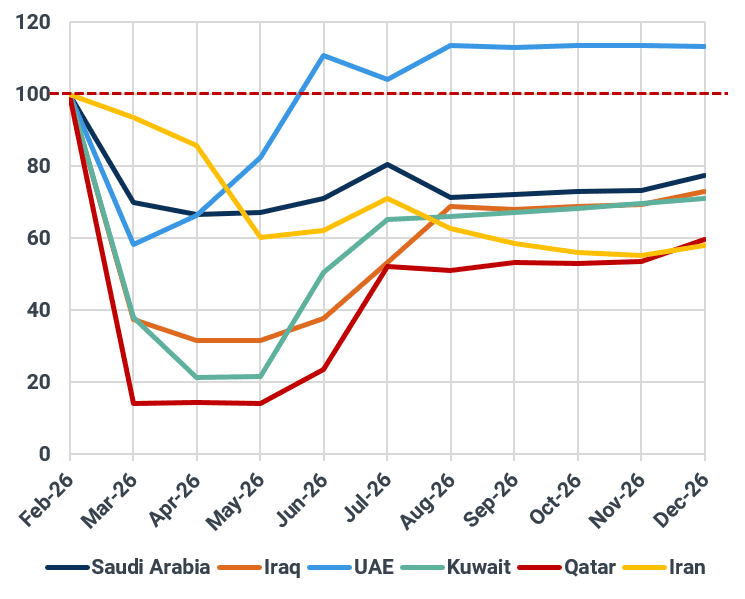
Source: Kpler



Related News.

Navigating the Multi-Orbit Era: In Conversation with Intellian’s Jon Harrison at SMM 2026
At SMM 2026 in Hamburg, the rapid evolution of maritime satellite communications took centre stage. Across the exhibition halls, discussions among…
Cyprus ports need joint energy and investment strategy, shipping agents chief says
Cyprus needs a coordinated strategy for shipping, energy and environmental protection to support port investment and modernisation, Cyprus shipping…

MASO Public Affairs introduces MASO Regulatory Intelligence
A new subscription service helping businesses understand what is changing and what it means for them MASO Public Affairs introduces MASO Regulatory…
Anglo-Eastern helps turn CMBTECH’s ammonia ambition into an operational reality
From early feasibility study and risk-based design to newbuilding supervision, crew readiness and technical management, Anglo-Eastern drew on its…

Escalation of attacks threatens to derail recovery in Middle East oil exports
World oil demand is forecast to fall by 2.5 mb/d y-o-y in 4Q26 and 2.6 mb/d on average in 2026. As the Iran war manifests itself through restricted…

New study finds shipping pays twice its share to EU ETS earmarked revenues should triple to help build market for sustainable fuels and technologies
Shipping is responsible for around 10% of EU ETS emissions but pays almost 20% of the ETS bill. Unlike other sectors, it has never received free…

MSARC strengthens maritime mass rescue readiness through training and national live exercise off Dakar, Senegal
Joint MSARC–FHAS programme combines three days of SAR training with a national multi-agency live exercise The Maritime Search and Rescue Council ,…

Sogese report deliveries are still being delayed as container freight rates fluctuate
FOR IMPORTERS Spot rates into the Mediterranean are back at January levels, Far East to Europe reliability sits at pandemic lows, and nearly…

Glencore begins trading on Australian Securities Exchange
Glencore has begun trading on the Australian Securities Exchange under the ASX code GLC. Gary Nagle, Glencore’s CEO, said it was an exciting day for…
BIMCO Shipping Number of the Week
Suez Canal container ship transits exceed 50% of pre-disruption levels "During the first two weeks of October, weekly container ship capacity…
Subscribe to our newsletter!
if you dont want to swim alone in the ocean of news, sign up for the newsletter, and you will receive daily all the important news of world shipping!
