Iran’s blockade trilemma: endure, escalate or negotiate

Nearly six months into the US-Iran war, the conflict has entered a third phase that looks like a game of chicken, after the hot war and the Islamabad negotiations. The key question is how long Tehran can afford to accept a status quo increasingly working against it.
Market & Trading Calls
- Neutral to slightly bullish Brent as the cost of restraint is rising for Iran. An escalation could negatively impact oil flows leaving the Persian Gulf.
- Slightly bullish Brent-Dubai EFS spread due to refiners increasingly scrambling for alternatives in the event of an escalation.
Key takeaways
- The renewed US blockade is making the status quo progressively more expensive for Tehran. Pressure now extends from crude and petrochemical export revenues to production shut-ins, imports, aviation, gasoline balances, and ultimately government subsidies. Politically, the status quo also increasingly becomes hard to manage.
- Tehran is confronted with a trilemma: endure, escalate, or negotiate. None is politically cheap. We do not see escalation as inevitable or necessarily imminent, but continued blockade conditions increasingly tilt the calculation in that direction. The more successfully Washington restores non-Iranian exports while containing Iran’s own, the greater Tehran’s incentive to alter the status quo.
Iran is stuck while its neighbours move on
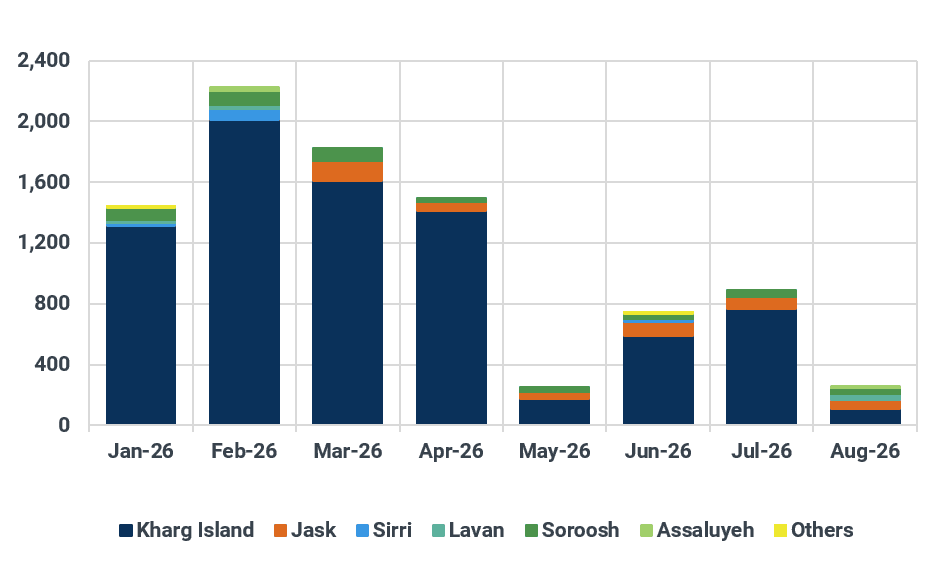
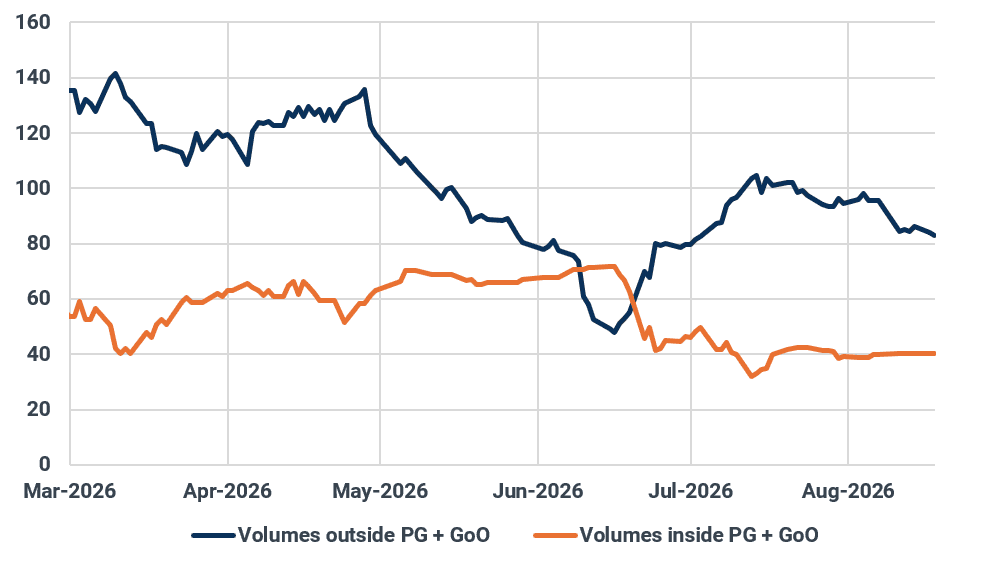
During Mar–April, Iran’s crude exports reached 1.85 mbd, while non-Iranian crude flows through the Strait of Hormuz fell as low as 300 kbd. That relationship has reversed. Iranian oil loadings have fallen to 248 kbd in August, with only 1 VLCC loading at Kharg Island over the past 3 weeks, and loaded barrels are trapped within the blockade zone.
Iran oil loadings, kbd
Source: Kpler
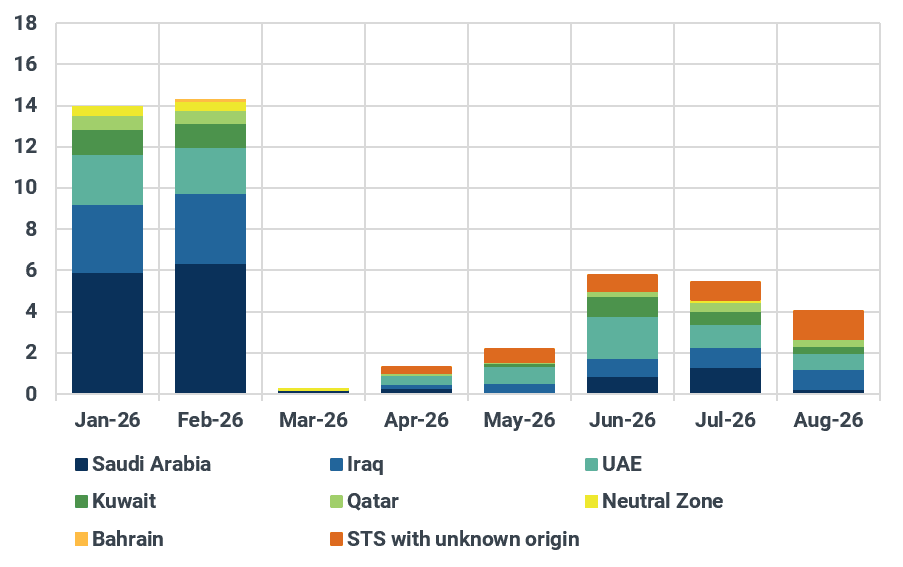
Meanwhile, 5.2 mbd of non-Iranian crude left the Gulf in the week starting 3 Aug. including STS volumes, rising to around 9 mbd including incremental flows through Adnoc’s Fujairah and Aramco’s East-West pipelines. Regional producers are therefore exporting around 65% of pre-war volumes.
Persian Gulf crude oil exports passing through the Strait of Hormuz, excluding Iranian oil, mbd
Source: Kpler. The chart doesn’t include piped volumes via Aramco’s East-West pipeline and Adnoc’s Fujairah pipeline.
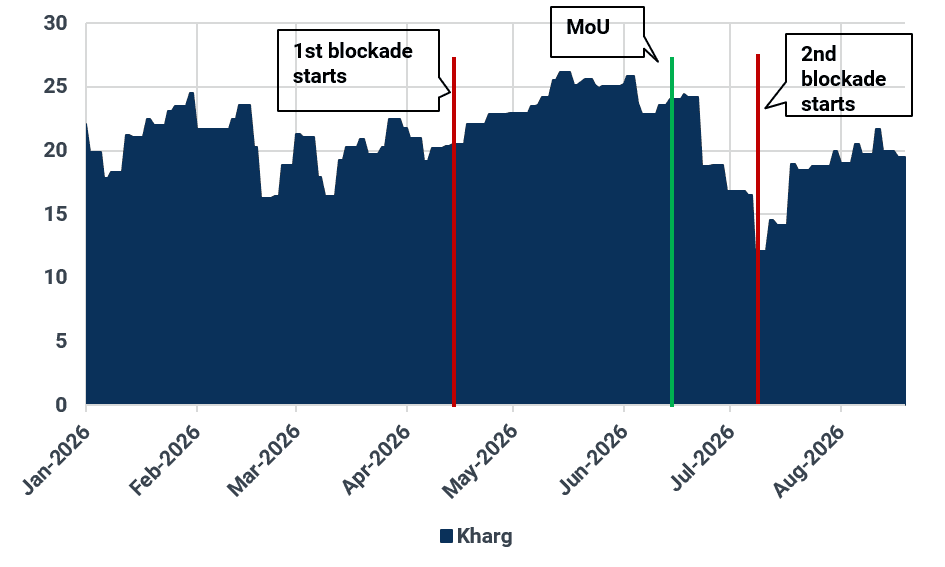
The blockade also appears harder to circumvent. Ballast vessels approaching Iranian terminals are receiving US Navy warnings. Kharg inventories have decresaed by 700 kb month-to-date to 19.3 mb despite minimal loadings, suggesting Iran has reduced production rather than allowing stocks to build.
Kharg oil inventories, mb
Source: Kpler
Iran still holds more than 80 mb of oil outside the blockade zone, providing Tehran with an important near-term buffer. We understand most of these barrels are already committed, supporting Central Bank governor Abdolnaser Hemmati’s claim that exports have “virtually stopped”. Revenues are typically repatriated only 1–2 months after discharge at Chinese ports. At current discharge rates, this oil-on-water could sustain a revenue stream for another 5–6 months before export receipts effectively disappear.
Iranian oil on water by location, mb
Source: Kpler
The costs extend beyond crude. Petrochemicals, Iran’s second-largest source of foreign revenues, are also being hit hard, with exports down 63% since early 2026. As storage fills, petrochemical plants could eventually be forced to shut down. Unlike oil fields, these plants are also major employers, widening the potential domestic impact. Food imports are under pressure, with corn, soybean, and wheat imports below their 5-year range. The UAE’s decision on 19 Aug. to halt trade with Iran threatens another important import channel.
None of these pressures individually implies imminent regime instability, but the risk comes from their accumulation and from the increasingly difficult choices required to manage them.
1. Endure and absorb the domestic risk
Iran can probably withstand the blockade for several more months. But doing nothing carries costs beyond economics. Iranian officials have long maintained that if the country cannot export oil, its neighbours should not be able to either. The recovery in Gulf exports increasingly undermines that deterrence narrative. Accepting a blockade while neighbouring exports recover risks looking like weakness to the domestic audience.
Gasoline adds a particularly sensitive domestic dimension. Iran produces 121 mld against consumption of 135 mld, a shortfall of ~90 kbd, despite already lowering specifications through petrochemical blending. The deficit can be managed through additional workarounds, but some, particularly higher prices or reduced subsidies, carry substantial political risks. Ghalibaf has recently explicitly opposed another gasoline price increase in a letter signed by around 160 MPs.
Tehran can therefore wait, but waiting itself has an economic, social, and ideological price.
2. Escalate and try to change the payoff
Escalation offers Tehran something endurance does not: the possibility of changing the calculation for everybody else. With US midterm elections approaching and Israeli elections due shortly, Iran has an incentive to increase the economic and political cost of continuing the war, through higher oil prices, shipping disruption, attacks on regional interests, or a broader geography of risk. For Tehran, it would allow to claim that preventing its exports has consequences for everyone else.
But July demonstrated the danger. Iranian pressure on shipping was followed by a forceful US response that likely weakened Tehran’s ability to control the Strait. The UAE’s economic response similarly demonstrates how escalation can compound the economic pressure Iran is trying to escape.
The recent appointments of Mohsen Rezaei and Ahmad Vahidi point toward greater influence for officials associated with a tougher stance. Escalation isn’t inevitable, but absorbing the blockade is now harder to reconcile with the leadership’s direction.
Tehran therefore needs to escalate enough to restore deterrence without triggering retaliation that leaves it worse off. That line will be increasingly difficult to find.
3. Negotiate and swallow the political cost
Negotiations offer the clearest economic exit but the hardest political one. Greater concessions could loosen the blockade and relieve pressure on exports and the domestic economy. Yet after months of presenting resistance as victory, accepting worse terms would be difficult to reconcile with the regime’s narrative and hardline constituency. The same domestic politics that make restraint difficult therefore also constrain compromise.
Escalation may become the least bad option
Recovering non-Iranian Persian Gulf exports look reassuring for the immediate physical market. That reduces today’s supply disruption while raising the economic and political cost to Tehran of maintaining the status quo. However, the longer the blockade persists, the more attractive escalation becomes relative to doing nothing for Iran, even as the consequences of escalation become more dangerous.

Source: Kpler



Related News.
Hong Kong Global Maritime Trade Summit to return for third edition
The International Chamber of Shipping, in collaboration with the Transport and Logistics Bureau of the Government of Hong Kong and the Hong Kong…

Appetite for US crude oil exports climbs despite high freight
South Korea tops US crude destinations at 568,600 b/d VLCC rates to Asia double, closing arbitrage window European refining margins…
Shipping stocks Rally as Hormuz Traffic plunges 75%
Ship traffic through the Strait of Hormuz — a critical chokepoint handling about 20% of global crude oil and liquefied natural gas shipments — has…
Diana Shipping announces Time Charter Contract for m/v G P Zafirakis with Classic Maritime
Diana Shipping, a global shipping company specializing in the ownership and bareboat charter-in of dry bulk vessels, announced that, through a…
New IMO ESP Code framework for Remote Inspection Techniques
The International Maritime Organisation, through Resolution MSC.584(111) , has adopted amendments to the International Code on the Enhanced…

ABS opens Offshore & Marine Support Center in Bergen
ABS has expanded its capabilities in the Norwegian maritime market with the opening of a cutting-edge support center in Bergen, bringing advanced…
MOL holds giant step memorial ceremony and beach cleanup at Kashima Coast
Memorial and Reflection 20 Years After the Accident: Learning from the Past to Foster an Even Stronger Safety Culture Mitsui O.S.K. Lines, announced…

KEZAD-based Arabian Gulf Steel Industries achieves lowest verified Carbon Footprint for Rebar
CARES UK verified Environmental Product Declaration confirms 139 kg CO₂e per tonne for rebar produced at AGSI’s KEZAD Abu Dhabi facility Arabian…
Indian Register of Shipping announces launch of first fleet support ship INS Surya
Indian Register of Shipping continues to strengthen its role in supporting the Indian Navy and India’s naval shipbuilding capabilities through the…

VLCCs Climbing the Record Charts
LR2 The TC1 75kt MEG/Japan index decreased by only a single point this week to WS928. The corresponding Baltic round-trip TCE fell by $2,000 to…
Subscribe to our newsletter!
if you dont want to swim alone in the ocean of news, sign up for the newsletter, and you will receive daily all the important news of world shipping!
