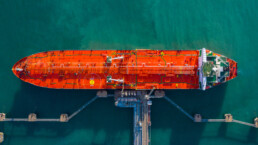

Oil-producing countries that have frequently experienced blockages in major Middle Eastern shipping routes, such as the Strait of Hormuz and the Red Sea due to wars, are increasingly purchasing oil tankers directly—a unique trend. Traditionally, oil-producing nations focused on crude and gas production, while buyers secured transportation. This was the standard practice.
However, supply chain disruptions caused by delayed shipments during conflicts have upended this model. The need for infrastructure to deploy tankers immediately during crises has become apparent, leading to what is being called a push to secure “strategic vessels.” This shift could open new markets for South Korean shipbuilders and shipping companies.
◇Why Are Oil Companies Buying Tankers Directly?
Reuters reported on July 31 that ADNOC Logistics & Services (ADNOC L&S), a logistics subsidiary of the UAE’s state-owned energy giant ADNOC, acquired five very large crude carriers (VLCCs) from Cyprus-based Frontline for approximately 590 million dollars (850 billion Korean won). ADNOC, the national energy company of Abu Dhabi—the UAE’s largest oil-producing emirate—controls over 90% of the UAE’s oil production and exports.
ADNOC also separately acquired three very large gas carriers (VLGCs) and reportedly ordered 25–30 crude, LNG, and LPG tankers from shipyards. The company is purchasing second-hand vessels to meet immediate needs while ordering new ships to prepare for future demand.
ADNOC L&S also chartered around 25 crude carriers from South Korea’s Sinokor Merchant Marine. Approximately 15 of these operate as “shuttle vessels,” transporting crude from production facilities inside the Strait of Hormuz to storage hubs in Fujairah (UAE) and Oman. This reflects rising demand for short-distance transport to move oil from high-risk areas to safer storage. The stored oil is later loaded onto larger tankers for export to Asia and other long-distance markets.
In the past, oil producers had little reason to own large fleets. Middle Eastern crude was typically traded via refiners or commodity traders who arranged shipping. Even when producers handled transportation, chartering ships from specialists was cheaper than owning them. Direct ownership incurs costs for purchase, crew, maintenance, and insurance. Separating production and shipping made economic sense.
However, repeated supply chain crises in the Strait of Hormuz and Red Sea have changed this. Conflicts reduce the number of ships willing to enter risky zones, delaying shipments. Undelivered oil accumulates in export terminals and storage tanks. When storage fills, production must be cut—no matter how much oil is produced, it cannot be exported without ships.
ADNOC’s aggressive fleet expansion is also driven by a tanker shortage. Low freight rates and uncertain oil demand forecasts in recent years delayed new orders. Uncertainty over future fuel types (LNG, methanol, ammonia) further slowed investments. As a result, operational VLCCs are scarce, and new builds take years to deliver. With wars exacerbating risks, oil producers are rushing to secure second-hand vessels. A shipping industry insider noted, “ADNOC’s purchase prices for second-hand ships are close to newbuild costs. If the UAE moves this aggressively, other Middle Eastern nations may follow.”
Could This Be a Boon for South Korea’s Shipbuilding Industry?
The competition among oil producers to secure strategic vessels could create new opportunities for South Korean shipbuilders. ADNOC, one of the world’s top-tier national oil companies, following Saudi Aramco, produces nearly 4.85 million barrels per day—double South Korea’s daily consumption (2.5 million barrels). If such market leaders expand fleet acquisitions, other Middle Eastern state enterprises may follow.
South Korean shipyards currently focus on high-value vessels like LNG carriers. However, if Middle Eastern companies expand orders for LNG, gas, and crude carriers beyond second-hand purchases, domestic shipbuilders could see broader demand. ADNOC L&S, for instance, ordered eight LNG carriers from Samsung Heavy Industries and Hanwha Ocean in 2024, with options for one additional carrier from each shipbuilder (two more in total). These vessels, to be delivered from 2028, will be chartered to ADNOC affiliates for 20 years.
Domestic shipping companies could also benefit indirectly. Long-term contracts—where producers order dedicated vessels and charter them for 10–20 years—may increase, offering more than temporary freight rate hikes.
Source: Chosun



Related News.

Navigating the Multi-Orbit Era: In Conversation with Intellian’s Jon Harrison at SMM 2026
At SMM 2026 in Hamburg, the rapid evolution of maritime satellite communications took centre stage. Across the exhibition halls, discussions among…
Cyprus ports need joint energy and investment strategy, shipping agents chief says
Cyprus needs a coordinated strategy for shipping, energy and environmental protection to support port investment and modernisation, Cyprus shipping…

MASO Public Affairs introduces MASO Regulatory Intelligence
A new subscription service helping businesses understand what is changing and what it means for them MASO Public Affairs introduces MASO Regulatory…
Anglo-Eastern helps turn CMBTECH’s ammonia ambition into an operational reality
From early feasibility study and risk-based design to newbuilding supervision, crew readiness and technical management, Anglo-Eastern drew on its…

Escalation of attacks threatens to derail recovery in Middle East oil exports
World oil demand is forecast to fall by 2.5 mb/d y-o-y in 4Q26 and 2.6 mb/d on average in 2026. As the Iran war manifests itself through restricted…
New study finds shipping pays twice its share to EU ETS earmarked revenues should triple to help build market for sustainable fuels and technologies
Shipping is responsible for around 10% of EU ETS emissions but pays almost 20% of the ETS bill. Unlike other sectors, it has never received free…
MSARC strengthens maritime mass rescue readiness through training and national live exercise off Dakar, Senegal
Joint MSARC–FHAS programme combines three days of SAR training with a national multi-agency live exercise The Maritime Search and Rescue Council ,…
Sogese report deliveries are still being delayed as container freight rates fluctuate
FOR IMPORTERS Spot rates into the Mediterranean are back at January levels, Far East to Europe reliability sits at pandemic lows, and nearly…
Glencore begins trading on Australian Securities Exchange
Glencore has begun trading on the Australian Securities Exchange under the ASX code GLC. Gary Nagle, Glencore’s CEO, said it was an exciting day for…
BIMCO Shipping Number of the Week
Suez Canal container ship transits exceed 50% of pre-disruption levels "During the first two weeks of October, weekly container ship capacity…
Subscribe to our newsletter!
if you dont want to swim alone in the ocean of news, sign up for the newsletter, and you will receive daily all the important news of world shipping!
