Floating Data Centers emerge as growth engine for shipbuilding industry
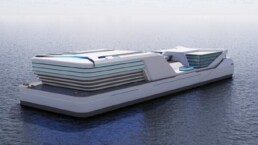

Samsung Heavy Industries and HD Hyundai are racing into sea-based AI infrastructure as land and power limits squeeze data center expansion
In particular, areas near densely populated regions suffer from high land prices and fierce complaints from residents regarding electromagnetic waves and noise. On the other hand, remote areas are hindered by data transmission delay (latency) issues and power grid connection costs. Furthermore, land-based data centers consume a large amount of cooling power, resulting in a significant loss of total received power.
Additionally, while constructing land-based data centers takes years due to land regulations, land acquisition, and building permit procedures, it is far too slow to meet the rapidly increasing AI demand.
The FDC has emerged as the answer to these chronic limitations. By floating structures on the sea and directly cooling servers using abundant deep-sea water, FDCs dramatically reduce energy consumption and operational costs. Furthermore, they are relatively free from land regulations, and the modular construction method can significantly shorten the delivery time.
HD Hyundai Chasing Samsung Heavy Industries’ Preemption, Overseas in Demonstration Stage
The domestic shipbuilding industry recognizes FDCs not as simple vessels but as high value-added offshore plant projects, engaging in a full-fledged preemptive competition.
Samsung Heavy Industries has taken the fastest lead as the domestic frontrunner. It has acquired Approval in Principle (AiP) and basic approval for a MW-class FDC conceptual design from global classification societies (ABS, LR), and joined hands with global AI server company Supermicro and power equipment enterprise ABB. Recently, it has drawn close to the commercialization stage, signing a contract for FDC design and production with Mousterian, a specialized data center developer in the United States.
HD Hyundai is accelerating its pursuit by establishing a dedicated organization centered on its shipbuilding intermediate holding company HD Korea Shipbuilding & Offshore Engineering and HD Hyundai Marine Solution. Recently, it signed an MOU with Schneider Electric, a global power infrastructure giant in France, to jointly develop an integrated power and cooling infrastructure for FDCs. The company is strengthening its Turn-key strategy, which supplies the FDC platform and its own power supply network as an integrated unit by linking not only its shipbuilding capabilities but also its proprietary engine generator infrastructure.
Based on its know-how in offshore plants and eco-friendly energy operations, Hanwha Ocean has initiated market entry and business feasibility reviews for FDCs, completing the Big 3 competitive landscape.
Overseas, demonstrations of underwater and floating concepts have been actively progressing, centered on Big Tech companies and specialized shipowners. Microsoft (MS) conducted “Project Natick,” which installed an underwater submarine-type data center with French state-owned shipbuilder Naval Group, proving high cooling efficiency and a low server failure rate.
Singapore’s Keppel Data Centres is pursuing a barge-based floating data center park, and Japan’s MOL has proposed a business model to convert secondhand vessels into FDCs, indicating that the global market has also entered the blooming stage.
Full-scale Upsizing and Commercialization in 2030
According to global credit rating agency Moody’s, an investment of up to $3 trillion is expected to be made in AI data center infrastructure by 2030. Accordingly, the FDC market is also projected to experience exponential growth.
One of the core challenges for FDCs is to reduce reliance on land-based power grids. In the future, FDCs are highly likely to develop into a “self-sufficient data island” format that operates independently without external power grids by directly linking to offshore wind power generation complexes or floating Small Modular Reactors (SMRs).
Along with this, by mass-producing 50MW to 500MW-class FDC modules in a factory-type manner utilizing the standardized production systems unique to shipyards, the industry will immediately respond to the massive data center construction demands of Big Tech companies (hyperscalers).
The full-scale commercialization of FDCs is expected to bring a massive paradigm shift to the global shipbuilding industry beyond a simple “addition of a new product.”
The existing shipbuilding industry has been severely swayed by the cyclical business cycle of docks. However, since FDCs align with the AI investment schedules of Big Tech, it can serve as a momentum to derisk (mitigate risks) the existing commercial vessel-centric revenue structure and expand the business portfolio into an “energy and digital infrastructure platform” supplier.
Furthermore, compared to general commercial vessels, an FDC is the highest-priced offshore plant concentrated with advanced engineering, including offshore structure design, blocking, flameproofing, vibration control, and power system integration. Beyond simple hull construction, high margins can be secured across the entire service area, including power grid supply, maintenance, repair and operations (MRO), and retrofitting businesses.
Therefore, in a situation where latecomers such as China have pursued closely to the chin with low-cost orders, FDCs are projected to be the optimal stage for Korea’s shipbuilding Big 3, equipped with overwhelming offshore plant engineering capabilities and power and cooling system integration competencies, to build a super-gap technological barrier.
FDCs represent a representative convergence industry born from the meeting of the massive AI wave and traditional offshore engineering technologies. The preemptive market moves by Samsung Heavy Industries and HD Hyundai are expected to serve as a turning point for the Korean shipbuilding industry to advance into a new future of constructing an “artificial intelligence network on the sea,” moving beyond the era of building ships that sail on the sea.
Source: BusinessKorea



Related News.
Hong Kong Global Maritime Trade Summit to return for third edition
The International Chamber of Shipping, in collaboration with the Transport and Logistics Bureau of the Government of Hong Kong and the Hong Kong…

Appetite for US crude oil exports climbs despite high freight
South Korea tops US crude destinations at 568,600 b/d VLCC rates to Asia double, closing arbitrage window European refining margins…
Shipping stocks Rally as Hormuz Traffic plunges 75%
Ship traffic through the Strait of Hormuz — a critical chokepoint handling about 20% of global crude oil and liquefied natural gas shipments — has…
Diana Shipping announces Time Charter Contract for m/v G P Zafirakis with Classic Maritime
Diana Shipping, a global shipping company specializing in the ownership and bareboat charter-in of dry bulk vessels, announced that, through a…
New IMO ESP Code framework for Remote Inspection Techniques
The International Maritime Organisation, through Resolution MSC.584(111) , has adopted amendments to the International Code on the Enhanced…
ABS opens Offshore & Marine Support Center in Bergen
ABS has expanded its capabilities in the Norwegian maritime market with the opening of a cutting-edge support center in Bergen, bringing advanced…
MOL holds giant step memorial ceremony and beach cleanup at Kashima Coast
Memorial and Reflection 20 Years After the Accident: Learning from the Past to Foster an Even Stronger Safety Culture Mitsui O.S.K. Lines, announced…

KEZAD-based Arabian Gulf Steel Industries achieves lowest verified Carbon Footprint for Rebar
CARES UK verified Environmental Product Declaration confirms 139 kg CO₂e per tonne for rebar produced at AGSI’s KEZAD Abu Dhabi facility Arabian…
Indian Register of Shipping announces launch of first fleet support ship INS Surya
Indian Register of Shipping continues to strengthen its role in supporting the Indian Navy and India’s naval shipbuilding capabilities through the…

VLCCs Climbing the Record Charts
LR2 The TC1 75kt MEG/Japan index decreased by only a single point this week to WS928. The corresponding Baltic round-trip TCE fell by $2,000 to…
Subscribe to our newsletter!
if you dont want to swim alone in the ocean of news, sign up for the newsletter, and you will receive daily all the important news of world shipping!
