Hitachi, MOL, and JAL sign MOU to conduct Japan’s first pilot test of Carbon Dioxide Removal Technology on Kume Island, Okinawa
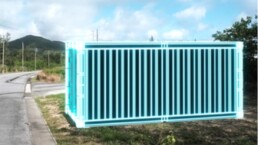

– Direct Ocean Capture (DOC): a technology for recovering CO2 directly from the ocean –
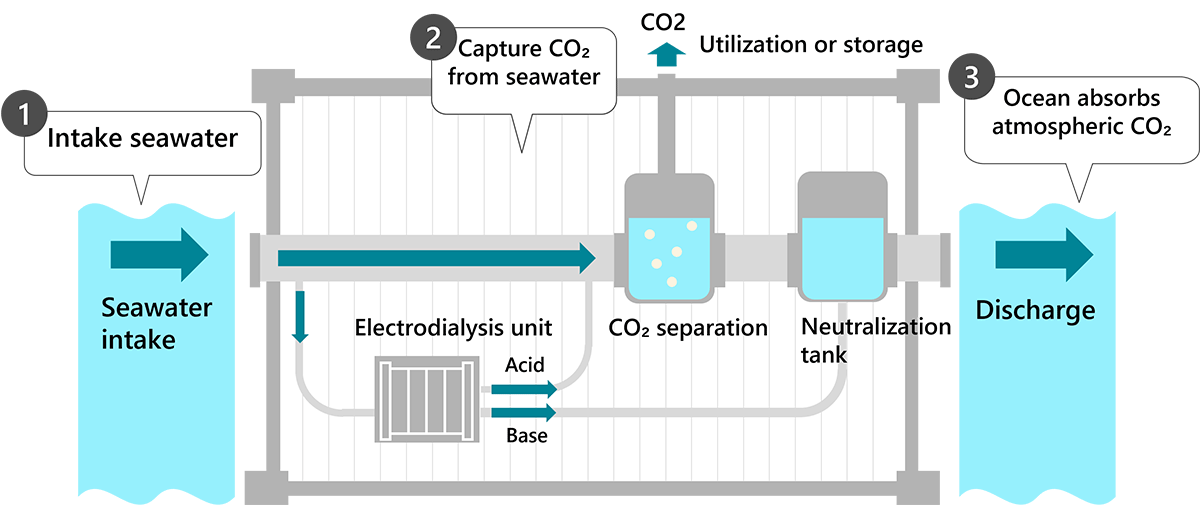
Hitachi, Ltd. (hereinafter “Hitachi”), Mitsui O.S.K. Lines, Ltd. (hereinafter “MOL”), and Japan Airlines Co., Ltd. (hereinafter “JAL”) have signed a Memorandum of Understanding (MOU) to conduct Japan’s first(Note 1) pilot test on Kume Island, Okinawa Prefecture, utilizing Direct Ocean Capture (hereinafter “DOC”)—a technology that directly separates and captures CO2 dissolved in seawater.
In this pilot test, the three companies aim to confirm the applicability of DOC technology using seawater from around Kume Island, and obtain foundational data on operational challenges and environmental impacts for deployment along Japan’s coast. Specifically, the test will use containerized pilot equipment installed on land on Kume Island, taking in seawater to separate CO2. In addition to this initiative, Kume Island hosts cutting-edge pilot projects that leverage its location, such as Ocean Thermal Energy Conversion (OTEC) (Note 2). With a concentration of expertise and talent in ocean research, the island offers an optimal environment for conducting Japan’s first DOC pilot test.
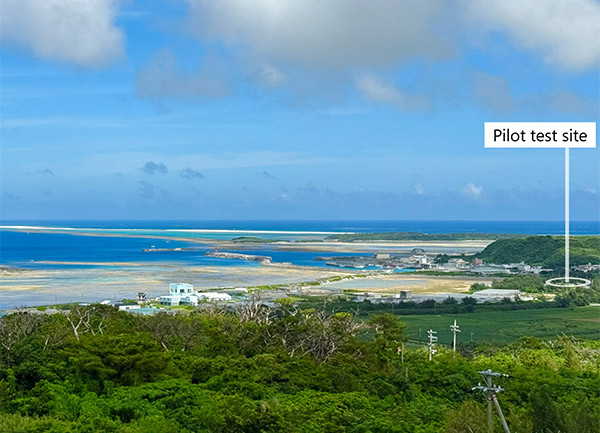
Rendered image of the container-type pilot test facility and the pilot test site
Based on the knowledge gained from this project, the three companies will explore potential applications and expansion of DOC technology—including local utilization of captured CO2, as well as promotional and environmental education initiatives centered on this pilot test—to contribute to the creation of new ocean-based value (the Blue Economy(Note 3)).
Background of the Pilot Test
In “hard-to-abate” sectors such as shipping and aviation, where electrification alone is difficult and emissions are hard to reduce, offsetting emissions has become a key challenge alongside corporate reduction efforts.
As demand continues to grow, expectations are rising for CO2 removal technologies as a key means to address this, driving the need to establish technologies that directly remove CO2 through engineered approaches. Establishing a domestic ecosystem is also becoming increasingly important from the perspective of curbing the future cost of procuring carbon credits(Note 4) from overseas.
The three companies have invested in Captura Corp., a U.S.-based DOC technology developer, through their respective investment subsidiaries and other channels, and have been jointly exploring a domestic pilot test toward the deployment of Captura’s technology in Japan by combining the expertise of each company. The companies position this pilot test as a first step toward building an island-based, domestically self-sufficient carbon economy in which the recovered CO2 is ultimately utilized as a feedstock for synthetic fuels such as E-SAF(Note 5).
About DOC Technology
DOC is a method for directly removing CO2 from seawater. Seawater naturally absorbs carbon until it reaches equilibrium with CO2 concentrations in the atmosphere. Artificially extracting and removing CO2 from seawater disrupts this balance, prompting the ocean to absorb more CO2 from the atmosphere to make up for the deficit. By repeating this cycle, atmospheric CO2 concentrations can be effectively lowered via the ocean. The concentration of CO2 in seawater is approximately 100 to 150 times higher than in the atmosphere. DOC is widely expected to be a promising climate change solution capable of capturing CO2 at lower costs and with lower energy consumption.
Roles of the Three Companies
Hitachi: Under its management plan, “Inspire 2027,” the Hitachi Group has established its sustainability strategy, PLEDGES(Note 6), and is leading this initiative. Utilizing advanced analytical instruments and characterization methods from Hitachi High-Tech Corporation, Hitachi will measure and record operating status and water quality/environmental data (e.g., Dissolved Inorganic Carbon (DIC) and pH in seawater). By analyzing this data and implementing Physical AI that directly feeds insights back into actual plant operations, Hitachi aims to identify and control operating conditions that deliver high energy efficiency. Furthermore, by recording and verifying data on the amount of CO2 captured and the electricity consumed, it will contribute to building an MRV(Note 7) data platform for generating highly trustworthy carbon credits. Hitachi Industrial Products, Ltd. will advance studies toward proposing and supplying the core equipment required for commercial plants. Through One Hitachi, the Hitachi Group aims to establish an intelligent DOC model originating in Japan.
MOL: The MOL Group positions its environmental strategy as a key initiative under its group management plan “BLUE ACTION 2035,” advancing decarbonization initiatives as an ocean-based social infrastructure company. In this pilot test, MOL will leverage the local foundation established through a comprehensive partnership agreement(Note 8) with Kumejima Town, Okinawa Prefecture, to build cooperative relationships with local stakeholders and prepare the pilot environment. Based on the insights gained, MOL aims to contribute both to expanding the use of DOC technology and to creating new local businesses and regional initiatives on Kume Island.
JAL: As part of its Green Transformation (GX) strategy under the “JAL Group Management Vision 2035,” the JAL Group has identified carbon dioxide removal (CDR) technologies as a key initiative. In this pilot test, together with Japan Transocean Air Co., Ltd. and Ryukyu Air Commuter Co., Ltd., both of which operate flights to Kumejima, the JAL Group will leverage regional partnerships to lead promotional activities and raise awareness of DOC technology both within and outside the industry. Furthermore, JAL will evaluate the utility of DOC technology with a view toward future procurement of E-SAF manufactured from captured CO2.
(Note 1) Japan’s first: As a DOC pilot test using pilot equipment connected to a seawater intake system, drawing in, processing, and discharging seawater from actual sea areas. As of July 2026, based on research by the three companies.
(Note 2) Ocean Thermal Energy Conversion (OTEC): A renewable energy generation system that produces electricity by driving turbines using the temperature difference (approx. 20°C) between warm surface seawater and cold deep seawater.
(Note 3) Blue Economy: An economic model that balances economic growth, improved livelihoods, and the health of ocean ecosystems through the sustainable use of ocean resources.
(Note 4) Carbon credit: A mechanism that quantifies GHG emission reductions or removals/absorptions so they can be traded between companies.
(Note 5) E-SAF: Next-generation synthetic aviation fuel with low environmental impact, produced by synthesizing captured CO2 and renewable-energy-derived hydrogen.
(Note 6) PLEDGES: Sustainability strategy formulated in the Hitachi Group’s management plan “Inspire 2027,” consisting of seven pillars including decarbonization and resource circulation.
(Note 7) MRV: Stands for Measurement/Monitoring, Reporting, and Verification. A series of processes and frameworks to accurately measure, report, and third-party verify greenhouse gas (GHG) emissions and reductions.
(Note 8) For details, please refer to the press releases:https://www.mol.co.jp/en/pr/2025/25083.html



Related News.

Poland’s additional national requirements distort competition says Danish Shipping
Poland has introduced a national survey requirement for smaller foreign-flagged vessels operating in Polish waters. This creates significant…

Battery Vessels could help electrify most of Global Shipping Emissions
Battery-electric ships are economical only if the pack is cycled frequently, so they have been confined to short-sea, ferry and harbour vessels…

Mintra and Ledgid explore collaboration to connect Maritime digital identity, learning and workforce development
Mintra® and LEDGID are exploring opportunities to bring together complementary capabilities in digital learning, maritime training, professional…

World Shipping Council calls for global agreement on shipping emissions as industry investment surpasses $200 billion USD
The World Shipping Council (WSC) is calling on governments to agree on binding global greenhouse gas regulations for international shipping without…

What happened to the ITF whistleblower’s complaint?
In January 2026, a whistleblower complained that International Transport Workers’ Federation (ITF) General Secretary Stephen Cotton had manipulated…

Growing regulatory scrutiny puts seafarer wellbeing firmly on maritime safety agenda, VIKAND warns
Seafarer wellbeing is coming under greater regulatory scrutiny as international rules and guidance increasingly recognise crew health and welfare as…

Good Times Bad Times the Premium Stays with the Strait
In October, we wrote that if the transfer network off Oman kept pace, Gulf crude would carry China's refill and keep drawing tonnage east,…

Allied Weekly Market Review Week 47
Pls find below the Allied - Weekly Market Review - Week 47 ALLIED - Weekly Market Report- Week 47


Climate TRACE releases September 2026 Emissions Data
Climate TRACE reported that global greenhouse gas (GHG) emissions for the month of September 2026 totaled 4.7 billion tonnes CO₂e. This remains…
Subscribe to our newsletter!
if you dont want to swim alone in the ocean of news, sign up for the newsletter, and you will receive daily all the important news of world shipping!
