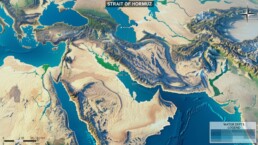

The Strait of Hormuz is rattling global trade, but the waterway is just one example of a vital maritime corridor becoming a frontline, in a new age of drones and missiles targeting economic lifelines.
From the Strait of Hormuz and the Red Sea to the Black Sea, attacks on commercial vessels have disrupted trade, raised insurance and freight costs, and forced shipping companies to reconsider routes once treated as dependable.
The stakes are high: roughly 80% of global merchandise trade by volume moves by sea. Disrupting even one major route can delay cargo, tighten supplies and drive up prices for energy, food and consumer goods thousands of miles away.
How drones are changing maritime warfare
“We have a new chokepoint and a new war,” David Roche, president and global strategist at Quantum Strategy, wrote in a July report, referring to the Sea of Azov, where Ukrainian drones have been striking Russian tankers, and the Black Sea.
Roche described this fighting as the first maritime offensive conducted almost entirely with drones, supplemented by missiles. Such weapons give smaller military forces a cheaper means of threatening ships, ports and other infrastructure whose disruption carries a huge economic cost.
Quantum estimates that about 25% of Russia’s grain exports and 25% to 30% of its Black Sea oil exports could be disrupted. Russia grows more than a fifth of internationally traded wheat, magnifying the potential consequences for global food prices.
Yevgeniya Gaber, a senior fellow at the Atlantic Council think tank, said Russia’s move earlier this month to suspend shipping through the Kerch Strait, which connects the Sea of Azov and the Black Sea, has effectively shut down a vital maritime corridor.
“Maritime transport through the Sea of Azov had become an increasingly important alternative to the land corridor connecting Russia with occupied Crimea,” Gaber told CNBC by email.
“The economic implications are equally important,” Gaber said, adding that the Sea of Azov has been used not only to transport sanctioned crude oil and petroleum products but also grain, coal and steel.
Gaber said Ukraine’s efforts to exploit Russia’s maritime and economic weaknesses constitute “one of the most significant blows to military and commercial fleets” since World War II. Indeed, Ukraine says it has degraded roughly one-third of Russia’s Black Sea fleet since 2022.
Why the Panama Canal could be the next flashpoint
In the Strait of Hormuz, commercial operators are contending with attacks and rapidly shifting signals over whether passage is safe. Governments can declare a waterway open, but shipowners make their own decisions based on the likelihood of a vessel being hit and crew members being injured or killed.
“We often treat the Strait of Hormuz, the Black Sea, or Bab el-Mandeb as isolated events. They are not,” said Daejin Lee, global head of research at Fertistream Freight.
“These waterways are increasingly becoming battlegrounds within the broader transition toward a new world order,” he told CNBC via email.
And the next threats are already emerging.
“If you’re talking about the next flashpoint, I wouldn’t look at the Strait of Hormuz,” said Lars Jensen, chief executive officer of Vespucci Maritime. “I would look at the Panama Canal.”
The strategic passage, which has offered a shortcut for ships transiting between the Pacific and the North Atlantic for more than a century, is already caught in a geopolitical dispute involving the U.S., China and Panama over influence. Potential weather-related restrictions toward the end of this year and early next year could compound those tensions by reducing capacity, Jensen added.
Impact on shipping ‘bigger than most realize’
For shipping companies, the challenge is preparing for a world where the next chokepoint can emerge before the last one has reopened.
Kevin O’Marah, co-founder and chief research officer at supply chain intelligence firm Zero100, told CNBC the Strait of Hormuz became the most critical part of the U.S.-Iran war after Iran discovered merely threatening traffic there was enough to stop it.
While none of Zero100′s clients had come under attack in the strait, O’Marah said some had decided to avoid that risk by actively managing inventories and rerouting shipments.
“It has added cost and delay for some of our clients in the energy, food, and electronics industries,” he said.
“As of now, traffic through the Strait looks to be running at about half the normal flow. The recent breakdown in the ceasefire has definitely hurt the situation but no one is surprised. Supply chain leaders, and in particular logistics specialists like Martin Brower and Maersk, are aware and have well established protocols for dealing with the risk.”
Mitigation strategies include rerouting across the Arabian Peninsula via pipeline for oil, overland into Turkey for certain kinds of commodities and avoiding the area completely as much as possible, O’Marah said.
The war in the Middle East “does not look like an escalating conflict to most supply chain leaders, but it does look likely to be a long-term problem in terms of freedom of movement through the Strait of Hormuz,” he added.
“We are planning on a steady state of transportation uncertainty and costs associated with reroutings, inventory buffering, and shipping surcharges.”
Alain Bejjani, a Dubai-based investor, business executive and judge on “Shark Tank Lebanon,” told CNBC shipping lanes would stay at the center of the war “because they are the conflict.”
“The war has migrated from territory to logistics. A strait does not close when missiles fly; it closes when insurers stop writing cover,” he said. “That makes disruption cheap to sustain and hard to price, which is exactly why it persists.”
A spokesperson for insurance broker Gallagher told CNBC war risk insurance — an add-on that covers financial losses caused by war, terrorism, and civil unrest — is still available. But they noted that “a handful but not many” ship owners or charters are opting to travel through the Strait of Hormuz.
“Given the challenging maritime security environment, rates have increased from levels that owners and charterers will be used to. The cost will vary depending on the vessel type, cargo and routing, however marine insurers are continuing to provide cover and helping to ensure marine commerce can continue with adequate coverage in place,” they added.
How companies are responding to shipping risks
Bejjani told CNBC that the structural consequence of maritime warfare “is bigger than most people realize.”
“The Gulf is bracketed by two straits, not one, and the region is now designing around both Hormuz and Bab el-Mandeb to the maximum extent possible,” he said.
“That is new. Past crises produced hedges. This one is producing an architecture: overland corridors, bypass pipelines, forward storage near the markets that matter most. It will cost heavily, take a decade, and ripple for decades more. I expect other strait-dependent regions to follow, though few with the same urgency or resources.”
He warned that, although shipping will maintain its edge in terms of volumes, it is likely to “lose its monopoly on trust” in the business world.
“Other modes of transport will be substantially enhanced where certainty matters most, and redundancy becomes a permanent, priced feature of logistics,” he said.
“The strait will reopen. The assumption that it stays open for free will not return.”
Source: CNBC



Related News.

Navigating the Multi-Orbit Era: In Conversation with Intellian’s Jon Harrison at SMM 2026
At SMM 2026 in Hamburg, the rapid evolution of maritime satellite communications took centre stage. Across the exhibition halls, discussions among…
Cyprus ports need joint energy and investment strategy, shipping agents chief says
Cyprus needs a coordinated strategy for shipping, energy and environmental protection to support port investment and modernisation, Cyprus shipping…

MASO Public Affairs introduces MASO Regulatory Intelligence
A new subscription service helping businesses understand what is changing and what it means for them MASO Public Affairs introduces MASO Regulatory…
Anglo-Eastern helps turn CMBTECH’s ammonia ambition into an operational reality
From early feasibility study and risk-based design to newbuilding supervision, crew readiness and technical management, Anglo-Eastern drew on its…

Escalation of attacks threatens to derail recovery in Middle East oil exports
World oil demand is forecast to fall by 2.5 mb/d y-o-y in 4Q26 and 2.6 mb/d on average in 2026. As the Iran war manifests itself through restricted…
New study finds shipping pays twice its share to EU ETS earmarked revenues should triple to help build market for sustainable fuels and technologies
Shipping is responsible for around 10% of EU ETS emissions but pays almost 20% of the ETS bill. Unlike other sectors, it has never received free…

MSARC strengthens maritime mass rescue readiness through training and national live exercise off Dakar, Senegal
Joint MSARC–FHAS programme combines three days of SAR training with a national multi-agency live exercise The Maritime Search and Rescue Council ,…

Sogese report deliveries are still being delayed as container freight rates fluctuate
FOR IMPORTERS Spot rates into the Mediterranean are back at January levels, Far East to Europe reliability sits at pandemic lows, and nearly…

Glencore begins trading on Australian Securities Exchange
Glencore has begun trading on the Australian Securities Exchange under the ASX code GLC. Gary Nagle, Glencore’s CEO, said it was an exciting day for…
BIMCO Shipping Number of the Week
Suez Canal container ship transits exceed 50% of pre-disruption levels "During the first two weeks of October, weekly container ship capacity…
Subscribe to our newsletter!
if you dont want to swim alone in the ocean of news, sign up for the newsletter, and you will receive daily all the important news of world shipping!
