
August opens with a renewed chapter on the Port Hedland strikes. Using AXS Dry Insights, we review the Capesize Pacific the flow of iron-ore shipments and the ballasters map to gauge the impact on today’s spot market.
THE RENEWED CHAPTER
August has opened where July left off. Industrial action has been announced at BHP’s Port Hedland terminal, with a planned 24-hour ban on ship-loading from 05:30 AWST on 8 August, followed by a 24-hour work stoppage from 05:30 AWST on 9 August. About 150 workers are expected to take part, and the action could delay around 16 shipments over the two days. It follows the 16 July stoppage, the first protected industrial action at the terminal in more than 25 years. It comes after Fair Work Commission-facilitated talks failed to break the deadlock, with the unions due to meet BHP again on 4 August. BHP has said it offered a 16% pay rise and has contingency plans to keep operating.
Port Hedland is the world’s largest bulk iron ore export port and the core of BHP’s Western Australia supply chain, so a two-day stoppage presents a risk to loading schedules. Yet the Capesize Pacific is not trading as though a squeeze is coming. To understand why, we look through AXS Dry Insights at two things: how the cargo is flowing and where the ships are.
THE FLOW OF SHIPMENTS
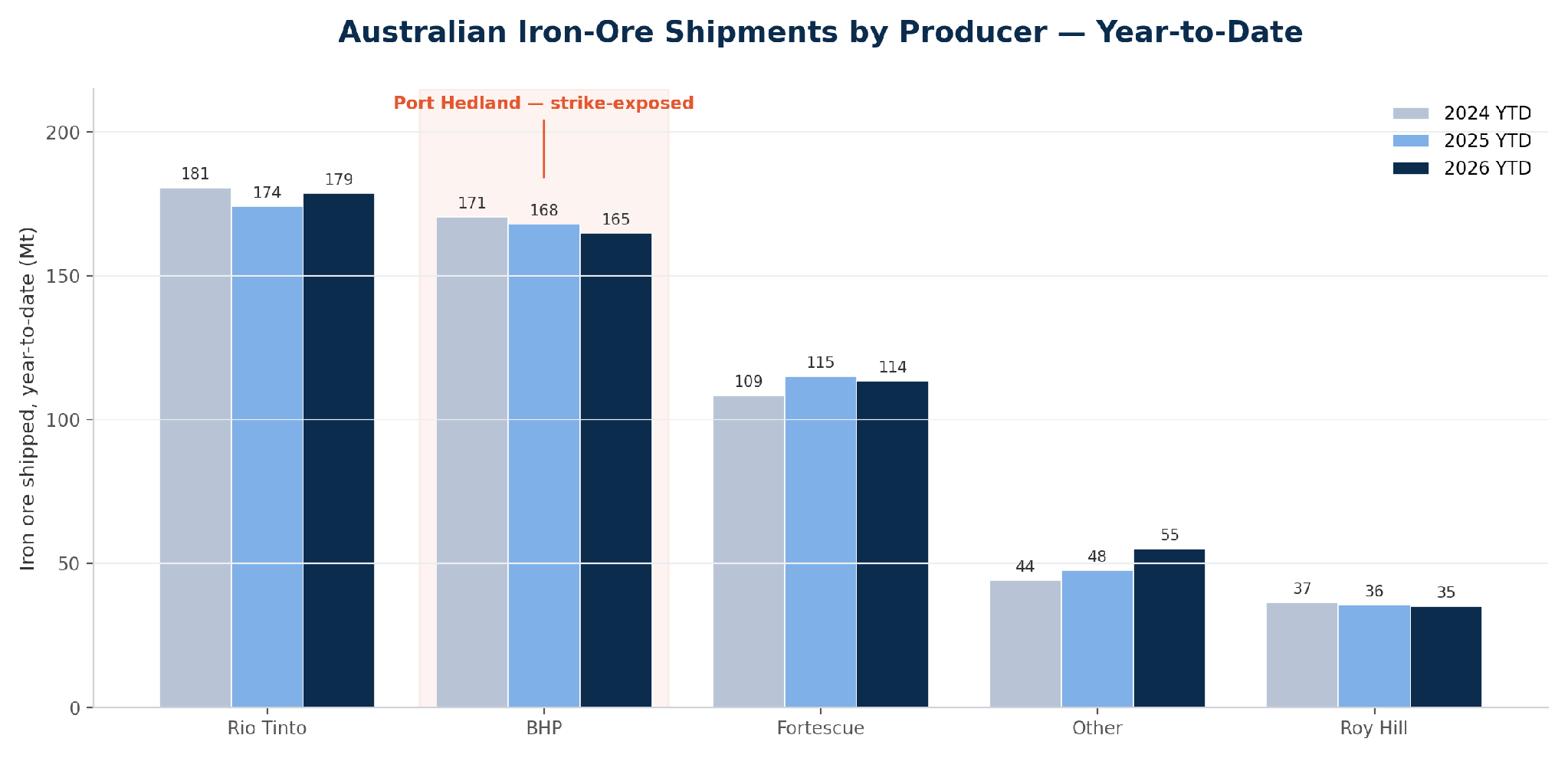
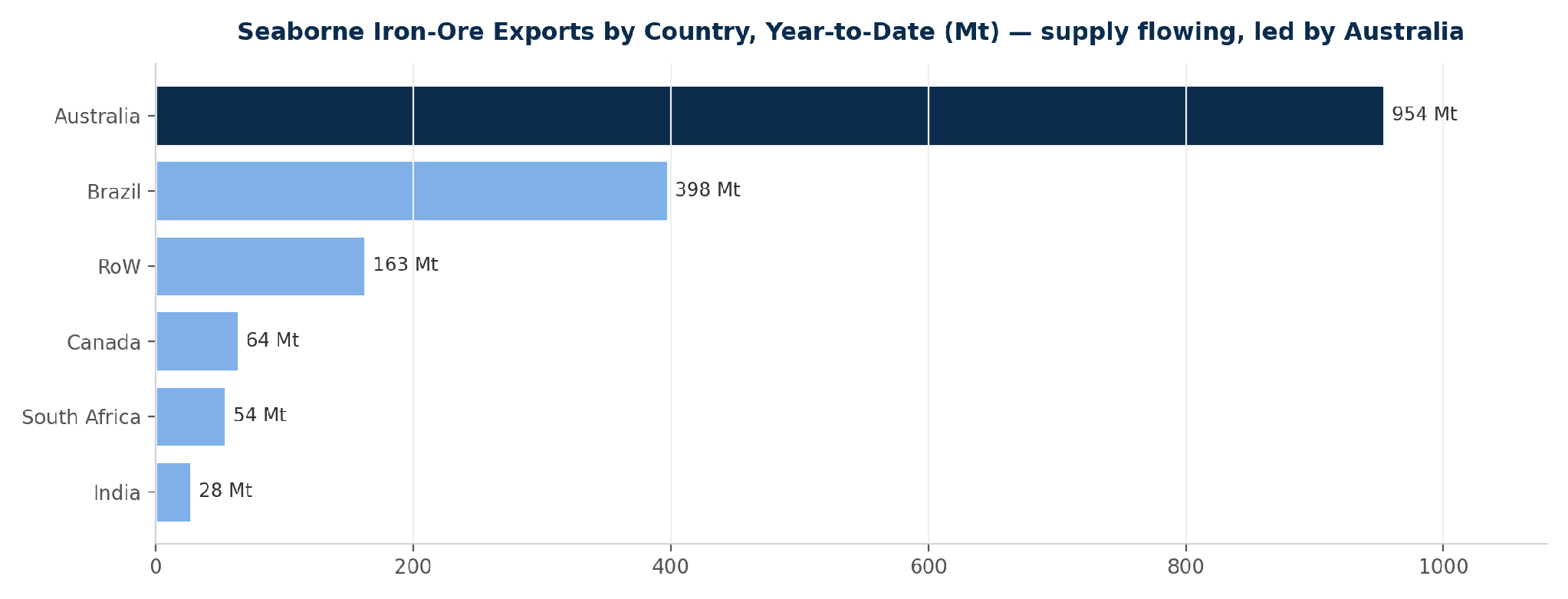
Current export flows do not point to a tightening physical market. Australian seaborne iron ore exports ran at 16.5 Mt in the latest full week and 953.7 Mt year-to-date, 1.3% above the same point last year, while Brazil shipped 9.1 Mt during the week. Among the majors, Rio Tinto has shipped 178.8 Mt year-to-date, BHP 164.9 Mt (close to last year’s 168.0 Mt) and Fortescue 113.5 Mt. The volume flow remains intact, with no evidence so far of a material shortfall in iron ore loadings that would, on its own, tighten the Pacific market or lift C5. If anything, last week’s data suggested marginally softer Australian export volumes rather than signs of tightening cargo availability.
THE BALLASTERS MAP: WHERE THE SHIPS ARE
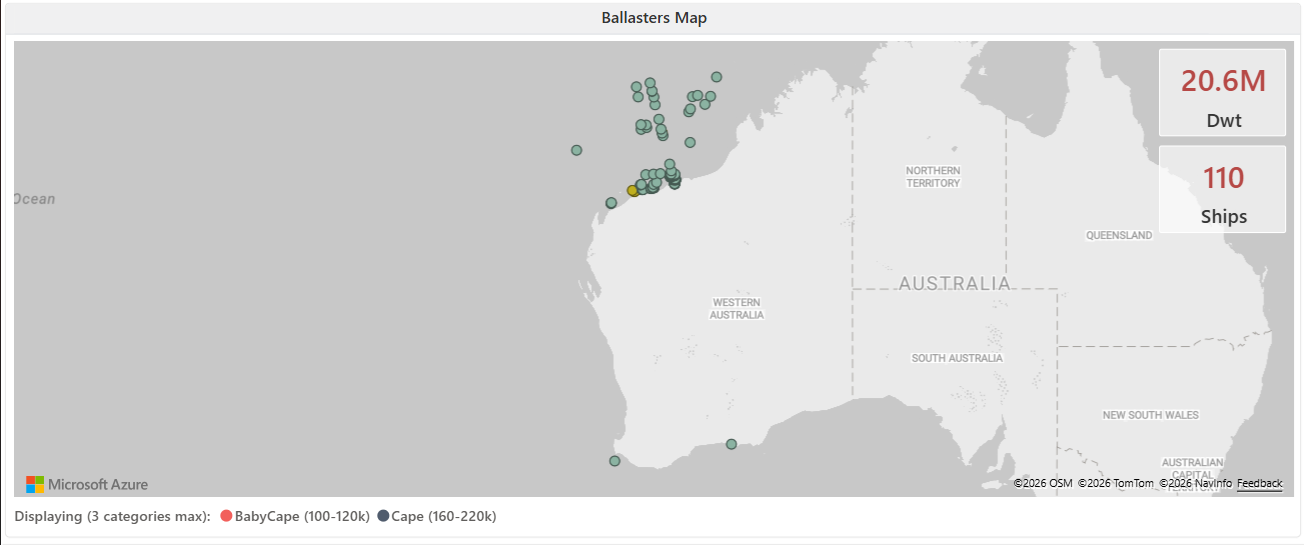
The ballasters map shows the prompt vessel supply around Western Australia. Around 110 Capesize ballasters, representing approximately 20.6 Mt of deadweight, were positioned off the Western Australian coast, with 54 already bound for Port Hedland, a further 16 heading for Port Walcott and 9 for Dampier. These vessels are sailing in ballast towards the loading ports in search of their next cargo, with supply concentrated across the region most exposed to any disruption in loading schedules.
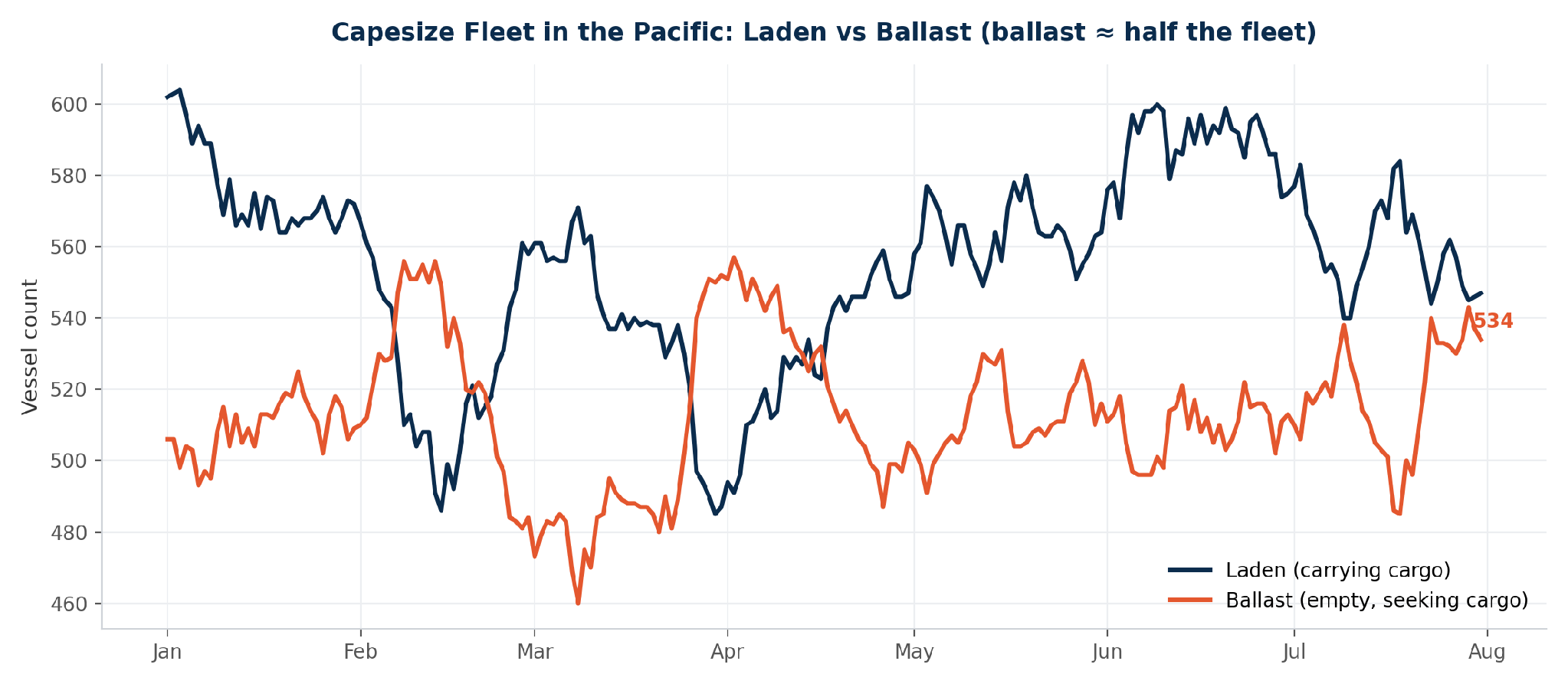
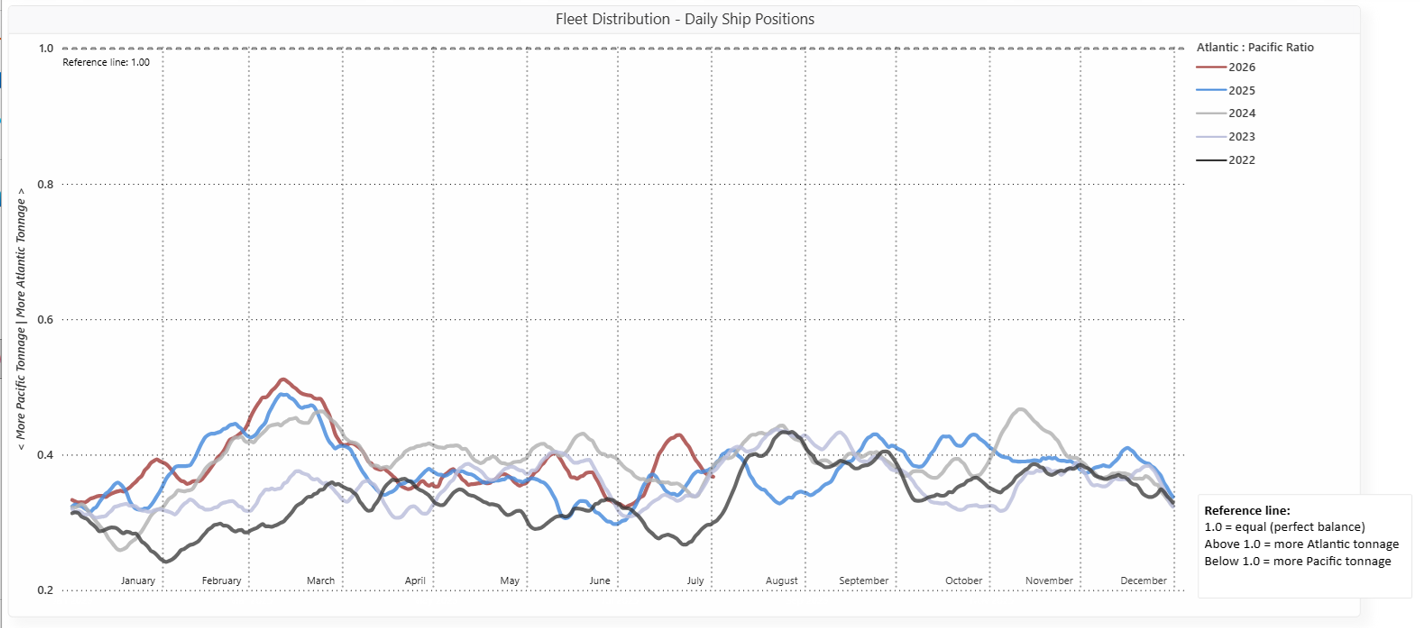
The fleet balance suggests that prompt vessel supply remains elevated. As of 31 July, the Pacific Capesize fleet comprised 547 laden vessels and 534 in ballast, leaving 49% of the fleet available for its next voyage—above the level seen at the start of the year. The Atlantic-to-Pacific ballast ratio stood at around 0.38, remaining well below 1.0 and indicating a continued concentration of ballast tonnage in the Pacific. In that context, any temporary interruption to loading schedules would leave more vessels competing for available cargoes rather than reduce vessel availability.
THE SPOT READ: C5 THE WEAKER LEG
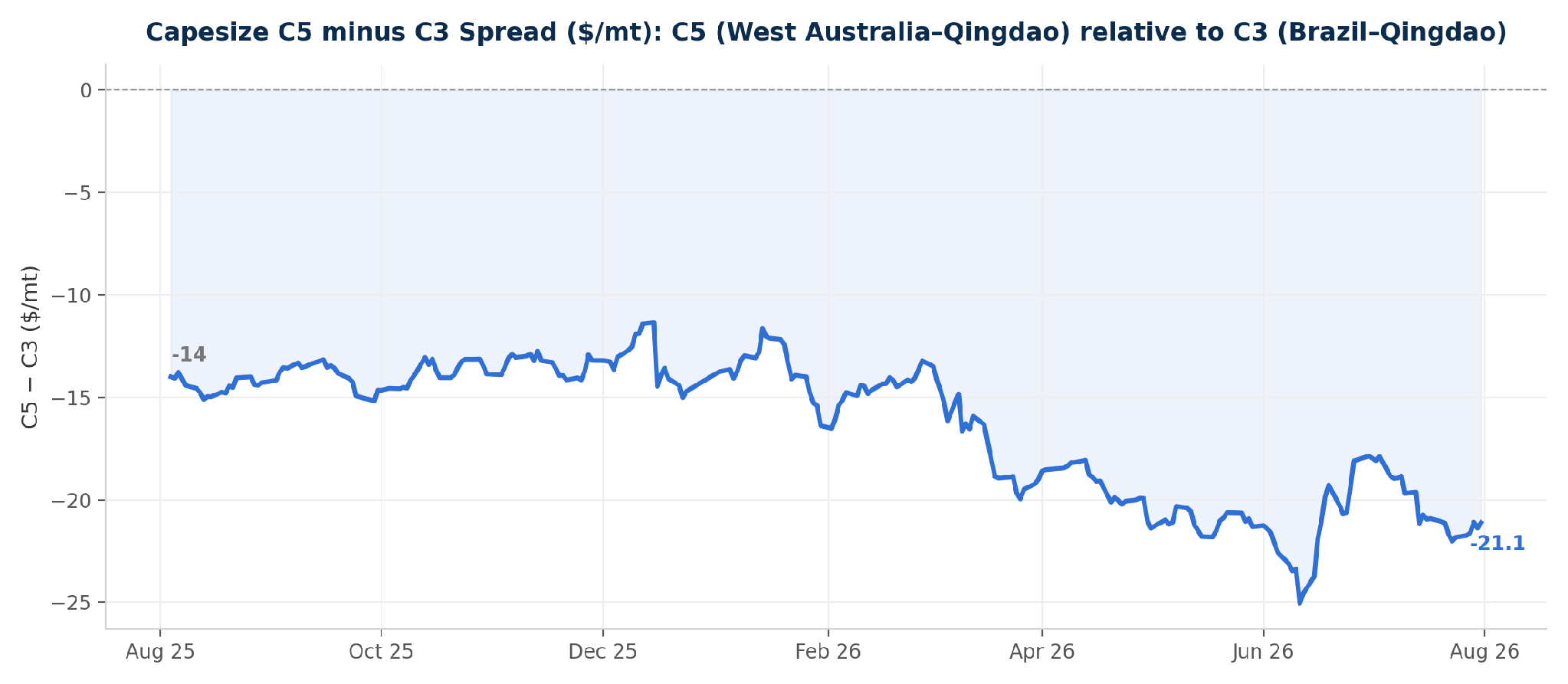
C5 (West Australia–Qingdao) is trading well below C3 (Brazil–Qingdao): the spread sat near –$21/mt at the end of July, wider than about –$14/mt a year earlier, with C5 running at roughly 0.37 times C3. With export volumes remaining stable and ballast supply elevated, there is little evidence to support a narrowing of the C5–C3 differential in the near term.
WHAT TO WATCH
Two factors will determine the near-term direction of the market. If ballast arrivals continue to outpace cargo availability, competition for prompt cargoes is likely to remain elevated, limiting support for C5 relative to C3. The planned industrial action at Port Hedland represents the principal upside risk. Should loading disruptions prove more prolonged than currently anticipated, reduced loading activity could tighten the prompt cargo market and provide support for C5 relative to current levels.
For now, however, the market appears to place greater weight on current fleet positioning than on the risk of operational disruption. The Pacific Capesize market continues to have a sizeable pool of ballast vessels, while the extent and duration of any disruption at Port Hedland remain uncertain.
METHODOLOGY
Freight, fleet, export and vessel-position data are from AXS Dry Insights (AXSMarine), as of 31 July / 1 August 2026, covering iron-ore export volumes, Capesize C3 and C5 assessments, laden and ballast fleet status in the Pacific, global ballast share, and daily ballast-vessel positions off Western Australia. Details of the industrial action reflect contemporaneous public news reporting. Figures are reported as sourced; no independent forecast is implied.
Source: Signal Ocean



Related News.

Navigating the Multi-Orbit Era: In Conversation with Intellian’s Jon Harrison at SMM 2026
At SMM 2026 in Hamburg, the rapid evolution of maritime satellite communications took centre stage. Across the exhibition halls, discussions among…
Cyprus ports need joint energy and investment strategy, shipping agents chief says
Cyprus needs a coordinated strategy for shipping, energy and environmental protection to support port investment and modernisation, Cyprus shipping…

MASO Public Affairs introduces MASO Regulatory Intelligence
A new subscription service helping businesses understand what is changing and what it means for them MASO Public Affairs introduces MASO Regulatory…
Anglo-Eastern helps turn CMBTECH’s ammonia ambition into an operational reality
From early feasibility study and risk-based design to newbuilding supervision, crew readiness and technical management, Anglo-Eastern drew on its…

Escalation of attacks threatens to derail recovery in Middle East oil exports
World oil demand is forecast to fall by 2.5 mb/d y-o-y in 4Q26 and 2.6 mb/d on average in 2026. As the Iran war manifests itself through restricted…
New study finds shipping pays twice its share to EU ETS earmarked revenues should triple to help build market for sustainable fuels and technologies
Shipping is responsible for around 10% of EU ETS emissions but pays almost 20% of the ETS bill. Unlike other sectors, it has never received free…
MSARC strengthens maritime mass rescue readiness through training and national live exercise off Dakar, Senegal
Joint MSARC–FHAS programme combines three days of SAR training with a national multi-agency live exercise The Maritime Search and Rescue Council ,…
Sogese report deliveries are still being delayed as container freight rates fluctuate
FOR IMPORTERS Spot rates into the Mediterranean are back at January levels, Far East to Europe reliability sits at pandemic lows, and nearly…

Glencore begins trading on Australian Securities Exchange
Glencore has begun trading on the Australian Securities Exchange under the ASX code GLC. Gary Nagle, Glencore’s CEO, said it was an exciting day for…
BIMCO Shipping Number of the Week
Suez Canal container ship transits exceed 50% of pre-disruption levels "During the first two weeks of October, weekly container ship capacity…
Subscribe to our newsletter!
if you dont want to swim alone in the ocean of news, sign up for the newsletter, and you will receive daily all the important news of world shipping!
