

Refining, rather than crude supply, has emerged as the primary constraint on global oil markets, as geopolitical disruptions, policy constraints and logistical bottlenecks continue to limit incremental refinery runs and refined product supply.
Refined products, not crude, are the binding constraint
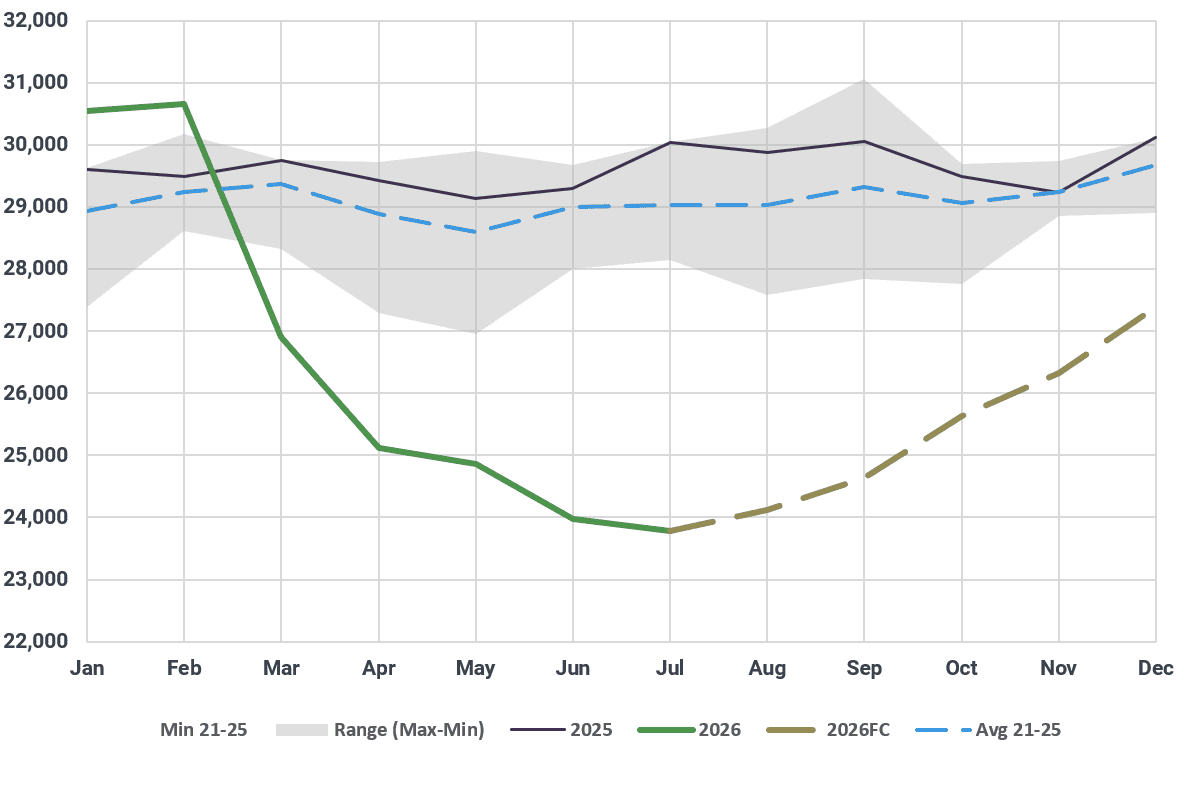
Crude oil continues to dominate headlines, but the more consequential tightness sits downstream. Global spare refining capacity has narrowed to levels which has triggered sever product tightness leaving no further room to absorb further supply shock in refined product market. U.S. utilization is already holding ~95%, European refiners are running at their strongest seasonal rates in several years, and refiners across Asia ex-China, Latin America and Africahave already lifted throughput close to practical limits in response to strong margins and available feedstock. As a result, the burden of incremental supply increasingly rests on China, Russia and the GCC, where constraints are driven by structural and geopolitical factors rather than refining economics.
Russian runs at multi-decade lows
Russian refinery throughput has fallen to its lowest level in more than two decades following sustained Ukrainian drone strikes on refinery infrastructure. A country that has historically been a major exporter of refined products has now relied on imports to balance domestic its fuel markets, further tightening an already constrained global product market. With refinery operations still under pressure, the scope for a meaningful recovery in product exports remains limited.
Middle East exports constrained despite available capacity
Ongoing regional tensions and shipping disruptions continue to constrain refined product exports from the Middle East. As a result, refiners have been unable to fully utilize available refining capacity to meet export demand, limiting the region’s ability to offset tighter product balances elsewhere.
China capped by policy, not capacity
China retains ample refining capacity, but throughput remains constrained by government-controlled product export quotas. As a result, refiners have been unable to capitalize on elevated export margins, leaving China’s contribution to incremental global product supply well below levels observed during previous periods of market tightness.
Russia, China and ME refinery runs combined & outlook, kbd
Source : Kpler
Net effect: a structurally subdued global run rate
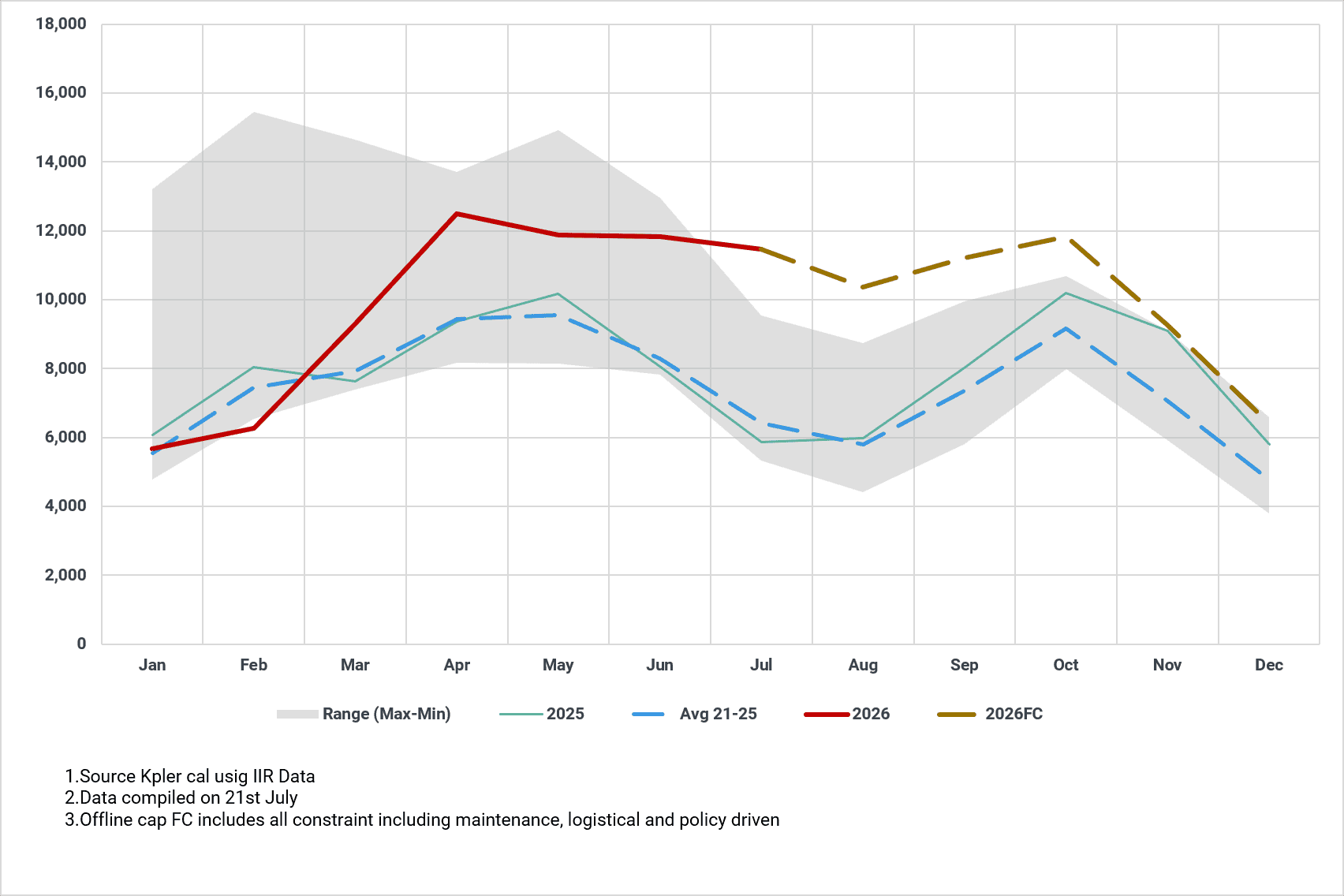
Taken together, these three constraints Russia’s impaired refinery operations, Middle Eastern export bottlenecks, and China’s policy-driven limits on throughput and product exports, are more than offsetting strong refinery utilization across the Atlantic Basin, particularly in the United States and Europe. As a result, global refinery runs are tracking toward one of the weakest seasonal levels in recent years and supporting refining margins.
The implication is clear: refined product markets remain considerably tighter than crude oil fundamentals alone would suggest. While global nameplate refining capacity remains available, the portion that can respond quickly to market disruptions has become extremely limited.
Global refinery Offline Cap actual & forecast, kbd



Related News.

Navigating the Multi-Orbit Era: In Conversation with Intellian’s Jon Harrison at SMM 2026
At SMM 2026 in Hamburg, the rapid evolution of maritime satellite communications took centre stage. Across the exhibition halls, discussions among…
Cyprus ports need joint energy and investment strategy, shipping agents chief says
Cyprus needs a coordinated strategy for shipping, energy and environmental protection to support port investment and modernisation, Cyprus shipping…

MASO Public Affairs introduces MASO Regulatory Intelligence
A new subscription service helping businesses understand what is changing and what it means for them MASO Public Affairs introduces MASO Regulatory…
Anglo-Eastern helps turn CMBTECH’s ammonia ambition into an operational reality
From early feasibility study and risk-based design to newbuilding supervision, crew readiness and technical management, Anglo-Eastern drew on its…

Escalation of attacks threatens to derail recovery in Middle East oil exports
World oil demand is forecast to fall by 2.5 mb/d y-o-y in 4Q26 and 2.6 mb/d on average in 2026. As the Iran war manifests itself through restricted…

New study finds shipping pays twice its share to EU ETS earmarked revenues should triple to help build market for sustainable fuels and technologies
Shipping is responsible for around 10% of EU ETS emissions but pays almost 20% of the ETS bill. Unlike other sectors, it has never received free…

MSARC strengthens maritime mass rescue readiness through training and national live exercise off Dakar, Senegal
Joint MSARC–FHAS programme combines three days of SAR training with a national multi-agency live exercise The Maritime Search and Rescue Council ,…
Sogese report deliveries are still being delayed as container freight rates fluctuate
FOR IMPORTERS Spot rates into the Mediterranean are back at January levels, Far East to Europe reliability sits at pandemic lows, and nearly…

Glencore begins trading on Australian Securities Exchange
Glencore has begun trading on the Australian Securities Exchange under the ASX code GLC. Gary Nagle, Glencore’s CEO, said it was an exciting day for…
BIMCO Shipping Number of the Week
Suez Canal container ship transits exceed 50% of pre-disruption levels "During the first two weeks of October, weekly container ship capacity…
Subscribe to our newsletter!
if you dont want to swim alone in the ocean of news, sign up for the newsletter, and you will receive daily all the important news of world shipping!
