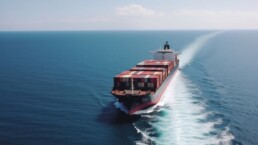

Rates for shipping containers from east Asia and China to the US continued to surge as importers pull volumes forward ahead of possible new tariffs, while liquid tanker rates continued to soften amid a tentative ceasefire in the Middle East.
STRAIT OF HORMUZ UPDATE
The flow of vessels through the Strait of Hormuz increased this week amid a six-day ceasefire between the US and Iran, but the 8,500 TEU (20-foot equivalent unit) Ever Lovely was hit by a projectile on 25 June, leading the International Maritime Organization (IMO) to pause its evacuation process.
Lars Jensen, president of consultancy firm Vespucci Maritime, said Iran has presently not claimed responsibility for the attack and that a US official has placed the blame on Iran.
According to the Strait of Hormuz tracker, a free, real-time dashboard that tracks the ongoing crisis using AI-powered analysis of current Strait conditions, insurance markets and diplomatic developments using real-time web data and AIS data for vessel positions, 12 vessels have transited the Strait over the past 24 hours.
US President Donald Trump accused Iran of the attack in a social media post and declared it a violation of the agreement.
Iranian state news agencies reported that three foreign tankers attempting to make an unauthorized passage through the strait were turned back after a warning from its military.
Iran’s Deputy Foreign Minister Kazem Gharibabadi also warned in a social media post that Tehran will reject any parallel shipping routes or maritime decision-making that bypasses its authority as a key coastal state.
SPIKING CONATINER RATES
Transpacific container rates spiked again this week, with rates ranging from $5,200-6,200/FEU (40-foot equivalent unit) to the West Coast and from $6,300-7,500/FEU to the East Coast.
Rates from supply chain advisors Drewry were up by 12% from Shanghai to Los Angeles and up by 6% from Shanghai to New York, as shown in the following chart.6
Year-on-year, rates from Drewry to the East Coast are up by 25% and rates to the West Coast are up by 54%.
Drewry said transpacific demand remains robust as importers continue frontloading shipments ahead of potential tariff changes and higher bunker-related costs.
Drewry expects rates to increase further in the coming weeks as general rate increases (GRIs) and peak season surcharges (PSS) are expected to be implemented in July.
Rates from online shipping marketplace and platform provider Freightos rose by 19% to the West Coast and by 13% to the East Coast.
Judah Levine, head of research at Freightos, said rates continue to climb as peaking demand from an early busy season is keeping vessels full at least into July.
“This development likewise means spot rates will start easing from the current or near-term levels as demand decreases, regardless of what happens in the Strait,” Levine said.
Rates on the New York Shipping Exchange Freight Index (NYFI) surged by 23% to the West Coast and by 23% to the East Coast while rates on the Shanghai Containerized Freight Index (SCFI), which tracks rates for containers leaving Shanghai, rose by 3.7% and is now about 2.5 times the rate seen at the start of the US-Iran conflict.
Container ships and costs for shipping containers are relevant to the chemical industry because while most chemicals are liquids and are shipped in tankers, container ships transport polymers, such as polyethylene (PE) and polypropylene (PP), which are shipped in pellets. Titanium dioxide (TiO2) is also shipped in containers.
They also transport liquid chemicals in isotanks.
LIQUID TANKERS
US chemical tanker freight rates assessed by ICIS were mostly lower as rates decreased from the US Gulf (USG) across most of the trade lanes. Overall, most players remain cautious awaiting resolution to the ongoing Middle East conflict.
Rates on the USG to Rotterdam route plunged on weaker demand, partially offset by limited availability, particularly for larger parcels. Space among the regular carriers remains scarce, and contracts of affreightment (COA) nominations have utilized most of the available tonnage.
Larger requirements continue to be well represented, with several larger lots of methanol and ethanol fixed or indicated to the ARA. There was also some interest in sending some smaller lots of various chemicals.
From the USG to Asia, the market continues to be rather uneventful, which has resulted in lower freight ideas. There have been very few new inquiries reported in the market over the past week, however a large parcel of ethanol was seen quoted in the market for a second half July lifting.
For the USG to South America trade lane, the market has weakened even further as rates continue to be pressured lower. Very few cargoes are being fixed by charterers due to a lack of buyers in the region. Overall, the market is strongly supported by solid COA nominations, naturally pushing spot rates even lower.
However, on the bunker side, fuel prices were lower amid the continued decline in energy prices.
Source: ICIS by Adam Yanelli, Additional reporting by Kevin Callahan



Related News.

Hong Kong Global Maritime Trade Summit to return for third edition
The International Chamber of Shipping, in collaboration with the Transport and Logistics Bureau of the Government of Hong Kong and the Hong Kong…

Appetite for US crude oil exports climbs despite high freight
South Korea tops US crude destinations at 568,600 b/d VLCC rates to Asia double, closing arbitrage window European refining margins…
Shipping stocks Rally as Hormuz Traffic plunges 75%
Ship traffic through the Strait of Hormuz — a critical chokepoint handling about 20% of global crude oil and liquefied natural gas shipments — has…
Diana Shipping announces Time Charter Contract for m/v G P Zafirakis with Classic Maritime
Diana Shipping, a global shipping company specializing in the ownership and bareboat charter-in of dry bulk vessels, announced that, through a…
New IMO ESP Code framework for Remote Inspection Techniques
The International Maritime Organisation, through Resolution MSC.584(111) , has adopted amendments to the International Code on the Enhanced…

ABS opens Offshore & Marine Support Center in Bergen
ABS has expanded its capabilities in the Norwegian maritime market with the opening of a cutting-edge support center in Bergen, bringing advanced…
MOL holds giant step memorial ceremony and beach cleanup at Kashima Coast
Memorial and Reflection 20 Years After the Accident: Learning from the Past to Foster an Even Stronger Safety Culture Mitsui O.S.K. Lines, announced…

KEZAD-based Arabian Gulf Steel Industries achieves lowest verified Carbon Footprint for Rebar
CARES UK verified Environmental Product Declaration confirms 139 kg CO₂e per tonne for rebar produced at AGSI’s KEZAD Abu Dhabi facility Arabian…

Indian Register of Shipping announces launch of first fleet support ship INS Surya
Indian Register of Shipping continues to strengthen its role in supporting the Indian Navy and India’s naval shipbuilding capabilities through the…

VLCCs Climbing the Record Charts
LR2 The TC1 75kt MEG/Japan index decreased by only a single point this week to WS928. The corresponding Baltic round-trip TCE fell by $2,000 to…
Subscribe to our newsletter!
if you dont want to swim alone in the ocean of news, sign up for the newsletter, and you will receive daily all the important news of world shipping!
