

For over thirty years in shipping and marine insurance, I have learned to be suspicious of consensus. Whenever everyone agrees on where the next danger lies, I become interested in what they may be overlooking. Today, most discussions in shipping revolve around familiar concerns.
The Red Sea.
The Strait of Hormuz.
China.
Taiwan.
Russia.
Sanctions.
Trump.
Environmental regulations.
Cyber threats.
Interest rates.
Freight markets.
Every conference panel, every market report and every industry gathering eventually gravitates toward one or more of these subjects. Yet, I increasingly find myself asking a different question.
What if the next major challenge facing shipping is not any one of these risks individually?
What if the real threat is the moment several of them collide simultaneously? History suggests this possibility deserves far more attention than it currently receives. The most severe crises rarely arrive in the form expected by the majority. They usually emerge from the interaction of multiple events, each manageable on its own, but collectively capable of creating a chain reaction that few anticipated.
The shipping industry has seen this before. In 2008, most people believed they were witnessing a strong market supported by seemingly endless growth. Freight rates were booming. Asset values were rising. Financing was abundant. Confidence was everywhere. Then, Lehman Brothers collapsed. Within months, owners who believed they were facing a freight market challenge discovered they were actually confronting a banking crisis, a liquidity crisis, a financing crisis and, ultimately, a survival crisis. The original event was financial. The consequences spread far beyond finance.
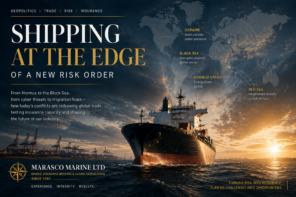
COVID offered another lesson.
What initially appeared to be a public health issue rapidly evolved into a crew-change crisis, a logistics crisis, a supply-chain crisis, a port congestion crisis and eventually a freight market phenomenon unlike anything seen in decades. Again, the original event was not the most important part of the story. The consequences were.
Today, I believe shipping may once again be approaching a period where the interaction between risks matters far more than the risks themselves. To understand why, we need to step back and look at the broader picture. More than two thousand years ago, the Greek historian Thucydides observed that conflict becomes more likely when a rising power challenges an established one.
Whether one agrees entirely with the so-called “Thucydides Trap” or not, the world today exhibits many of the characteristics he described.
The United States remains the dominant military and financial power, on the other hand China continues its economic and industrial ascent. Russia, despite unprecedented sanctions and political pressure, remains a significant geopolitical actor. India is emerging as a major force. Regional powers such as Turkey, Saudi Arabia and Iran are becoming increasingly influential.
For shipping, this changing balance of power matters enormously. Not because war is inevitable. But because uncertainty is increasing.
Shipping thrives on predictability. Investments are made years in advance. Newbuildings are ordered based on assumptions extending a decade or more into the future. Financing structures rely upon long-term confidence. Chartering strategies depend on stable trade patterns.
The more uncertain the geopolitical environment becomes, the more difficult it becomes to make decisions with conviction.
This is where China enters the discussion. Many shipping executives I speak with identify China as the single most important variable for the coming decade. They are not necessarily concerned about military conflict. Some are. But many are focused on something else entirely. China today influences almost every major component of the maritime ecosystem.
China is a dominant consumer of raw materials and a dominant exporter of manufactured goods. The world’s largest shipbuilder. A major source of maritime finance. An increasingly important owner of ports and logistics infrastructure. A key participant in global supply chains. A slowdown in Chinese growth affects freight demand. A trade dispute affects cargo flows. A sanctions regime can rapidly spread beyond politics and trade, affecting banking relationships, payment flows, insurance availability, chartering decisions and ultimately the commercial viability of a voyage.
A military confrontation affects all of the above simultaneously.
Few countries influence so many variables at the same time. Yet I would argue that even China itself is not the real issue.
The real issue is how the rest of the world reacts to China.
History repeatedly demonstrates that markets often suffer greater damage from reactions than from events.
A tariff imposed in Washington can affect cargo volumes in Asia. A sanctions announcement in Brussels can alter chartering decisions in the Middle East. A political decision in Beijing can influence financing appetite in London or Oslo. Anything that threatens future earnings influences financing appetite.
The world has become so interconnected that no major maritime risk remains isolated for long.
This is precisely why I believe the most underestimated threat over the next five years is not China. It is not Russia. It is not Taiwan. It is not even war.
It is the convergence of risks.
The possibility that several individually manageable events occur at the same time and begin reinforcing one another.
By Anastasios Maraslis
Founder/President, Marasco Marine Ltd



Related News.
Hong Kong Global Maritime Trade Summit to return for third edition
The International Chamber of Shipping, in collaboration with the Transport and Logistics Bureau of the Government of Hong Kong and the Hong Kong…

Appetite for US crude oil exports climbs despite high freight
South Korea tops US crude destinations at 568,600 b/d VLCC rates to Asia double, closing arbitrage window European refining margins…
Shipping stocks Rally as Hormuz Traffic plunges 75%
Ship traffic through the Strait of Hormuz — a critical chokepoint handling about 20% of global crude oil and liquefied natural gas shipments — has…
Diana Shipping announces Time Charter Contract for m/v G P Zafirakis with Classic Maritime
Diana Shipping, a global shipping company specializing in the ownership and bareboat charter-in of dry bulk vessels, announced that, through a…
New IMO ESP Code framework for Remote Inspection Techniques
The International Maritime Organisation, through Resolution MSC.584(111) , has adopted amendments to the International Code on the Enhanced…

ABS opens Offshore & Marine Support Center in Bergen
ABS has expanded its capabilities in the Norwegian maritime market with the opening of a cutting-edge support center in Bergen, bringing advanced…

MOL holds giant step memorial ceremony and beach cleanup at Kashima Coast
Memorial and Reflection 20 Years After the Accident: Learning from the Past to Foster an Even Stronger Safety Culture Mitsui O.S.K. Lines, announced…

KEZAD-based Arabian Gulf Steel Industries achieves lowest verified Carbon Footprint for Rebar
CARES UK verified Environmental Product Declaration confirms 139 kg CO₂e per tonne for rebar produced at AGSI’s KEZAD Abu Dhabi facility Arabian…

Indian Register of Shipping announces launch of first fleet support ship INS Surya
Indian Register of Shipping continues to strengthen its role in supporting the Indian Navy and India’s naval shipbuilding capabilities through the…

VLCCs Climbing the Record Charts
LR2 The TC1 75kt MEG/Japan index decreased by only a single point this week to WS928. The corresponding Baltic round-trip TCE fell by $2,000 to…
Subscribe to our newsletter!
if you dont want to swim alone in the ocean of news, sign up for the newsletter, and you will receive daily all the important news of world shipping!
