Five eBL platforms adopt DCSA Standard Annex v.2 with IGP&I approval, enabling global, cross-platform eBL exchange


The Digital Container Shipping Association announces that five electronic Bill of Lading solution providers, CargoX, edoxOnline, TradeGo, WaveBL and eTEU, have implemented the DCSA Standard Annex for eBL Platform Interoperability v.2, each having received approval from the International Group of Protection and Indemnity Clubs
With this shared, IGP&I-approved framework now in place, businesses can for the first time exchange eBLs across a network of different platforms, removing the long-standing requirement for all parties to a shipment to use the same system. The framework also enables these eBLs to be exchanged globally, including in jurisdictions that do not yet legally recognise an eBL as equivalent to a paper Bill of Lading.
Until now, the electronic Bill of Lading has been constrained by a structural limitation: an eBL issued on one platform remained on that platform. Every party to a shipment, including the shipper, carrier, bank and freight forwarder, therefore had to operate on the same system. In an industry where a single shipment routinely involves multiple parties across multiple jurisdictions, this closed-network barrier has been among the most significant obstacles to eBL adoption. Adoption has been further constrained by legal fragmentation, with eBLs limited in practice to jurisdictions that formally recognise them as equivalent to a paper Bill of Lading.
The implementation of the DCSA Standard Annex v.2 addresses this directly. CargoX, edoxOnline, TradeGo, WaveBL and eTEU can now exchange eBLs across their respective platforms under a common legal and technical framework, developed by DCSA in collaboration with the wider industry. Further platforms are progressing through the same approval process, and the interoperable network is expected to continue expanding.
The significance of this milestone lies in its multilateral nature. Earlier interoperability was achieved only on a bilateral basis, with individual platforms connecting to one another through separate, one-to-one arrangements. The DCSA framework replaces those isolated connections with a shared model that any approved platform can adopt, establishing a genuine multi-platform network rather than a series of point-to-point links.
The framework brings together three components:
- The Platform Interoperability (PINT) standard, the technical layer which enables different platforms to exchange eBLs in a common, secure manner;
- The Control Tracking Registry (CTR), an authoritative record of which platform controls an eBL at any given moment, safeguarding against duplication and double financing; and
- The DCSA Standard Annex for eBL Platform Interoperability, the legal foundation that allows users on different platforms to transact with one another, including in jurisdictions that have not yet adopted enabling legislation for electronic trade documents.
Each of the four platforms has incorporated the Standard Annex into its terms, and these have been approved by the IGP&I, whose member clubs underwrite the liabilities behind the majority of the world’s ocean-going trade. This approval establishes the validity and security of the framework across the marine insurance market, providing the assurance on which industry-wide trust depends, while keeping the ecosystem open to any platform that adopts the shared framework.
“This is a defining moment for digital trade documentation.” said Thomas Bagge, CEO of DCSA. “For digital trade to scale, interoperability cannot remain confined to isolated connections between individual platforms. The industry needs a shared framework that allows trusted exchange across a network of providers, regardless of which platform each party has chosen. By developing the technical, legal and trust foundations together with eBL solution providers and the wider industry, we are moving the electronic Bill of Lading from fragmented pilots toward dependable, industry-wide adoption. This is precisely the kind of collaboration required to achieve the industry’s goal of 100% eBL adoption by 2030.”
The milestone reflects close to five years of collaboration between DCSA and the participating eBL platforms, and builds on earlier live interoperability pilots and the first standards-based interoperable eBL transactions completed in 2025.
Patrick Vlačič, VP at CargoX, said: “Interoperability is vital to the adoption of new technologies. Cell phones are now ubiquitous in part because they are completely interoperable, something wasn’t always the case. The seamless transfer of eBL will only be possible when we have that, and the DCSA Standard Annex for electronic bill of lading (eBL) Platform Interoperability v.2 is a significant step forward towards that goal.”
Jason Yu, CEO of TradeGo, said: “Under DCSA’s guidance, eBL platforms have jointly formulated the DCSA Standard Annex, now officially approved by the IGP&I. This marks a new phase of interoperability between eBL platforms, supported by authoritative recognition and unified industry standards. By enabling ecosystem interoperability, we significantly lower the barriers to eBL adoption and accelerate its application in international trade.”
Boaz Lessem, Chief Legal, Regulation and Partnerships Officer at WaveBL, said: “The IGP&I’s approval of the DCSA Standard Annex v.2 marks a major milestone for the eBL industry, reflecting years of collaboration and negotiation between DCSA and leading eBL platforms in recognition that interoperability is essential to global trade digitisation. It proves that multilateral platform rulebooks are not an obstacle, but the legal bridge enabling trusted cross-platform exchange of electronic bills of lading, while preserving the unique value each platform brings to the market.”
Alejandro Pernías, CEO of Global Share North America LLC (edoxonline), said: “The IGP&I’s approval of our revised bylaws, including the incorporation of the DCSA Standard Annex v.2, represents an important milestone for edoxOnline and for the wider adoption of interoperable eBLs. It reinforces the importance of shared legal frameworks in enabling trusted, multilateral interoperability, and supports the transition of eBLs from isolated digital solutions into truly global digital trade infrastructure.”
Eduard Oboimov, Co-Founder of eTEU, said: “Interoperability is critical to making eBLs scalable across global trade. By enabling businesses to exchange eBLs seamlessly across platforms, the industry creates a more open digital trade ecosystem. We believe this is particularly important for SMEs, helping them access trade finance by using in-transit cargo as collateral and accelerating broader eBL adoption.”
The implementation of the DCSA Standard Annex v.2 marks a turning point in the journey toward fully interoperable electronic trade documentation. As more platforms adopt the shared framework and the network continues to grow, the industry moves closer to an open ecosystem in which businesses can transact freely across platforms, with the security and legal certainty that global trade depends on. DCSA welcomes further eBL solution providers to join the framework and help build the connected, interoperable future of digital trade.



Related News.

Navigating the Multi-Orbit Era: In Conversation with Intellian’s Jon Harrison at SMM 2026
At SMM 2026 in Hamburg, the rapid evolution of maritime satellite communications took centre stage. Across the exhibition halls, discussions among…

Cyprus ports need joint energy and investment strategy, shipping agents chief says
Cyprus needs a coordinated strategy for shipping, energy and environmental protection to support port investment and modernisation, Cyprus shipping…

MASO Public Affairs introduces MASO Regulatory Intelligence
A new subscription service helping businesses understand what is changing and what it means for them MASO Public Affairs introduces MASO Regulatory…

Anglo-Eastern helps turn CMBTECH’s ammonia ambition into an operational reality
From early feasibility study and risk-based design to newbuilding supervision, crew readiness and technical management, Anglo-Eastern drew on its…

Escalation of attacks threatens to derail recovery in Middle East oil exports
World oil demand is forecast to fall by 2.5 mb/d y-o-y in 4Q26 and 2.6 mb/d on average in 2026. As the Iran war manifests itself through restricted…
New study finds shipping pays twice its share to EU ETS earmarked revenues should triple to help build market for sustainable fuels and technologies
Shipping is responsible for around 10% of EU ETS emissions but pays almost 20% of the ETS bill. Unlike other sectors, it has never received free…

MSARC strengthens maritime mass rescue readiness through training and national live exercise off Dakar, Senegal
Joint MSARC–FHAS programme combines three days of SAR training with a national multi-agency live exercise The Maritime Search and Rescue Council ,…
Sogese report deliveries are still being delayed as container freight rates fluctuate
FOR IMPORTERS Spot rates into the Mediterranean are back at January levels, Far East to Europe reliability sits at pandemic lows, and nearly…
Glencore begins trading on Australian Securities Exchange
Glencore has begun trading on the Australian Securities Exchange under the ASX code GLC. Gary Nagle, Glencore’s CEO, said it was an exciting day for…
BIMCO Shipping Number of the Week
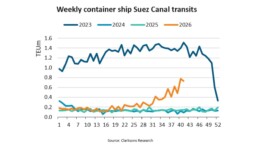
Suez Canal container ship transits exceed 50% of pre-disruption levels "During the first two weeks of October, weekly container ship capacity…
Subscribe to our newsletter!
if you dont want to swim alone in the ocean of news, sign up for the newsletter, and you will receive daily all the important news of world shipping!
