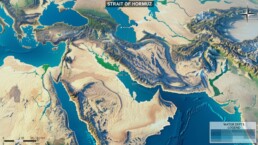
Iran has been widely condemned for demanding up to $2 million for vessels to ship through the Strait of Hormuz. DW explores the reasons why Egypt can charge for the Suez Canal and Panama for its waterway, but Iran can’t.
The Iranian regime has been accused of extortion and threats to global energy security after reports emerged that Tehran has begun charging up to $2 million (€1.7 million) per vessel for “safe passage” through the Strait of Hormuz.
The strait is the world’s most indispensable energy corridor, squeezed between Iran and Oman. Before the Iran war, it carried one-fifth of all the oil and gas consumed worldwide.
Iran’s government has justified the fees as war reparations for damage suffered caused during US-Israeli attacks on the country, as well as payment for “navigational services,” environmental protection and enhanced security.
The government announced that it was drafting a joint protocol with Oman to require ships to obtain permits before transiting the strait.
While some Asian shipping firms and smaller operators have quietly coughed up, major global players are refusing to pay, while the Institute for the Study of War (ISW) think tank labeled the tolls a maritime “protection racket.”
The United States and China agreed on their joint opposition to the levy, Reuters news agency reported earlier this month, citing a US State Department official. Gulf countries have also rejected the move.
Maritime experts insist there are good reasons why Iran cannot charge fees in Hormuz when other vital chokepoints — like the Suez Canal and Panama Canal — levy similar tolls for passage through their waterways.
What are the rules for straits?
Under international maritime law, natural straits used by shipping are governed by a special set of rules designed to protect global trade and freedom of navigation.
The United Nations Convention on the Law of the Sea (UNCLOS) gives vessels — and aircraft — from all nations the right of so-called transit passage through international straits that connect two parts of the high seas.
To qualify for transit passage, a vessel must move through the strait without delay and without anchoring except in emergencies.
Those transits must be allowed to happen without interference from the coastal state, the UNCLOS rules state.
Coastal states can charge only limited service charges, including pilotage and towing.
Why can canal operators charge fees?
Canals like Suez and Panama are man-made waterways built, owned and maintained by sovereign states at enormous cost.
Egypt generates annual revenues of around $4 billion in fees for ships transiting the 193-kilometer (120-mile) Suez shortcut.
The 1888 Constantinople Convention, signed by major powers at the time, explicitly allows the Egyptian government to levy tolls to cover maintenance, operations and upgrades.
Meanwhile, the Panama Canal Authority, which runs the US-built canal on behalf of Panama, is also permitted to charge fees under separate treaties.
Completed in 1914 to link the Pacific and Atlantic Oceans, the Panama Canal requires huge ongoing maintenance, including constant dredging to combat sedimentation and landslides.
Both canal operators typically charge less than half the fees that Iran is reportedly charging.
Are there any exceptions?
Grey areas do exist where fees can be charged for passage along straits and even oceans.
Russia, for example, charges icebreaker escort fees, pilotage and service tariffs on the Northern Sea Route (NRS) along the country’s northern coast.
The NSR offers a much shorter route between Europe and Asia than the Suez Canal. It runs through the Arctic Ocean, linking the Atlantic to the Pacific via the Barents Sea and Bering Strait.
The route is mainly used in summer when the ice melts and is frequently transited by ships from Russia, China and South Korea.
Moscow treats large sections as internal waters or ice-covered areas under UNCLOS Article 234.
Canada has similar sovereignty claims over the Northwest Passage, a sea route through the Canadian Arctic Archipelago linking the Atlantic and Pacific Oceans. From time to time, the Ottawa government mulls charging fees, only to face US opposition.
Another long-standing example is the Turkish Straits. The Bosporus and Dardanelles, which connect the Black Sea to the Mediterranean through Turkey, are governed by the 1936 Montreux Convention.
Under this treaty, Turkey must allow freedom of passage for merchant ships and can only charge limited service fees for navigation aids and lighthouses, not full transit tolls.
How is this dispute likely to play out?
The Hormuz charging row remains a major obstacle in the ongoing peace talks between the US and Iran aimed at reopening Hormuz.
Washington insists the strait must fully reopen as international waters, allowing ships from all nations to pass without Iranian control, fees, or special permission.
“The Strait is going to be open to everybody; it’s international waters,” US President Donald Trump told reporters during a White House cabinet meeting on Wednesday. “We’ll watch over it, but nobody’s going to control it.”
He also took aim at Oman’s apparent involvement in Tehran’s plans, saying: “Oman will behave just like everybody else, or we’ll have to blow them up.”
Washington continues to urge shipping companies not to pay the tolls and has warned that firms that do could face secondary US sanctions for doing business with Iran.
While the broader US naval blockade of Iranian shipping remains in effect during negotiations, the US and the United Nations are working on a plan to protect shipping once the war is over.
This includes the use of multinational naval patrols, increased monitoring and demining operations in the strait to protect shipping.
Source: Deutsche Welle



Related News.
Hong Kong Global Maritime Trade Summit to return for third edition
The International Chamber of Shipping, in collaboration with the Transport and Logistics Bureau of the Government of Hong Kong and the Hong Kong…

Appetite for US crude oil exports climbs despite high freight
South Korea tops US crude destinations at 568,600 b/d VLCC rates to Asia double, closing arbitrage window European refining margins…
Shipping stocks Rally as Hormuz Traffic plunges 75%
Ship traffic through the Strait of Hormuz — a critical chokepoint handling about 20% of global crude oil and liquefied natural gas shipments — has…
Diana Shipping announces Time Charter Contract for m/v G P Zafirakis with Classic Maritime
Diana Shipping, a global shipping company specializing in the ownership and bareboat charter-in of dry bulk vessels, announced that, through a…
New IMO ESP Code framework for Remote Inspection Techniques
The International Maritime Organisation, through Resolution MSC.584(111) , has adopted amendments to the International Code on the Enhanced…

ABS opens Offshore & Marine Support Center in Bergen
ABS has expanded its capabilities in the Norwegian maritime market with the opening of a cutting-edge support center in Bergen, bringing advanced…

MOL holds giant step memorial ceremony and beach cleanup at Kashima Coast
Memorial and Reflection 20 Years After the Accident: Learning from the Past to Foster an Even Stronger Safety Culture Mitsui O.S.K. Lines, announced…
KEZAD-based Arabian Gulf Steel Industries achieves lowest verified Carbon Footprint for Rebar
CARES UK verified Environmental Product Declaration confirms 139 kg CO₂e per tonne for rebar produced at AGSI’s KEZAD Abu Dhabi facility Arabian…
Indian Register of Shipping announces launch of first fleet support ship INS Surya
Indian Register of Shipping continues to strengthen its role in supporting the Indian Navy and India’s naval shipbuilding capabilities through the…

VLCCs Climbing the Record Charts
LR2 The TC1 75kt MEG/Japan index decreased by only a single point this week to WS928. The corresponding Baltic round-trip TCE fell by $2,000 to…
Subscribe to our newsletter!
if you dont want to swim alone in the ocean of news, sign up for the newsletter, and you will receive daily all the important news of world shipping!
