Disconnect between Chinese iron ore imports and steel production widens

Chinese iron ore imports continue to grow even as domestic steel output weakens, driving port inventories toward record highs. Until Simandou’s accelerating ramp-up is offset by cuts elsewhere in the supply chain, the inventory overhang is set to deepen, complicating the demand outlook for traditional exporters.
KEY TAKEAWAYS
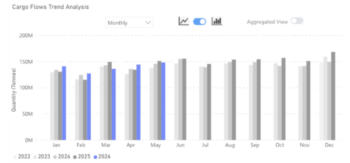
● Global iron ore flows in May 2026 were down 2% y/y.
● Flows to China increased by 3% y/y.
● Flows destined to ports outside of China fell by 15% y/y.
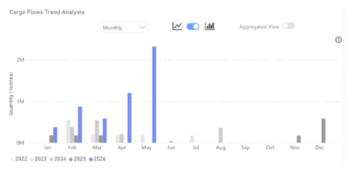
● Iron ore flows from Guinea reached 2.1mt in May as Simandou continued to ramp up.
Global iron ore flows reached 145mt in May 2026, down 2% on the same month last year. Flows to China continued to increase, by 3% this month, but growth was the lowest it has been since March, as the steel industry in China faces mounting headwinds.
Outside of China, demand for iron ore remains subdued as steel production is still under pressure. As a result, iron ore flows destined for ports outside of China fell by 15% y/y in May 2026.
Guinea to China to boost cape rates even if total volumes
Iron ore flows from Guinea reached over 2 million tons in May, a record and almost double the previous record from the previous month. Despite this, Guinea still only accounted for 2% of all global iron ore flows in May 2026. Australia and Brazil continued to dominate, exporting 86mt and 33mt respectively.
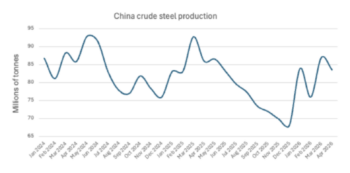
The NBS reports Chinese crude steel production tracking 4% below prior-year levels year-to-date, yet iron ore imports have moved in the opposite direction, up 3% over the same period. The result is a port inventory build that has taken Chinese stockpiles to 160mt as of the week ending May 22nd, within touching distance of the 165mt record set in March 2026 and some 22% above the July 2025 trough. The disconnect between import strength and steel output is the defining feature of this market, and it is now correcting: import growth is decelerating as portside rebalancing mechanics take hold.
The near-term demand trajectory for Australian exporters is unfavourable on two counts. Aggregate Chinese import demand is expected to ease from current levels as the inventory overhang is absorbed, reducing overall seaborne volumes. Simultaneously, the structural shift toward higher-grade feedstock, accelerated by Simandou’s commercial ramp-up, reduces the relative attractiveness of Australian mid-grade fines at a time when Chinese mills are under margin pressure and incentivised to optimise blend economics.
For the capesize market, however, the Simandou narrative is a meaningful structural offset. Guinea-to-China adds approximately 25% in tonne-miles relative to an equivalent Australian voyage; at Simandou’s projected plateau of 10mt per month, the incremental tonne-mile generation is substantial. Critically, this freight uplift occurs regardless of whether overall Chinese import volumes grow — it is a trade-route effect, not a volume effect. Even a gradual displacement of Australian tonnes, well ahead of full ramp, should provide durable underlying support for capesize rates through the balance of the year.
Source:Signal Ocean



Related News.

Navigating the Multi-Orbit Era: In Conversation with Intellian’s Jon Harrison at SMM 2026
At SMM 2026 in Hamburg, the rapid evolution of maritime satellite communications took centre stage. Across the exhibition halls, discussions among…

Cyprus ports need joint energy and investment strategy, shipping agents chief says
Cyprus needs a coordinated strategy for shipping, energy and environmental protection to support port investment and modernisation, Cyprus shipping…

MASO Public Affairs introduces MASO Regulatory Intelligence
A new subscription service helping businesses understand what is changing and what it means for them MASO Public Affairs introduces MASO Regulatory…

Anglo-Eastern helps turn CMBTECH’s ammonia ambition into an operational reality
From early feasibility study and risk-based design to newbuilding supervision, crew readiness and technical management, Anglo-Eastern drew on its…

Escalation of attacks threatens to derail recovery in Middle East oil exports
World oil demand is forecast to fall by 2.5 mb/d y-o-y in 4Q26 and 2.6 mb/d on average in 2026. As the Iran war manifests itself through restricted…

New study finds shipping pays twice its share to EU ETS earmarked revenues should triple to help build market for sustainable fuels and technologies
Shipping is responsible for around 10% of EU ETS emissions but pays almost 20% of the ETS bill. Unlike other sectors, it has never received free…

MSARC strengthens maritime mass rescue readiness through training and national live exercise off Dakar, Senegal
Joint MSARC–FHAS programme combines three days of SAR training with a national multi-agency live exercise The Maritime Search and Rescue Council ,…

Sogese report deliveries are still being delayed as container freight rates fluctuate
FOR IMPORTERS Spot rates into the Mediterranean are back at January levels, Far East to Europe reliability sits at pandemic lows, and nearly…

Glencore begins trading on Australian Securities Exchange
Glencore has begun trading on the Australian Securities Exchange under the ASX code GLC. Gary Nagle, Glencore’s CEO, said it was an exciting day for…

BIMCO Shipping Number of the Week
Suez Canal container ship transits exceed 50% of pre-disruption levels "During the first two weeks of October, weekly container ship capacity…
Subscribe to our newsletter!
if you dont want to swim alone in the ocean of news, sign up for the newsletter, and you will receive daily all the important news of world shipping!
