The IMO’s Net Zero Framework: Why supporters must stay strong


The IMO’s Net-Zero Framework is back on track. A majority of International Maritime Organization member states continue to support the framework – which aims to reduce greenhouse gas (GHG) emissions from ships in line with its 2023 greenhouse gas reduction strategy – and they deserve our respect and gratitude. These countries have withstood massive pressure – aimed at killing or weakening the Net-Zero Framework (NZF) – from the US, Saudi Arabia, UAE, other petro-states, and from the world’s two largest “flags of convenience” Panama and Liberia.
The NZF’s supporters have been further vindicated by this week’s landslide vote by the UN General Assembly to adopt the International Court of Justice’s climate crisis ruling. Now it is clear that “tackling the climate crisis is a legal duty under international law, and not just a political choice” .
While pressure on the NZF now seems to have eased somewhat, supportive governments – many of whom called for the NZF’s urgent adoption – will need to remain vigilant and strong in order to parry inevitable future attacks and attempts to further delay adoption, which is currently scheduled for early December.
The same applies to that majority of shipping industry stakeholders – such as port and shipping authorities and industry bodies that have supported the NZF and the 2023 IMO GHG Strategy that preceded it. They have a lot to lose through an unplanned, chaotic, and uncertain energy transition. Such a scenario will be disruptive, more costly and bad for business. Now is not the time for them to sit on the sidelines.
So why is the NZF – as it stands – so important? The framework includes a global fuel standard (GFS), requiring ships to gradually reduce how polluting their fuel is (i.e., how much greenhouse gas is emitted for each unit of energy used, across a fuel’s life cycle). The framework also introduces a mechanism that puts a price on the greenhouse gases ships emit, giving the shipping industry a clear financial reason to reduce emissions in line with the global fuel standard.
The NZF will apply to all oceangoing ships over 5,000 gross tonnage (GT) – responsible for over 85% of global shipping emissions. This is crucial – the global shipping industry emits around 3% of global emissions, equivalent to a major industrialised country like Japan – and reductions are essential if dangerous global heating is to be avoided.
While the NZF is not perfect – the Clean Shipping Coalition, along with many progressive states, wishes it had gone further and been more ambitious – it contains an important foundation that can be built upon in the future.
The IMO’s 2023 GHG Strategy set out a roadmap for reducing greenhouse gas emissions from global shipping, with targets to reduce emissions by 30% by 2030, 80% by 2040 (both in comparison to 2008 levels) and to achieve net-zero emissions by 2050. This will only be possible if the NZF is adopted “as is”, and paired with a revised and strengthened Carbon Intensity Indicator – a key IMO tool for measuring and driving improvements in the energy efficiency and thus climate emissions of ships.
The NZF is set to be discussed at two IMO intercessional meetings, one in September and another immediately prior to December’s MEPC 85, which will itself immediately precede a resumed Extraordinary Session 2, during which the NZF is scheduled for adoption.
These intercessional meetings are only taking place before the planned adoption so that concerns about the NZF can be properly discussed. They are not a green light for alternative “technical measure only” proposals that are incapable of delivering the shipping climate obligations enshrined in the 2023 GHG Strategy.
Neither the Panama/Liberia/Argentina proposal nor the one from Japan are fit for that purpose, nor evidence sufficient support for approval – embarrassingly for Japan only 7 countries expressed support for progressing its proposal. The lack of a GHG pricing component in these two proposals means that the only option for enforcement is to arrest ships that are found to be non-compliant. Not only does this fail to raise the money that is essential to ensure a just and equitable transition and provide the necessary subsidising of higher-priced zero-emission fuels, it creates high-stakes risks for the industry which would have to make judgments on how best to manage their exposure to this ultimate sanction. And this can only result in high volatility and uncertainty in how decarbonisation and transport costs will evolve.
If the NZF was to be reopened at the request of those that want it weakened, those that want it strengthened would have every right to have their proposals considered as well. However, there really is no need for reopening this process – the NZF is as it is because it already represents a carefully negotiated balance of interests.
Every alternative has already been considered and failed to gain enough support. If conducted in good faith a lengthy re-litigation process would in all likelihood end up in the same place, with valuable time lost.
Supporters of the NZF, IMO member states in particular, but also industry stakeholders, must be clear: the NZF “as is” is the only option on the table with the potential of delivering the commitments made in 2023, and any alternative policy framework that stalls the maritime energy transition – or reverses it – is unacceptable. The stakes are too high.
In a world that is getting hotter, the Net-Zero Framework will bring certainty to the shipping sector, and give shape to an energy transition that leaves no country behind. Governments that have supported the Net-Zero Framework must now double their efforts to protect it as it moves towards IMO adoption.
John Maggs is the Clean Shipping Coalition’s Representative to the International Maritime Organization.



Related News.

Navigating the Multi-Orbit Era: In Conversation with Intellian’s Jon Harrison at SMM 2026
At SMM 2026 in Hamburg, the rapid evolution of maritime satellite communications took centre stage. Across the exhibition halls, discussions among…
Cyprus ports need joint energy and investment strategy, shipping agents chief says
Cyprus needs a coordinated strategy for shipping, energy and environmental protection to support port investment and modernisation, Cyprus shipping…

MASO Public Affairs introduces MASO Regulatory Intelligence
A new subscription service helping businesses understand what is changing and what it means for them MASO Public Affairs introduces MASO Regulatory…
Anglo-Eastern helps turn CMBTECH’s ammonia ambition into an operational reality
From early feasibility study and risk-based design to newbuilding supervision, crew readiness and technical management, Anglo-Eastern drew on its…

Escalation of attacks threatens to derail recovery in Middle East oil exports
World oil demand is forecast to fall by 2.5 mb/d y-o-y in 4Q26 and 2.6 mb/d on average in 2026. As the Iran war manifests itself through restricted…
New study finds shipping pays twice its share to EU ETS earmarked revenues should triple to help build market for sustainable fuels and technologies
Shipping is responsible for around 10% of EU ETS emissions but pays almost 20% of the ETS bill. Unlike other sectors, it has never received free…

MSARC strengthens maritime mass rescue readiness through training and national live exercise off Dakar, Senegal
Joint MSARC–FHAS programme combines three days of SAR training with a national multi-agency live exercise The Maritime Search and Rescue Council ,…
Sogese report deliveries are still being delayed as container freight rates fluctuate
FOR IMPORTERS Spot rates into the Mediterranean are back at January levels, Far East to Europe reliability sits at pandemic lows, and nearly…

Glencore begins trading on Australian Securities Exchange
Glencore has begun trading on the Australian Securities Exchange under the ASX code GLC. Gary Nagle, Glencore’s CEO, said it was an exciting day for…
BIMCO Shipping Number of the Week
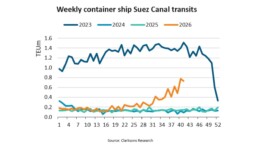
Suez Canal container ship transits exceed 50% of pre-disruption levels "During the first two weeks of October, weekly container ship capacity…
Subscribe to our newsletter!
if you dont want to swim alone in the ocean of news, sign up for the newsletter, and you will receive daily all the important news of world shipping!
