LPG highlighted as a practical pathway to accelerate decarbonisation in LR’s latest Fuel for thought report
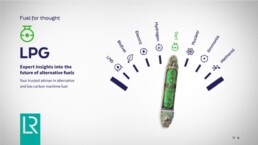

The updated edition of LR’s Fuel for Thought LPG report positions LPG as an immediately deployable, scalable and technically proven fuel pathway capable of delivering meaningful emissions reductions across the maritime sector.
Lloyd’s Register has published an updated edition of its Fuel for Thought: LPG report, produced jointly with the World Liquid Gas Association (WLGA), setting out how LPG can support the maritime sector’s transition to lower carbon propulsion with immediate, scalable impact.
With more than 1,600 LPG carriers already in operation and a mature global supply chain supported by over 1,000 storage facilities and terminals, LPG combines mature technology, global availability and established infrastructure with a practical and credible pathway to lower-emission shipping.
Fuel for thought: LPG shows how LPG can deliver meaningful environmental benefits compared with conventional marine fuels. Fossil LPG emits around 97% less sulphur oxides, 90% less particulate matter and approximately 20% less carbon dioxide than heavy fuel oil, while lifecycle greenhouse gas emissions can be reduced by up to 17% compared with marine gas oil.
The fuel’s lower carbon-to-hydrogen ratio also positions it as a viable route to improving compliance with measures such as EEXI, CII and regional regulation including EU ETS and FuelEU Maritime.
The updated report underscores that LPG is already proven in service. Dual-fuel LPG propulsion is well established in the gas carrier segment, with a growing LPG-fuelled fleet and strong orderbook. Furthermore, gas carriers currently account for only a small share of global shipping emissions, leaving significant potential for cross-segment adoption across container ships, bulk carriers and other vessel types.
Beyond its environmental performance, LPG presents a compelling commercial proposition for shipowners seeking cost-effective decarbonisation solutions. Lower capital expenditure compared to other alternative fuel solutions, combined with competitive fuel pricing in key regions, strengthens its appeal as a transitional fuel. Retrofit pathways are also more accessible, with a significant number of existing cross-segment ship types technically capable of conversion to LPG propulsion.
The report also highlights strong market fundamentals supporting wider uptake. Global seaborne LPG trade reached a record 145 million tonnes in 2025 and is expected to continue growing, supported by rising demand in major import markets and increasing fleet capacity. At the same time, around 500 global LPG terminals could potentially become LPG bunkering points for non-gas carriers as well with minimal new investment, helping to address one of the key barriers facing alternative fuel adoption.
Looking ahead, the report emphasises that LPG’s long-term role will be shaped by the growth of renewable production. Renewable LPG (rLPG) and bio-LPG are chemically identical to conventional LPG and can be used as drop-in fuels without modifications, offering up to 80% emissions reduction depending on feedstock. Industry projections suggest rLPG could meet up to 50% of global demand by 2050, creating a credible long-term pathway towards near-zero-emission shipping operations.
The report also highlights the potential to pair LPG with onboard carbon capture systems to further reduce emissions and extend vessel lifespans. Combining LPG propulsion with carbon capture could deliver significant cost benefits, including reduced carbon pricing exposure and lower onboard storage requirements due to already lower CO2 emissions.
However, barriers remain. The regulatory framework for LPG bunkering is still developing and engine options, particularly beyond two-stroke applications, are not yet fully mature. The report suggests that wider adoption will depend on how quickly these technical and regulatory gaps are addressed.

Constantinos Chaelis, Global Gas Segment Director, Lloyd’s Register, said: “Our latest Fuel for Thought: LPG report reinforces what our industry has long needed—an immediately deployable, commercially viable and technically proven cross-segment pathway to accelerate decarbonisation.
“With mature infrastructure, a growing dual‑fuel fleet and clear emissions advantages over conventional marine fuels, LPG offers shipowners a practical route to compliance and meaningful carbon reduction today. As renewable LPG scales and retrofit options expand, in consideration with onboard carbon capture, LPG stands out as a credible long‑term solution capable of supporting the sector’s transition toward lower, and ultimately near‑zero‑emission operations.”

Nikos Xydas, World Liquid Gas Association (WLGA) Technical Director, said: “LPG has become one of the most widely adopted alternative marine fuels globally in the gas carriers segment.
“Whether for the world’s largest ships or for the smallest outboard motors, LPG offers a low-carbon, low-emissions and cost-effective fuel today, and a credible long-term pathway in the future with drop-in renewable LPG and renewable dimethyl ether into existing fuel systems, for a future-ready solution.



Related News.

Navigating the Multi-Orbit Era: In Conversation with Intellian’s Jon Harrison at SMM 2026
At SMM 2026 in Hamburg, the rapid evolution of maritime satellite communications took centre stage. Across the exhibition halls, discussions among…
Cyprus ports need joint energy and investment strategy, shipping agents chief says
Cyprus needs a coordinated strategy for shipping, energy and environmental protection to support port investment and modernisation, Cyprus shipping…

MASO Public Affairs introduces MASO Regulatory Intelligence
A new subscription service helping businesses understand what is changing and what it means for them MASO Public Affairs introduces MASO Regulatory…
Anglo-Eastern helps turn CMBTECH’s ammonia ambition into an operational reality
From early feasibility study and risk-based design to newbuilding supervision, crew readiness and technical management, Anglo-Eastern drew on its…

Escalation of attacks threatens to derail recovery in Middle East oil exports
World oil demand is forecast to fall by 2.5 mb/d y-o-y in 4Q26 and 2.6 mb/d on average in 2026. As the Iran war manifests itself through restricted…

New study finds shipping pays twice its share to EU ETS earmarked revenues should triple to help build market for sustainable fuels and technologies
Shipping is responsible for around 10% of EU ETS emissions but pays almost 20% of the ETS bill. Unlike other sectors, it has never received free…

MSARC strengthens maritime mass rescue readiness through training and national live exercise off Dakar, Senegal
Joint MSARC–FHAS programme combines three days of SAR training with a national multi-agency live exercise The Maritime Search and Rescue Council ,…
Sogese report deliveries are still being delayed as container freight rates fluctuate
FOR IMPORTERS Spot rates into the Mediterranean are back at January levels, Far East to Europe reliability sits at pandemic lows, and nearly…

Glencore begins trading on Australian Securities Exchange
Glencore has begun trading on the Australian Securities Exchange under the ASX code GLC. Gary Nagle, Glencore’s CEO, said it was an exciting day for…
BIMCO Shipping Number of the Week
Suez Canal container ship transits exceed 50% of pre-disruption levels "During the first two weeks of October, weekly container ship capacity…
Subscribe to our newsletter!
if you dont want to swim alone in the ocean of news, sign up for the newsletter, and you will receive daily all the important news of world shipping!
