Spire Global expands energy trading intelligence with Intraday-to-45-day weather forecasts and trader-grade decision platform


New capabilities deliver validated outperformance of European Centre for Medium-Range Weather Forecasts (ECMWF) sub-seasonal-range (S2S) forecasts by 14.2% at 3–6 weeks, enabling energy trading desks to price risk and identify market-moving weather events ahead of public models*
Spire Global, a global provider of satellite data, analytics and intelligence, announced an expanded energy trading intelligence offering comprising a full forecast stack — from intraday wind ramps to 45-day sub-seasonal regime shifts — delivered through Cirrus, Spire’s trader-grade decision platform.
This expansion comes as energy trading desks face increasing exposure to weather-driven volatility amid growing renewable penetration and tightening forward market conditions. As renewable generation expands across North American and European power markets, weather volatility has become an increasingly primary driver of market risk. Missed wind ramps, late-flagged cold outbreaks, and undetected weather regime changes each carry direct P&L consequences. Most trading desks rely on the same public models, limiting differentiation and eroding edge. Traditional models lose accuracy at the 3–6-week range, precisely when forward positions, gas-demand pricing, and hedging decisions are made.
Spire’s expanded forecast stack addresses the full trading horizon, giving energy trading desks a proprietary edge built on satellite-derived data that provides an independent signal alongside public forecast models:
- High-Resolution Forecast (0–7 days): Twice-daily 3 km forecasts across the U.S., Europe, and Southeast Asia, resolving intraday wind ramps and localized weather variability.
- Optimized Point Forecasts (0-15 days): Asset-level, hourly-refreshed weather forecasts with 15-minute granularity across 10,500+ sites globally, calibrated to local site conditions.
- Power Generation Forecasts (0–15 days): Translates space-based weather data and AI-driven model output into hour-by-hour wind and solar generation curves in a format energy traders use to make real-time decisions. Each curve overlays Spire’s High-Resolution Forecast against benchmark models and full ensemble spread, so traders can quickly identify where Spire diverges from consensus, gauge forecast uncertainty, and time their positions accordingly. Coverage spans key European markets and all major US energy markets.
- Spire AI-S2S (1–45 days): Spire’s proprietary sub-seasonal model, a 200-member generative AI ensemble, is trained on satellite-derived GNSS radio occultation data and historical atmospheric datasets, operating independently of public sub-seasonal forecast systems. It delivers daily probabilistic forecasts with quantified uncertainty, anomalies relative to climatology, and weather-regime analysis tuned for North American and European energy markets. Validated against ECMWF’s ReAnalysis 5th Generation (ERA5), a global climate and weather dataset, AI-S2S outperformed ECMWF’s sub-seasonal-range forecast ensemble by 14.2% on surface temperatures at 3–6 weeks, a key variable for forecasting energy demand and pricing risk. Spire’s AI-S2S also delivered more accurate 500 mb height forecasts, a critical upper-atmospheric field widely used by energy traders to anticipate future weather regimes, pattern shifts, and market-moving risk. These advancements provide an independent signal alongside traditional public forecasts, enabling earlier detection of large-scale weather shifts at the hardest range to forecast accurately.
“Weather is now the single biggest unpriced variable in energy markets — and the traders who forecast it better win,” said Shawn Mechelke, General Manager, Weather, Climate and Aviation at Spire. “Spire AI-S2S gives desks a validated, independent signal at the extended range, when public models lose reliability and the value of being right is highest. Paired with Cirrus and our full intraday-to-sub-seasonal stack, Spire is giving trading desks what they’ve never had: the infrastructure to systematically monetize weather volatility.”
“Energy markets need better weather forecasts across every decision horizon, from intraday ramps to sub-seasonal regime shifts,” said Tom Gowan, Ph.D., Director of Weather Prediction and AI at Spire. “At short ranges, our high-resolution models capture the fine-scale weather details, localized wind ramps and power-market impacts traders need to act on. At the extended range, Spire AI-S2S represents a major technical breakthrough: delivering improved forecast skill over the world’s leading public models in the weeks 3–6 timeframe, where forecast skill is hardest to achieve, through proprietary AI techniques and well-calibrated probabilistic outputs that provide a truly independent signal. We believe this is only the beginning of what AI, proprietary satellite data, and Spire’s deep weather expertise can bring to energy markets.”
Cirrus consolidates the full forecast stack alongside public benchmark models in a single interface — a trader-grade decision environment designed to surface anomalies, compare model runs, and pressure-test positions before markets move. For desks operating within existing infrastructure, all products are also available via API with no platform rebuild required.
Source:BusinessWire



Related News.

Navigating the Multi-Orbit Era: In Conversation with Intellian’s Jon Harrison at SMM 2026
At SMM 2026 in Hamburg, the rapid evolution of maritime satellite communications took centre stage. Across the exhibition halls, discussions among…
Cyprus ports need joint energy and investment strategy, shipping agents chief says
Cyprus needs a coordinated strategy for shipping, energy and environmental protection to support port investment and modernisation, Cyprus shipping…

MASO Public Affairs introduces MASO Regulatory Intelligence
A new subscription service helping businesses understand what is changing and what it means for them MASO Public Affairs introduces MASO Regulatory…

Anglo-Eastern helps turn CMBTECH’s ammonia ambition into an operational reality
From early feasibility study and risk-based design to newbuilding supervision, crew readiness and technical management, Anglo-Eastern drew on its…

Escalation of attacks threatens to derail recovery in Middle East oil exports
World oil demand is forecast to fall by 2.5 mb/d y-o-y in 4Q26 and 2.6 mb/d on average in 2026. As the Iran war manifests itself through restricted…

New study finds shipping pays twice its share to EU ETS earmarked revenues should triple to help build market for sustainable fuels and technologies
Shipping is responsible for around 10% of EU ETS emissions but pays almost 20% of the ETS bill. Unlike other sectors, it has never received free…

MSARC strengthens maritime mass rescue readiness through training and national live exercise off Dakar, Senegal
Joint MSARC–FHAS programme combines three days of SAR training with a national multi-agency live exercise The Maritime Search and Rescue Council ,…
Sogese report deliveries are still being delayed as container freight rates fluctuate
FOR IMPORTERS Spot rates into the Mediterranean are back at January levels, Far East to Europe reliability sits at pandemic lows, and nearly…

Glencore begins trading on Australian Securities Exchange
Glencore has begun trading on the Australian Securities Exchange under the ASX code GLC. Gary Nagle, Glencore’s CEO, said it was an exciting day for…
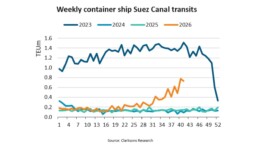
BIMCO Shipping Number of the Week
Suez Canal container ship transits exceed 50% of pre-disruption levels "During the first two weeks of October, weekly container ship capacity…
Subscribe to our newsletter!
if you dont want to swim alone in the ocean of news, sign up for the newsletter, and you will receive daily all the important news of world shipping!
