South Korean shipbuilders lead LNG carrier orders
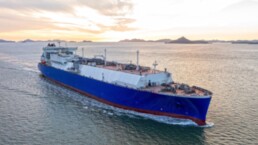

The domestic shipbuilding industry is continuing its rally of liquefied natural gas carrier orders, raising expectations for a long-term boom. Analysts indicate that shipowners are placing preemptive orders as the expansion of LNG production in the United States and the demand for replacing aging vessels coincide. In particular, domestic shipbuilders are taking the market lead by leveraging their highly advanced technological competitiveness required for LNG carriers.
According to the shipbuilding industry on May 19, the three major domestic shipbuilders (HD Korea Shipbuilding & Offshore Engineering, Hanwha Ocean, and Samsung Heavy Industries) have won orders for a total of 33 LNG carriers so far this year. First, HD Korea Shipbuilding & Offshore Engineering, the intermediate shipbuilding holding company of HD Hyundai, has secured orders for a total of 16 LNG carriers this year, more than doubling its annual volume of 7 vessels from last year.
Samsung Heavy Industries signed a supply contract for 3 LNG carriers worth 1.1242 trillion won ($864.77 million) with an Oceania region shipowner on May 18, increasing its cumulative LNG carrier orders to a total of 12 vessels this year. Unsurprisingly, it surpassed last year’s annual LNG carrier order performance of 11 vessels even before the first half of the year passed. Hanwha Ocean also recently won an order for 1 LNG carrier worth 363.2 billion won ($279.38 million) from a European shipowner, securing a total of 5 LNG carriers so far this year. Global LNG carrier orders are also increasing rapidly this year. A total of 37 LNG carriers were ordered last year, but a total of 37 vessels have already been ordered from January to April alone this year, quickly catching up to last year’s annual scale.
The industry views that shipowners delayed orders last year due to tariff wars and geopolitical uncertainties, but began placing new orders again at the end of last year. In fact, LNG carrier orders from January to November last year were limited to 19 vessels, but 18 vessels were ordered during the single month of December alone. Furthermore, analysis suggests that shipowners are paying more attention to the possibility of LNG cargo volume expansion, which will begin in earnest after 2027, rather than short-term market conditions. According to Clarkson Research, the order volume for LNG carriers of 100,000 cubic meters or larger is projected to be at the level of 125 vessels this year and 85 vessels next year. This is explained by the simultaneous expansion of increasing maritime LNG cargo volumes and the demand to replace aging vessels due to strengthened environmental regulations.
Clarkson Research forecast that global LNG cargo volumes will increase from 360 million tons as of 2020 to 670 million tons in 2030. In addition, it estimated that the number of aging LNG carriers with a vessel age of 20 years or more will reach a scale of approximately 247 vessels by 2030.
In particular, the fact that large-scale LNG projects are scheduled, centered around the United States and Qatar, is raising expectations for an expansion in medium to long-term LNG carrier demand. Multiple LNG terminal development projects are scheduled after 2028, primarily in the United States, and South Korean shipbuilders possessing high value-added LNG carrier technology are expected to benefit in this process. LNG carriers are considered a high value-added and highly difficult vessel type that must stably transport LNG at minus 163 degrees Celsius. Specifically, dual-fuel (DF) propulsion technology that recycles boil-off gas (BOG) as fuel and ultra-low temperature cargo hold design and construction capabilities are evaluated as core competitive advantages.
The fact that newbuilding prices for LNG carriers are maintaining a high level is also favorable news for the domestic shipbuilding industry. According to Clarkson Research, recent newbuilding prices for LNG carriers are forming at around $250 million per vessel. As profitability is higher compared to general commercial vessels due to the nature of high value-added vessel types, expectations for strong performance by domestic shipbuilders are growing this year, following last year. Although Chinese shipyards have also recently been expanding their targeting of the LNG carrier market, the industry evaluates that domestic shipbuilders still maintain strengths in terms of technological prowess and delivery stability. In fact, domestic shipbuilders have already secured a significant portion of the volume for large LNG projects, such as the Qatar North Field expansion p
Source:Business Korea



Related News.

Navigating the Multi-Orbit Era: In Conversation with Intellian’s Jon Harrison at SMM 2026
At SMM 2026 in Hamburg, the rapid evolution of maritime satellite communications took centre stage. Across the exhibition halls, discussions among…

Cyprus ports need joint energy and investment strategy, shipping agents chief says
Cyprus needs a coordinated strategy for shipping, energy and environmental protection to support port investment and modernisation, Cyprus shipping…

MASO Public Affairs introduces MASO Regulatory Intelligence
A new subscription service helping businesses understand what is changing and what it means for them MASO Public Affairs introduces MASO Regulatory…

Anglo-Eastern helps turn CMBTECH’s ammonia ambition into an operational reality
From early feasibility study and risk-based design to newbuilding supervision, crew readiness and technical management, Anglo-Eastern drew on its…

Escalation of attacks threatens to derail recovery in Middle East oil exports
World oil demand is forecast to fall by 2.5 mb/d y-o-y in 4Q26 and 2.6 mb/d on average in 2026. As the Iran war manifests itself through restricted…

New study finds shipping pays twice its share to EU ETS earmarked revenues should triple to help build market for sustainable fuels and technologies
Shipping is responsible for around 10% of EU ETS emissions but pays almost 20% of the ETS bill. Unlike other sectors, it has never received free…

MSARC strengthens maritime mass rescue readiness through training and national live exercise off Dakar, Senegal
Joint MSARC–FHAS programme combines three days of SAR training with a national multi-agency live exercise The Maritime Search and Rescue Council ,…

Sogese report deliveries are still being delayed as container freight rates fluctuate
FOR IMPORTERS Spot rates into the Mediterranean are back at January levels, Far East to Europe reliability sits at pandemic lows, and nearly…

Glencore begins trading on Australian Securities Exchange
Glencore has begun trading on the Australian Securities Exchange under the ASX code GLC. Gary Nagle, Glencore’s CEO, said it was an exciting day for…

BIMCO Shipping Number of the Week
Suez Canal container ship transits exceed 50% of pre-disruption levels "During the first two weeks of October, weekly container ship capacity…
Subscribe to our newsletter!
if you dont want to swim alone in the ocean of news, sign up for the newsletter, and you will receive daily all the important news of world shipping!
