Oil and LNG turbulence to spur nuclear revival, new uranium squeeze


Despite historical phaseout efforts, nuclear’s role in energy security is strengthening, particularly as gas and oil markets once again demonstrate vulnerability to geopolitics and geographical bottlenecks.
Oil and LNG markets have been shaken in early 2026, and this volatility is strengthening the case for nuclear as an energy-security hedge. The current war in the Middle East has transitioned from a flow disruption into a broader supply crisis, with global demand growth expectations for 2026 sharply downgraded amid availability constraints and economic uncertainty.
The global build-out and restart of nuclear power has been gathering momentum quietly for several years, driven by a mix of climate and energy security priorities. Countries such as China have steadily expanded nuclear capacity to reduce greenhouse gas emissions and support industrial growth, while many others accelerated plans following the disruption caused by the Russia-Ukraine war, which exposed vulnerabilities in fossil fuel supply chains and reinforced the need for reliable, domestically controlled baseline energy sources. More recently, escalating tensions in the Middle East have added another layer of urgency, incentivizing governments to move faster on nuclear deployment as a hedge against geopolitical instability and potential energy price shocks, accelerating what had been a gradual, under-the-radar resurgence into a more pronounced phase of growth.
In the US and Canada, the emphasis has been on the development of small modular reactors (SMRs), particularly to serve dedicated, behind-the-meter demand such as industrial sites, data centers and government or corporate operations. SMRs are intended to be faster to deploy, more flexible and better-suited to specific use cases — especially as energy-intensive sectors seek reliable, carbon-free power independent of the wider grid. However, this approach is still largely in the demonstration and early deployment phase, meaning it remains uncertain whether SMRs will scale quickly enough, or economically enough, to match the pace of nuclear expansion elsewhere. In April 2025, the Canadian Nuclear Safety Commission (CNSC) issued a license to construct Ontario Power Generation Inc.’s BWRX-300, the first SMR construction authorization in a major economy.
The bulk of new nuclear power capacity is concentrated in Asia, highlighting the geographic factor in incremental long-term uranium demand. The region boasts more than two-thirds of the world’s reactors under construction, with close to 40 units in China alone. Japan has also made nuclear a linchpin of its energy-security strategy; the return to commercial operation of large reactors early in the second quarter of 2026 marks a meaningful shift in fuel displacement, reinforcing nuclear’s role in reducing LNG exposure. In South Korea, nuclear is likewise becoming a higher priority. A 1-GW reactor can reduce consumption of LNG by about 850,000 metric tons per year, oil by about 26,710 barrels per day and coal by about 2.22 million mt/y.
The key question is whether uranium supply can keep up. The market is already pricing in tightness. Platts assessed U3O8 (triuranium octoxide, known as yellowcake) at $83.75/lb on Jan. 14, 2026 — the highest since August 2024 — and by March 27, the current-month assessment was $83.25/lb, with market participants repeatedly linking price action to utility and investor buying and the pace of physical fund activity. Platts is a part of S&P Global Energy. Supply-side signals since then have reinforced, not eased, these concerns. Major producers continue to face operational bottlenecks, most notably at in-situ recovery (ISR) operations dependent on sulfuric acid. NAC Kazatomprom JSC’s April revision to its 2026 production guidance — cutting expected output as it prioritizes value over volume — underscores the limited elasticity of primary supply, even at elevated prices. More broadly, while uranium mine development spending has rebounded from cycle lows, meeting higher-demand scenarios requires timely execution, and much of the remaining restart capacity remains capital-intensive and technically constrained. Project timelines reinforce the point: Even when construction is greenlit, new volumes typically arrive years later, leaving near-term supply response structurally limited.
Recent uranium projects — including Burke Hollow in the US, the Phoenix ISR project (a sub-property of Wheeler River) in Saskatchewan and the DASA development in Niger — illustrate a sector that is only just emerging from a decade-long downturn. After years of depressed prices and stalled investment following the Fukushima nuclear disaster, new mine construction has been limited, with much of the recent activity focused on restarts or early-stage developments, rather than fully mature operations. As a result, most of these projects have either only recently entered production or are still under construction, meaning they lack a sufficient operating track record to assess whether they have delivered the returns initially expected.
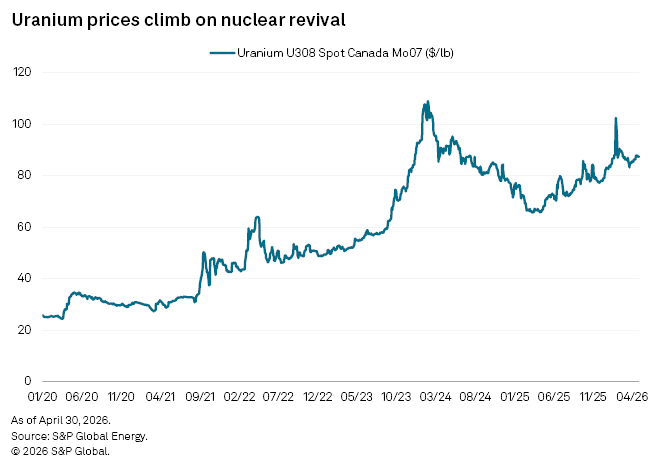
At the same time, with supply response slower and more complex than headline resources suggest, prices should remain supported and volatile, especially as Middle East risk intermittently tightens risk premiums and complicates logistics, even if the direct physical link to uranium is less immediate than for hydrocarbons.
William Mason contributed to this article.
This article was published by S&P Global Market Intelligence and not by S&P Global Ratings, which is a separately managed division of S&P Global.
Source: Platts By Patricia Barreto and Francesca Price



Related News.

Hong Kong Global Maritime Trade Summit to return for third edition
The International Chamber of Shipping, in collaboration with the Transport and Logistics Bureau of the Government of Hong Kong and the Hong Kong…

Appetite for US crude oil exports climbs despite high freight
South Korea tops US crude destinations at 568,600 b/d VLCC rates to Asia double, closing arbitrage window European refining margins…
Shipping stocks Rally as Hormuz Traffic plunges 75%
Ship traffic through the Strait of Hormuz — a critical chokepoint handling about 20% of global crude oil and liquefied natural gas shipments — has…

Diana Shipping announces Time Charter Contract for m/v G P Zafirakis with Classic Maritime
Diana Shipping, a global shipping company specializing in the ownership and bareboat charter-in of dry bulk vessels, announced that, through a…

New IMO ESP Code framework for Remote Inspection Techniques
The International Maritime Organisation, through Resolution MSC.584(111) , has adopted amendments to the International Code on the Enhanced…

ABS opens Offshore & Marine Support Center in Bergen
ABS has expanded its capabilities in the Norwegian maritime market with the opening of a cutting-edge support center in Bergen, bringing advanced…
MOL holds giant step memorial ceremony and beach cleanup at Kashima Coast
Memorial and Reflection 20 Years After the Accident: Learning from the Past to Foster an Even Stronger Safety Culture Mitsui O.S.K. Lines, announced…

KEZAD-based Arabian Gulf Steel Industries achieves lowest verified Carbon Footprint for Rebar
CARES UK verified Environmental Product Declaration confirms 139 kg CO₂e per tonne for rebar produced at AGSI’s KEZAD Abu Dhabi facility Arabian…

Indian Register of Shipping announces launch of first fleet support ship INS Surya
Indian Register of Shipping continues to strengthen its role in supporting the Indian Navy and India’s naval shipbuilding capabilities through the…

VLCCs Climbing the Record Charts
LR2 The TC1 75kt MEG/Japan index decreased by only a single point this week to WS928. The corresponding Baltic round-trip TCE fell by $2,000 to…
Subscribe to our newsletter!
if you dont want to swim alone in the ocean of news, sign up for the newsletter, and you will receive daily all the important news of world shipping!
