Strengthening fundamentals for Norway-Germany hydrogen imports


As recently highlighted in our quarterly report, Provaris continues to see strengthening fundamentals for the development of RFNBO‑compliant hydrogen supply chains from Norway into Germany, underpinned by recent market feedback from European utilities and evolving policy frameworks across Germany and the European Union
Strengthening fundamentals for Norway–Germany hydrogen imports
Provaris continues to see strengthening fundamentals for the development of RFNBO‑compliant hydrogen supply chains from Norway into Germany, underpinned by recent market feedback from European utilities and evolving policy frameworks across Germany and the European Union.
Clear demand outlook for RFNBO hydrogen into Germany
Germany remains Europe’s largest energy market and a priority destination for renewable hydrogen imports. Recent engagement with German utilities reinforces the clear potential for RFNBO‑compliant hydrogen imports from Norway into Germany from around 2030, with Northern German ports viewed as logical entry points into existing and planned hydrogen infrastructure.
Importantly, the market outlook in Germany has continued to improve, driven by stronger regulatory clarity and demand‑side incentives. Enhancements to Germany’s greenhouse gas (GHG) quota framework materially strengthen long‑term demand expectations for renewable fuels of non‑biological origin, including RFNBO hydrogen and its derivatives. This provides a more robust and visible sales outlook for future hydrogen imports over the coming decades.
The three key industry sectors where GHG quota directly applies:
- Transport: road transport, aviation, shipping, with RFNBO quotas ~5% by mid-2030s and 8-10% by 2040.
- Refining and Fuel Production in Germany with green H2 to replace existing grey H2 in the refining process, creates early, industrial‑scale hydrogen demand.
- Industry which includes Steel, Cement, Metal Refining, with Germany requiring 42% of hydrogen used in industry is RFNBO by 2030.
The key takeaway… “Germany’s GHG quota creates a legally enforced demand floor for RFNBO hydrogen in the transport and fuel supply sectors, with industry demand layered on top via support mechanisms rather than penalties.”
Supportive European policy signals
At the European level, recent initiatives from the European Commission, including programmes such as AccelerateEU, are being viewed positively by market participants. These initiatives signal ongoing political and regulatory support for the scaling of RFNBO production, helping to reduce supply‑side risk and improve the overall investment environment for cross‑border hydrogen value chains.
Together, these German and EU‑wide policy developments are contributing to greater confidence across the hydrogen supply chain, from upstream production in Norway through to offtake and distribution in Germany.
Relevance for Provaris’ compressed hydrogen solution
This evolving policy and market backdrop aligns closely with Provaris’ strategy to enable simple, scalable and energy‑efficient hydrogen transport using compressed hydrogen shipping. The ability to deliver gaseous hydrogen directly—without the need for conversion to derivatives and reconversion at import—continues to resonate with European utilities seeking flexible, RFNBO‑compliant import solutions, particularly for early to mid‑scale volumes.
Germany’s hydrogen infrastructure commitment
Germany’s demand‑side policy framework is being complemented by a significant, long‑term commitment to hydrogen infrastructure, reinforcing the country’s transition toward a hydrogen‑ready economy.
In October 2024, Germany approved the development of a nationwide hydrogen core network comprising approximately 9,040 kilometres of pipelines, connecting industrial centres, storage facilities, power plants and key import corridors. Around 60% of the network will be created through the conversion of existing natural gas pipelines, enabling faster deployment and lower overall costs. Total investment for the network is estimated at approximately €18.9 billion, with the core network targeted for full integration by 2032.
Provaris continues to meet with TSOs associated with the rollout of the core network with early sections of the work to be operational from 2025, and further expansion 2026-27; connecting ports to anchor corridors feeding industrial clusters across Germany.
Ongoing engagement and next steps
Against this improving backdrop, Provaris is continuing discussions with European utilities and supply‑side stakeholders to further assess project timing, infrastructure integration and upstream development opportunities in Norway. Follow‑up technical and commercial discussions are anticipated after the northern hemisphere summer period, including potential site visits to Norwegian production locations.
Provaris remains focused on advancing its hydrogen shipping and storage solutions to support investment decisions aligned with Europe’s 2030 energy transition objectives. Now we are past the ‘hype’ stage of sector develop, the reality of industrial scale-up of demand means that import demand is back on the agenda.



Related News.

Navigating the Multi-Orbit Era: In Conversation with Intellian’s Jon Harrison at SMM 2026
At SMM 2026 in Hamburg, the rapid evolution of maritime satellite communications took centre stage. Across the exhibition halls, discussions among…
Cyprus ports need joint energy and investment strategy, shipping agents chief says
Cyprus needs a coordinated strategy for shipping, energy and environmental protection to support port investment and modernisation, Cyprus shipping…

MASO Public Affairs introduces MASO Regulatory Intelligence
A new subscription service helping businesses understand what is changing and what it means for them MASO Public Affairs introduces MASO Regulatory…
Anglo-Eastern helps turn CMBTECH’s ammonia ambition into an operational reality
From early feasibility study and risk-based design to newbuilding supervision, crew readiness and technical management, Anglo-Eastern drew on its…

Escalation of attacks threatens to derail recovery in Middle East oil exports
World oil demand is forecast to fall by 2.5 mb/d y-o-y in 4Q26 and 2.6 mb/d on average in 2026. As the Iran war manifests itself through restricted…
New study finds shipping pays twice its share to EU ETS earmarked revenues should triple to help build market for sustainable fuels and technologies
Shipping is responsible for around 10% of EU ETS emissions but pays almost 20% of the ETS bill. Unlike other sectors, it has never received free…

MSARC strengthens maritime mass rescue readiness through training and national live exercise off Dakar, Senegal
Joint MSARC–FHAS programme combines three days of SAR training with a national multi-agency live exercise The Maritime Search and Rescue Council ,…
Sogese report deliveries are still being delayed as container freight rates fluctuate
FOR IMPORTERS Spot rates into the Mediterranean are back at January levels, Far East to Europe reliability sits at pandemic lows, and nearly…

Glencore begins trading on Australian Securities Exchange
Glencore has begun trading on the Australian Securities Exchange under the ASX code GLC. Gary Nagle, Glencore’s CEO, said it was an exciting day for…
BIMCO Shipping Number of the Week
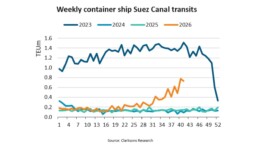
Suez Canal container ship transits exceed 50% of pre-disruption levels "During the first two weeks of October, weekly container ship capacity…
Subscribe to our newsletter!
if you dont want to swim alone in the ocean of news, sign up for the newsletter, and you will receive daily all the important news of world shipping!
