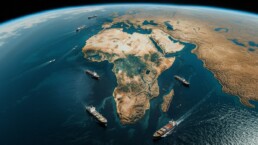

With war between the United States and Israel and Iran effectively paralysing Middle East routes, the global shipping network is being rapidly reshaped. In particular, as shipping companies reroute to go around the Cape of Good Hope instead of the Persian Gulf, South Africa’s presence is coming into focus.
According to the Washington Post on the 31st, major global shipping companies such as Maersk, Hapag-Lloyd, and CMA CGM are changing their vessel routes to avoid high-risk waters including the Strait of Hormuz and the Red Sea. As these companies turn their helms toward routes around the southern tip of Africa, ship traffic in waters near South Africa is quickly increasing.
After the Strait of Hormuz, through which about 20% of the world’s crude oil shipments pass, was closed, and with Yemen’s Houthi rebels formalizing their participation on the 28th of last month, shipping companies appear to have changed routes as a last resort. Controlling northern Yemen, the Houthis are seen as being well positioned to exert control over the Bab el-Mandeb Strait, which connects Europe and Asia and is known to handle about 15% of global maritime trade.
As a result, the importance of the route around the southern tip of Africa is rising sharply. This route detours about 9,000 kilometers via the Cape of Good Hope and was used as a bypass for merchant ships during the 2023 Israel-Hamas war. Brian Ingpen, a maritime economist based in Cape Town, said, “Ship traffic passing South Africa will roughly double,” adding, “If the situation worsens, up to 150 ships a day could round the Cape of Good Hope.”
South Africa’s economy is enjoying an unexpected windfall. The marine services sector in particular is benefiting, with demand rising for support services such as ▲crew changes ▲emergency parts and supplies ▲medical evacuations, breathing new life into the industry. Through these services, shipping companies can avoid unnecessary port calls and reduce downtime (a suspension of vessel operations), maximizing operating efficiency.
However, the chronic expense issue is expected to weigh heavily on shipping companies. According to the shipping industry, choosing a Cape of Good Hope detour adds 10 to 15 days to a voyage, which means freight rates inevitably rise by at least 20%. Adding intensified competition from logistics supply disruptions and higher insurance costs, some analyses suggest the actual increase in expense could far exceed 20%.
Experts say it cannot be ruled out that the axis of global shipping may shift to the southern African route. Brian Ingpen said, “The Cape route has historically functioned as an important sea lane,” assessing that, “Rather than a new change, the current situation is closer to a return to the past.”
Meanwhile, if the Houthis do not choose a full blockade of the Red Sea, there is a chance the situation could improve as transits of the Bab el-Mandeb Strait continue. The Guardian said, “The Houthis could intervene in a so-called ‘managed escalation’ by modulating the level of attacks instead of a Red Sea blockade,” adding, “The actions of Saudi Arabia, which is deeply involved in shaping order in Yemen, will also serve as a key variable.”
Source: ChosunBiz



Related News.
India joins ISF Verify, bringing trusted digital certification within reach of 30 per cent of the global seafarer workforce
Agreement with the world’s second-largest seafarer supply country marks a major milestone for global digital certification. The Directorate General…

OpenGate Capital to acquire Maersk Training, the Global Safety Training and Gas-Safety Services Business of Maersk
OpenGate Capital, a global private equity firm, announced today that it has signed a definitive agreement to acquire Maersk Training and its…

Can AI Save the Planet? Planet Classroom examines AI’s Climate Impact, Energy Demands and Clean Energy Solutions
C. M. (Cathy) Rubin and The Nest Campus CEO Peter Gilmer explore AI's growing environmental footprint, billions in climate investment, and the…

Smart Port Market Size to be valued at USD 23.10 Billion by 2034; Increasing Volume of International Maritime Trade to Boost Market Development: Fortune Business Insights™
The global smart port market size was valued at USD 3.4 billion in 2025 and is expected to be worth USD 4.2 billion in 2026. The market is projected…
Closer cooperation with India can strengthen Danish shipping
Minister of Business and Competitiveness Martin Lidegaard is leading a Danish business delegation to India. Green shipping is among the…

IRClass Academy and PIP Makassar strengthen Executive Maritime Capability through IMPDP 2026
Indian Register of Shipping , through its professional training and development arm IRClass Academy, has further strengthened its engagement in…

MOL, Sharp, IOM Implement Solar Panel Donation Project
Move Will Enhance Living Conditions in Power-short Areas of Kenya Mitsui O.S.K. Lines, announced the donation of solar power panels to communities in…

Intermodal Report Week 44 2026
Pls find below the Intermodal Report - Week 44 2026 Intermodal Report Week 44 2026

Allied Weekly Market Review Week 44
Pls find below the Allied - Weekly Market Review - Week 44 ALLIED - Weekly Market Report- Week 44

Nor-Shipping partners with Marketing in Maritime to deliver Marketing & Communications day and awards in 2027
Nor-Shipping is partnering with Marketing in Maritime to deliver a dedicated Marketing & Communications Day and awards initiative at the 2027…
Subscribe to our newsletter!
if you dont want to swim alone in the ocean of news, sign up for the newsletter, and you will receive daily all the important news of world shipping!
