US leads Brazil in Corn exports to China


KEY TAKEAWAYS
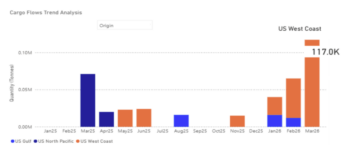
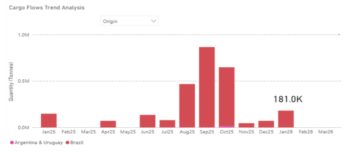
● China’s corn flows are shifting in early 2026. Brazil dominated China’s corn imports in 2025, but early Q1 2026 data indicate the U.S. is regaining market share.
● Dry bulk sentiment improved week over week. The BDI moved back above 2,000, supported mainly by gains in the Capesize and Panamax segments.
● Atlantic freight strength remains concentrated in larger sizes.
● Vessel supply remains elevated in several basins. Ballaster counts are still high across parts of the Pacific and Atlantic, especially in Supramax and Handysize, limiting upside in some segments.
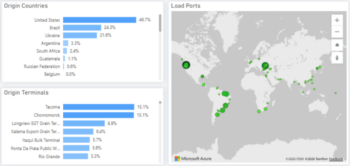
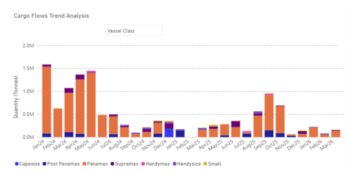
Chinese corn imports declined to approximately 3.8M mt in 2025, down from 8.4M mt in 2024. Of this, around 2.5M mt originated from Brazil (Panamax: ~2.0M mt vs. 1.78M mt in 2024), while imports from the U.S. totaled 169k mt (Panamax: ~153k mt vs. 1.36M mt in 2024). This contraction aligns with China’s policy direction over the past three years. The focus has been on increasing domestic self-sufficiency. As such, the recent decline in imports is not primarily driven by trade tensions, but rather reflects a policy-driven agricultural transformation underway in Beijing.
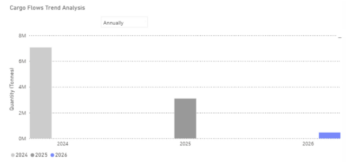
With imports declining and domestic output rising, China’s evolving grain policy is expected to have far-reaching implications for major exporters, including Brazil, the U.S., and Ukraine. Looking ahead, China is likely to continue prioritizing internal efficiency, requiring global corn exporters to adapt to a lower level of Chinese import demand.
While Brazil was the primary supplier of corn to China in 2025, early Q1 2026 data show the U.S. has regained market share and moved ahead by late March.
Freight Market Overview
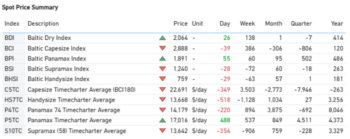
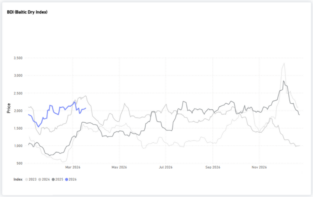
The Baltic Dry Index (BDI) recorded an uptick in sentiment before the end of the week, with the index value moving above the 2,000-point mark, driven by weekly gains in the Capesize and Panamax segments.
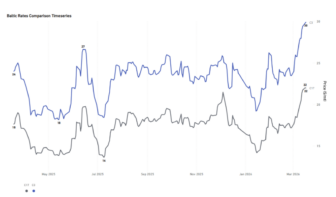
The rate for the Tubarao to Qingdao route held the firmer sentiment of the previous week, with rates still around $30/mt (+23% YoY). Similarly, the Saldanha Bay-Qingdao rates were assessed at around $22/mt (+24% YoY).
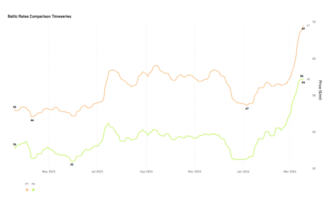
Rates for the USG–Qingdao and Santos–Qingdao routes are reaching exceptional highs. The Santos–Qingdao rate was assessed at $54/mt (+50% YoY). Notably, the USG–Qingdao rate strengthened further to around $70/mt, approximately $10/mt higher than the previous week (+49% YoY).
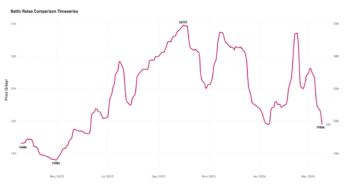
Rates on the USG-to-Skaw–Passero route continued to decline, as highlighted in our previous Dry Market Monitor, and are now around $19k/day, down by $11k/day over the past month.
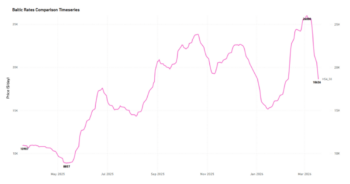
The USG trip to Skaw–Passero recorded levels of around $18k/day, a decrease of approximately $5k/day from the previous week, which contrasts with the annual rebound of $7.7k/day.
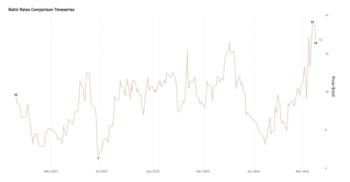
Rates on the West Australia–Qingdao route extended their softening trend WoW, at around $13/mt (+27% YoY). Despite the recent easing, levels remain well above the mid-January trough of approximately $7.5/mt.
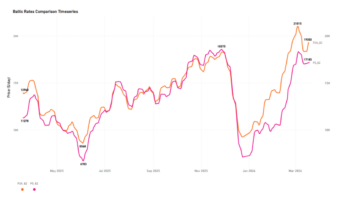
The Panamax Pacific market has now reversed the weaker trend recorded in the previous week. Specifically, rates on the P3A_82 route rose to $19k/day, and on the P5_82 route to $17k/day.
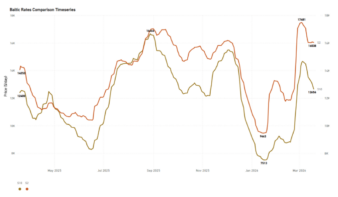
The positive trend in the Supramax Pacific market has reversed to a weaker sentiment. Compared with the previous week, rates for the S10 route have now settled below $13k/day.
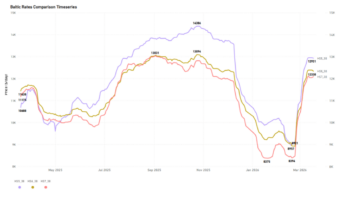
The Pacific Handysize freight market appears to have reached its highest point since the lows recorded in January and February. Rates for the HS5_38 and HS6_38 routes have strengthened to around $12–13k/day each compared with the previous week, while the HS7_38 rate confirmed the sentiment of the previous week at $12k/day
Ballasters Overview
Capesize | 5D MA Mixed
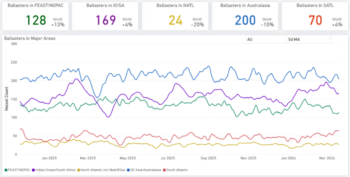
Vessel supply, although still elevated, showed a decrease to 200 vessels in Australasia, compared with last week when the vessel count climbed to over 230 units. In the Atlantic, both the North saw a notable decrease (-20%), while in the South, the vessel count maintained a similar trend to the previous week (~70, 5D MA).
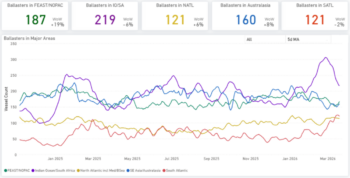
The Indian Ocean experienced a decrease in levels to around 220 after peaking above 300 at the end of February. Meanwhile, in the Far East/NOPAC, following signs of a decline a week ago, levels have started to increase again to nearly 190, whereas early indications in the previous week pointed to a drop below 170. Evidence of increased supply pressure remains in the South, with a vessel count of nearly 120.
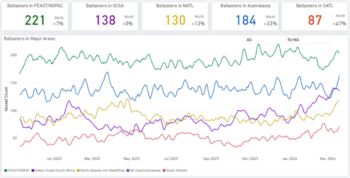
The Pacific region continued to exhibit elevated vessel availability, a trend persisting from the preceding three weeks. The vessel count in the Far East/NOPAC has climbed notably, now standing at 220. Meanwhile, the Atlantic saw a sharp rise in ballasters, particularly in the North Atlantic, where the number held at the elevated level of 130 vessels.
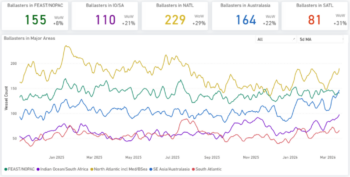
Handysize vessels continued to face elevated supply pressure since the end of February. In the North Atlantic, the vessel count remained high, exceeding 220 and now nearing 230 (+29% WoW). In the Pacific, pressure intensified in Australasia, where the vessel count surpassed 160 (+20% WoW).
Demand | Tonne Miles — 7D MA Index View
Capesize ↓ 0.2% WoW | Panamax ↓ 2.5% WoW
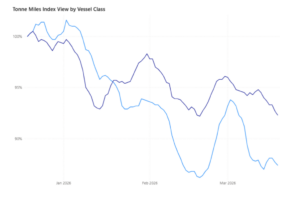
The tonne-mile growth rate, measured on a Base 100 Index basis, weakened for the larger vessel classes this week. The Capesize index declined to 87.7, down 0.6% WoW from 87.9. The Panamax index also fell to 93.1, decreasing 2.6% WoW from 95.5. Despite the softer weekly performance, Panamax remains closer to the Base 100 benchmark, while Capesize continues to lag more significantly. Capesize now sits 12.3 points below base, while Panamax stands 6.9 points below the benchmark.
Supramax ↓ 2.5% WoW | Handymax ↓ 2.0% WoW | Handysize ↓ 2.3% WoW
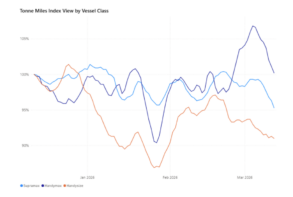
The tonne-mile growth rate, measured on a Base 100 Index basis, showed a mixed trend this week. Supramax declined to 95.9% from 98.3% WoW, while Handysize also eased to 94.9% from 96.2%. In contrast, Handymax remained above the benchmark at 105.8%, although slightly lower than 107% the previous week.
Source:Signal



Related News.

Navigating the Multi-Orbit Era: In Conversation with Intellian’s Jon Harrison at SMM 2026
At SMM 2026 in Hamburg, the rapid evolution of maritime satellite communications took centre stage. Across the exhibition halls, discussions among…

Cyprus ports need joint energy and investment strategy, shipping agents chief says
Cyprus needs a coordinated strategy for shipping, energy and environmental protection to support port investment and modernisation, Cyprus shipping…

MASO Public Affairs introduces MASO Regulatory Intelligence
A new subscription service helping businesses understand what is changing and what it means for them MASO Public Affairs introduces MASO Regulatory…

Anglo-Eastern helps turn CMBTECH’s ammonia ambition into an operational reality
From early feasibility study and risk-based design to newbuilding supervision, crew readiness and technical management, Anglo-Eastern drew on its…

Escalation of attacks threatens to derail recovery in Middle East oil exports
World oil demand is forecast to fall by 2.5 mb/d y-o-y in 4Q26 and 2.6 mb/d on average in 2026. As the Iran war manifests itself through restricted…

New study finds shipping pays twice its share to EU ETS earmarked revenues should triple to help build market for sustainable fuels and technologies
Shipping is responsible for around 10% of EU ETS emissions but pays almost 20% of the ETS bill. Unlike other sectors, it has never received free…

MSARC strengthens maritime mass rescue readiness through training and national live exercise off Dakar, Senegal
Joint MSARC–FHAS programme combines three days of SAR training with a national multi-agency live exercise The Maritime Search and Rescue Council ,…

Sogese report deliveries are still being delayed as container freight rates fluctuate
FOR IMPORTERS Spot rates into the Mediterranean are back at January levels, Far East to Europe reliability sits at pandemic lows, and nearly…

Glencore begins trading on Australian Securities Exchange
Glencore has begun trading on the Australian Securities Exchange under the ASX code GLC. Gary Nagle, Glencore’s CEO, said it was an exciting day for…

BIMCO Shipping Number of the Week
Suez Canal container ship transits exceed 50% of pre-disruption levels "During the first two weeks of October, weekly container ship capacity…
Subscribe to our newsletter!
if you dont want to swim alone in the ocean of news, sign up for the newsletter, and you will receive daily all the important news of world shipping!
