Quvia launches sync for intelligent edge-to-cloud data mobility

New solution uses predictive intelligence to determine what data moves, when and under what conditions across edge and cloud environments
In testing, Quvia Sync demonstrated the ability to transfer up to 1 terabyte of data in 24 hours on a maritime vessel while meeting defined data SLAs and without increasing connectivity costs
Quvia, an edge-to-cloud network platform, today announced Quvia Sync, a solution for large-scale data synchronization between edge and cloud. Quvia Sync enables companies in network-constrained environments to move data predictably and efficiently without disrupting operations or Quality of Experience (QoE)—while honoring data SLAs and keeping connectivity costs under control.
Edge environments such as aircraft, ships, and offshore platforms generate massive volumes of operational and sensor data. As AI accelerates, the need to move that data between the edge and the cloud is growing because AI models rely on the cloud for training and updates.
Quvia Sync makes this possible by introducing intelligence that determines what data moves, when and how, based on application needs and operational priorities.
“AI inferencing is unlocking real opportunity, but data and AI model mobility remain a core challenge for our customers,” said Benny Retnamony, founder and CEO, Quvia. “As space, edge and cloud converge, the constraint is shifting from bandwidth to intelligence. Quvia is the digital fabric that enables that intelligence and makes data and AI model mobility across edge and cloud possible, so companies can deploy and scale new applications, services and experiences at the edge.”
Quvia Sync seamlessly integrates multi-vendor, on-premises data sources to capture metadata and understand data context, while honoring data SLAs and cost constraints. It continuously evaluates network conditions and available capacity to determine when and where data should move, selecting the optimal path across any combination of providers, orbits and network types. This allows companies to efficiently synchronize edge data while maintaining consistent QoE.
In testing, Quvia Sync demonstrated the ability to transfer up to 1 terabyte of data in 24 hours on a maritime vessel while meeting defined data SLAs and without increasing connectivity costs.
How Quvia Sync works:
- Dynamic Path Optimization: Transfers data across the lowest-cost available paths, using idle bandwidth windows.
- Context-Aware Prioritization: Identifies application requirements and data backlogs to prioritize time-sensitive data.
- Operational Visibility: Provides insight into synchronization status, backlog and performance to support predictable operations.
By unlocking large-scale data movement, Sync allows companies to launch services that were previously impractical due to bandwidth constraints. For example, seismic survey vessels can transmit terabytes of sonar data in near real time, cruise lines can offer digital-first guest experiences including social-media-ready content libraries, and airlines can deliver personalized, connected passenger experiences that continue across aircraft and flights.
Quvia Sync is currently available to select customers, with broader availability planned for later this year.
Source:BusinessWire



Related News.

Navigating the Multi-Orbit Era: In Conversation with Intellian’s Jon Harrison at SMM 2026
At SMM 2026 in Hamburg, the rapid evolution of maritime satellite communications took centre stage. Across the exhibition halls, discussions among…

Cyprus ports need joint energy and investment strategy, shipping agents chief says
Cyprus needs a coordinated strategy for shipping, energy and environmental protection to support port investment and modernisation, Cyprus shipping…

MASO Public Affairs introduces MASO Regulatory Intelligence
A new subscription service helping businesses understand what is changing and what it means for them MASO Public Affairs introduces MASO Regulatory…

Anglo-Eastern helps turn CMBTECH’s ammonia ambition into an operational reality
From early feasibility study and risk-based design to newbuilding supervision, crew readiness and technical management, Anglo-Eastern drew on its…

Escalation of attacks threatens to derail recovery in Middle East oil exports
World oil demand is forecast to fall by 2.5 mb/d y-o-y in 4Q26 and 2.6 mb/d on average in 2026. As the Iran war manifests itself through restricted…

New study finds shipping pays twice its share to EU ETS earmarked revenues should triple to help build market for sustainable fuels and technologies
Shipping is responsible for around 10% of EU ETS emissions but pays almost 20% of the ETS bill. Unlike other sectors, it has never received free…

MSARC strengthens maritime mass rescue readiness through training and national live exercise off Dakar, Senegal
Joint MSARC–FHAS programme combines three days of SAR training with a national multi-agency live exercise The Maritime Search and Rescue Council ,…
Sogese report deliveries are still being delayed as container freight rates fluctuate
FOR IMPORTERS Spot rates into the Mediterranean are back at January levels, Far East to Europe reliability sits at pandemic lows, and nearly…

Glencore begins trading on Australian Securities Exchange
Glencore has begun trading on the Australian Securities Exchange under the ASX code GLC. Gary Nagle, Glencore’s CEO, said it was an exciting day for…
BIMCO Shipping Number of the Week
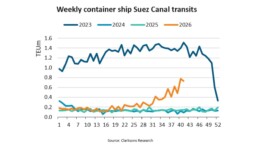
Suez Canal container ship transits exceed 50% of pre-disruption levels "During the first two weeks of October, weekly container ship capacity…
Subscribe to our newsletter!
if you dont want to swim alone in the ocean of news, sign up for the newsletter, and you will receive daily all the important news of world shipping!
