MSC seeks major stake in Korea’s oil tanker heavyweight Janggeum Maritime

MSC of Switzerland, the world’s largest shipping company, is set to acquire half of the shares in a key company of the Korean shipping firm Sinokor Merchant Marine Group for joint management. Amid an unfolding oil crisis originating from Iran, the deal is being evaluated as a transaction that could change the landscape of the shipping market, heralding the birth of a ‘behemoth carrier’ in the Very Large Crude Carrier market.
According to shipping industry sources on March 20, regulatory authorities in Greece and Cyprus announced a business combination filing regarding MSC securing joint management rights of ‘Janggeum Maritime,’ a related company responsible for the tanker business of Sinokor Merchant Marine Group. According to the filing, the two companies have already signed a basic investment agreement. MSC will acquire a 50% stake in Janggeum Maritime, and Director Jeong Ga-hyeon, the eldest son of Sinokor Merchant Marine Chairman Jeong Tae-soon, will hold the remaining 50%, establishing a joint management system.
MSC, a Swiss shipping company, is pursuing a business combination to secure joint management rights by acquiring a 50% stake in Janggeum Maritime. The Hellenic Competition Commission, Greece’s regulatory authority, recently announced that it had received a business combination notification between MSC’s subsidiary, SAS LUX, and Janggeum Maritime. MSC and Sinokor Merchant Marine have already signed a basic agreement related to this. It is known that Sinokor Merchant Marine also reported this matter to the Fair Trade Commission last month.
Sinokor Merchant Marine is a company that charters vessels such as VLCCs and container ships to oil refineries and trading companies. With the prolonged oil shortage due to the blockade of the Strait of Hormuz, Sinokor’s valuation is soaring. The company operates 130 to 150 VLCCs, accounting for 14-17% of the approximately 880 VLCCs worldwide. Bloomberg News also analyzed that “excluding the shadow fleet, Sinokor Merchant Marine operates 40% of the very large crude carriers that can operate without problems on all global routes.” This is an unprecedented market share for a single carrier.
The amount MSC paid for the 50% stake in Janggeum Maritime has not been disclosed. Industry analysis suggests that the value of Janggeum Maritime’s related assets has likely more than doubled due to recent geopolitical risks in the Middle East and rising VLCC charter fees. Chairman Jeong explained, “The acquisition agreement was finalized before the Middle East situation,” adding, “The price will proceed as is.” He emphasized, “This is not about selling the entire company but is for business cooperation.”
Sinokor Merchant Marine has been increasing its VLCC purchases since 2022, right after the COVID-19 pandemic. This was a pre-emptive investment, considering that vessel charter fees can soar to more than 10 times their usual rate during events like pandemics or wars. The charter fees being discussed in the market reach as high as $500,000 per day, which is 10 times the average of last year. With the Strait of Hormuz closed, there is also growing demand to use VLCCs as ‘floating oil storage.’ This means money can be made simply by storing oil on the sea.
MSC is the number one company in the container ship market, holding a market share of about 21% based on fleet capacity. Attention is now focused on whether the entry of a ‘behemoth carrier’ into the VLCC market, amid the oil crisis originating from Iran, will change the future landscape of the shipping market. MSC has been diversifying its business from its traditional container-centric portfolio to include bulk carriers, cruise ships, and Pure Car and Truck Carriers (PCTC).
On this day, Jeong Tae-soon, Chairman of Sinokor Merchant Marine, also confirmed the sale of the stake in Janggeum Maritime. Regarding the possibility of changing the sale price considering the significant increase in Sinokor’s valuation due to the Middle East situation, he stated, “Regardless of the Middle East situation, the plan to sell the stake will proceed as is.”
However, for this transaction to be finalized, it must pass the review of competition authorities in major countries. The business combination approval process is expected to proceed with regulatory authorities in related countries, including Greece, Korea, Cyprus, and Norway.
Source:Business Korea



Related News.

Navigating the Multi-Orbit Era: In Conversation with Intellian’s Jon Harrison at SMM 2026
At SMM 2026 in Hamburg, the rapid evolution of maritime satellite communications took centre stage. Across the exhibition halls, discussions among…
Cyprus ports need joint energy and investment strategy, shipping agents chief says
Cyprus needs a coordinated strategy for shipping, energy and environmental protection to support port investment and modernisation, Cyprus shipping…

MASO Public Affairs introduces MASO Regulatory Intelligence
A new subscription service helping businesses understand what is changing and what it means for them MASO Public Affairs introduces MASO Regulatory…
Anglo-Eastern helps turn CMBTECH’s ammonia ambition into an operational reality
From early feasibility study and risk-based design to newbuilding supervision, crew readiness and technical management, Anglo-Eastern drew on its…
Escalation of attacks threatens to derail recovery in Middle East oil exports
World oil demand is forecast to fall by 2.5 mb/d y-o-y in 4Q26 and 2.6 mb/d on average in 2026. As the Iran war manifests itself through restricted…
New study finds shipping pays twice its share to EU ETS earmarked revenues should triple to help build market for sustainable fuels and technologies
Shipping is responsible for around 10% of EU ETS emissions but pays almost 20% of the ETS bill. Unlike other sectors, it has never received free…

MSARC strengthens maritime mass rescue readiness through training and national live exercise off Dakar, Senegal
Joint MSARC–FHAS programme combines three days of SAR training with a national multi-agency live exercise The Maritime Search and Rescue Council ,…
Sogese report deliveries are still being delayed as container freight rates fluctuate
FOR IMPORTERS Spot rates into the Mediterranean are back at January levels, Far East to Europe reliability sits at pandemic lows, and nearly…
Glencore begins trading on Australian Securities Exchange
Glencore has begun trading on the Australian Securities Exchange under the ASX code GLC. Gary Nagle, Glencore’s CEO, said it was an exciting day for…
BIMCO Shipping Number of the Week
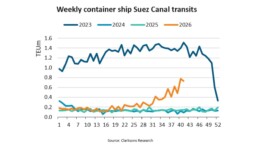
Suez Canal container ship transits exceed 50% of pre-disruption levels "During the first two weeks of October, weekly container ship capacity…
Subscribe to our newsletter!
if you dont want to swim alone in the ocean of news, sign up for the newsletter, and you will receive daily all the important news of world shipping!
