Shipping industry faces ‘Cost Bomb’ from Oil Prices and Exchange Rates
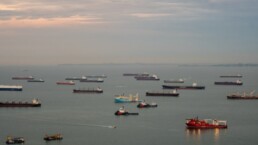

Korea’s Shipping Industry Grapples With Rising Costs Due to Escalating Oil Prices and Exchange Rates While Charter Rates Have More Than Doubled
As geopolitical tensions in the Middle East have recently escalated, Korea’s shipping industry is facing a ‘triple burden’ of rising oil prices, soaring charter rates, and exchange rate pressures.
In particular, analysis suggests that the overall cost structure of shipping companies is being shaken as oil tanker charter rates have more than doubled in a short period, with international oil prices and the won-dollar exchange rate rising in tandem.
According to the shipping industry on March 13, oil tanker charter rates have surged more than twofold following the Iran crisis.
Oil tanker charter rates, which were in the $200,000 range at the end of February, soared to $475,700 early this month. Although rates have since declined, they remain in the $400,000 range.
When a single vessel is unable to determine its route and remains on standby at sea, charter fees of tens of millions of won per day accrue for large ships.
In particular, as charter fee payments are made in dollars, a rise in the won-dollar exchange rate also increases the actual cost burden.
As of that day, the won-dollar exchange rate stood at 1,490 won, approaching the 1,500 won level.
With international oil prices also rising on top of this, the shipping industry’s transportation cost burden is expanding in all directions.
In the shipping industry, fuel costs (bunker) constitute a significant expense, accounting for approximately 20-30% or more of total operating costs.
Accordingly, shipping companies typically enter into Bunker Adjustment Factor (BAF) contracts with shippers to partially offset the burden of rising oil prices.
This method adjusts freight rates based on the average oil price over a specific period, ultimately leading to increased logistics cost burdens for shippers.
However, in the case of spot purchasing, where fuel is bought as needed without long-term contracts, fuel cost burdens are directly reflected in high oil price environments like the current one.
Shipping companies have maintained spot purchasing ratios at the 20-30% level to respond nimbly to market conditions and optimize costs.
However, with the recent surge in oil prices, this strategy is now acting as a cost burden factor instead.
A shipping industry official said, “Vessels currently inside the Strait of Hormuz are having difficulty operating at all, effectively incurring opportunity costs.”
The official continued, “While operational methods differ from company to company, shipping companies with higher chartering ratios will inevitably face greater cost burdens.”
Source: BusinessKorea



Related News.
Hong Kong Global Maritime Trade Summit to return for third edition
The International Chamber of Shipping, in collaboration with the Transport and Logistics Bureau of the Government of Hong Kong and the Hong Kong…
Appetite for US crude oil exports climbs despite high freight
South Korea tops US crude destinations at 568,600 b/d VLCC rates to Asia double, closing arbitrage window European refining margins…
Shipping stocks Rally as Hormuz Traffic plunges 75%
Ship traffic through the Strait of Hormuz — a critical chokepoint handling about 20% of global crude oil and liquefied natural gas shipments — has…
Diana Shipping announces Time Charter Contract for m/v G P Zafirakis with Classic Maritime
Diana Shipping, a global shipping company specializing in the ownership and bareboat charter-in of dry bulk vessels, announced that, through a…
New IMO ESP Code framework for Remote Inspection Techniques
The International Maritime Organisation, through Resolution MSC.584(111) , has adopted amendments to the International Code on the Enhanced…

ABS opens Offshore & Marine Support Center in Bergen
ABS has expanded its capabilities in the Norwegian maritime market with the opening of a cutting-edge support center in Bergen, bringing advanced…
MOL holds giant step memorial ceremony and beach cleanup at Kashima Coast
Memorial and Reflection 20 Years After the Accident: Learning from the Past to Foster an Even Stronger Safety Culture Mitsui O.S.K. Lines, announced…
KEZAD-based Arabian Gulf Steel Industries achieves lowest verified Carbon Footprint for Rebar
CARES UK verified Environmental Product Declaration confirms 139 kg CO₂e per tonne for rebar produced at AGSI’s KEZAD Abu Dhabi facility Arabian…
Indian Register of Shipping announces launch of first fleet support ship INS Surya
Indian Register of Shipping continues to strengthen its role in supporting the Indian Navy and India’s naval shipbuilding capabilities through the…

VLCCs Climbing the Record Charts
LR2 The TC1 75kt MEG/Japan index decreased by only a single point this week to WS928. The corresponding Baltic round-trip TCE fell by $2,000 to…
Subscribe to our newsletter!
if you dont want to swim alone in the ocean of news, sign up for the newsletter, and you will receive daily all the important news of world shipping!
