New vulnerabilities found in a common navigational data gateway, as OT threats surge 150%

New vulnerabilities expose ship navigation and network data Cydome Research Team identifies new vulnerabilities in NAVTOR NavBox devices
Vulnerabilities could allow unauthenticated remote access to vessel telemetry and ECDIS data amid 150% surge in maritime OT attacks.
Cydome, the leading provider of maritime-specific cybersecurity solutions, announced the discovery and responsible disclosure of three security vulnerabilitiesaffecting the NAVTOR NavBox, a widely deployed operational technology gateway in the global shipping industry.
The vulnerabilities, identified in NavBox version 4.12.0.3, could allow unauthorized remote access to sensitive vessel telemetry, network configurations, and sensitive operational data such as ECDIS IP addresses. The vulnerabilities were shared with NavTor as part of Cydome’s responsible reporting process, and NavTor acknowledged the findings, confirming they impacted NavBox v4.12.0.3 and have been remediated. NavTor also informed that affected customers were notified prior to the publication of the CVEs.
Fixed versions:
- CVE-2026-2752: Fixed in version 4.16.2.4 (November 2025) and later.
- CVE-2026-2753: Fixed in version 4.14.1.2 (December 2024) and later.
- CVE-2026-2754: Fixed in version 4.16.2.4 (November 2025) and later.
This discovery comes as Cydome’s latest research reveals a 150% increase in cyberattacks targeting maritime OTover the past year. As shipping companies accelerate digitalization, once-isolated operational vessel systems are now connected to the internet, creating “blind spots” that traditional IT security tools often fail to see. In fact, the Cydome report shows that 50% of OT incidents begin with unauthorized external access, while cyber attackers use generative AI technologies to accelerate device exploitation even in areas that once required specialized expertise.
The Reality of OT Risks at Sea. For maritime IT managers overseeing global fleets, OT devices like the NavBox fulfill critical operational and safety functions. However, because of the highly specialized nature of those devices, which frequently employ unique maritime protocols, they are hard to patch or replace, and could be highly exposed to exploitation.
“Shipping companies are currently facing a significant gap,” said Nir Ayalon, CEO of Cydome. “While their fleets become more connected with LEO broadband service, their OT devices are more exposed than ever to cyber threats. Cydome’s mission is to promote the safety of the industry and sea travel, and as part of that, we identified and responsibly released the NavBox vulnerabilities to help shipping companies prevent the risk before it’s exploited by malicious actors.”
The Discovered Vulnerabilities The three vulnerabilities identified by Cydome’s research team include:
- CVE-2026-2752 – Missing Authentication on HTTP API Endpoints, CVSS V3: 7.5 HIGH, which could allow for unauthorized retrieval of network information.
- CVE-2026-2753 – Absolute Path Traversal Vulnerability, CVSS V3: 7.5 HIGH, which could allow unauthorized retrieval of arbitrary files from the host operating system.
- CVE-2026-2754 – Information Disclosure Vulnerability, CVSS V3: 5.3 MEDIUM, which could expose internal application details via stack traces.
A Collaborative Approach to Maritime Safety Cydome worked closely with NAVTOR to ensure a swift and responsible resolution of the vulnerabilities for all affected customers.



Related News.

Navigating the Multi-Orbit Era: In Conversation with Intellian’s Jon Harrison at SMM 2026
At SMM 2026 in Hamburg, the rapid evolution of maritime satellite communications took centre stage. Across the exhibition halls, discussions among…

Cyprus ports need joint energy and investment strategy, shipping agents chief says
Cyprus needs a coordinated strategy for shipping, energy and environmental protection to support port investment and modernisation, Cyprus shipping…

MASO Public Affairs introduces MASO Regulatory Intelligence
A new subscription service helping businesses understand what is changing and what it means for them MASO Public Affairs introduces MASO Regulatory…

Anglo-Eastern helps turn CMBTECH’s ammonia ambition into an operational reality
From early feasibility study and risk-based design to newbuilding supervision, crew readiness and technical management, Anglo-Eastern drew on its…

Escalation of attacks threatens to derail recovery in Middle East oil exports
World oil demand is forecast to fall by 2.5 mb/d y-o-y in 4Q26 and 2.6 mb/d on average in 2026. As the Iran war manifests itself through restricted…
New study finds shipping pays twice its share to EU ETS earmarked revenues should triple to help build market for sustainable fuels and technologies
Shipping is responsible for around 10% of EU ETS emissions but pays almost 20% of the ETS bill. Unlike other sectors, it has never received free…

MSARC strengthens maritime mass rescue readiness through training and national live exercise off Dakar, Senegal
Joint MSARC–FHAS programme combines three days of SAR training with a national multi-agency live exercise The Maritime Search and Rescue Council ,…
Sogese report deliveries are still being delayed as container freight rates fluctuate
FOR IMPORTERS Spot rates into the Mediterranean are back at January levels, Far East to Europe reliability sits at pandemic lows, and nearly…

Glencore begins trading on Australian Securities Exchange
Glencore has begun trading on the Australian Securities Exchange under the ASX code GLC. Gary Nagle, Glencore’s CEO, said it was an exciting day for…
BIMCO Shipping Number of the Week
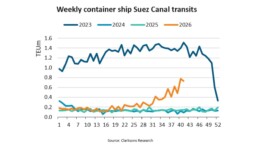
Suez Canal container ship transits exceed 50% of pre-disruption levels "During the first two weeks of October, weekly container ship capacity…
Subscribe to our newsletter!
if you dont want to swim alone in the ocean of news, sign up for the newsletter, and you will receive daily all the important news of world shipping!
