Alfa Laval completes factory acceptance test for FCM ammonia, confirming commercial readiness for ammonia-fuelled engines
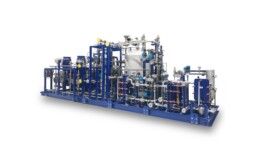

Alfa Laval has successfully completed the certified Factory Acceptance Tes for FCM Ammonia fuel supply system, class certified by China Classification Society . The milestone confirms that the fuel supply system has passed all functional and safety verification procedures in accordance with the required standards, demonstrating that it is engineered and tested for safe integration into an ammonia-fuelled two-stroke engine environment.
From concept to class-certified commercial reality
As the maritime sector advances toward low- and zero-carbon fuels, ammonia is gaining momentum as a key decarbonization pathway for deep-sea shipping in the long run. However, commercial adoption depends on more than engineering feasibility and supply chain availability; it also requires certified safe systems and validated manufacturing processes.
The FAT for the first FCM Ammonia, out of the seven units ordered by Tianjin Southwest Maritime for its dual-fuel ammonia carriers, marks a major step from development to commercial execution. It confirms that the system is technically robust, safe, and qualified to meet the demands of shipbuilding.
At the core of this milestone is dual validation. CPGC (CSSC Power Group Corporation), which is the system integrator and buyer, has validated the fuel supply system design and production quality. In parallel, CCS has conducted a comprehensive review and on-site witnessing of the Alfa Laval FCM Ammonia fuel supply system in accordance with the Guidelines for Ships Using Alternative Fuels and relevant international regulations, certifying the system’s compliance with stringent marine safety and technical standards. Together, these validations confirm both customer confidence and regulatory acceptance for commercial readiness.

“By completing the certified FAT for Alfa Laval’s FCM Ammonia, one of the first in the industry for a two-stroke dual-fuel ammonia application, we position ourselves as frontrunners supporting the safe adoption of ammonia in commercial shipping,” says Roberto Comelli, Europe E&S Manager, Marine Separation & Fuel Supply Systems, Alfa Laval. “This milestone confirms that our ammonia fuel supply technology has reached a new level of industrial maturity, and together with our partners, we are ready from design to production and will help the industry transition.”
“Full supply chain control is essential when introducing a new fuel into the marine environment, and it all starts with ensuring key component traceability and robust supplier qualification,” says Cui Yuwei, General Manager of CCS Athens Branch. “The successful completion of this FAT signifies that the system has met the fundamental requirements for commercial application in terms of design safety, functional integrity, and production quality control. This is a significant step forward for the industry in enabling ammonia as a viable fuel for the next generation of commercial vessels.”
The FCM Ammonia system is part of a wider ammonia propulsion project bringing together key stakeholders across the marine value chain. The two-stroke dual-fuel ammonia engine is supplied by WinGD, while the vessel will be constructed at CSSC Huangpu Wenchong Shipbuilding for Tianjin Southwest Maritime. This collaboration reflects the technical depth and coordinated industry effort required to introduce ammonia as a marine fuel at a commercial scale.
Certified design, safety and production readiness
The FAT validates FCM Ammonia design, control architecture, safety layers and ammonia-handling routines in a marine environment. The comprehensive test program covered full hardware integration and I/O verification, control and safety logic validation, simulation of operational and fault scenarios, functional testing of ammonia-handling, and detailed documentation review conducted in accordance with class requirements.
The project has enabled Alfa Laval to establish and validate a supply chain capable of delivering ammonia fuel supply system for marine applications, aligned with class requirements. This ensures that the capability demonstrated at Alfa Laval’s manufacturing site at Monza, Italy, represents a commercial solution ready for series production.
Moving from certification to onboard integration
The completed FAT covers the first step in a series to be delivered under the contract. Following class approval and customer validation, the next phases will include installation on board the LPG/ammonia vessel, commissioning activities, followed by fuel and gas trials at sea. Additional identical modules will follow as the vessel program progresses. CCS will continue to oversee the upcoming phases.



Related News.

Navigating the Multi-Orbit Era: In Conversation with Intellian’s Jon Harrison at SMM 2026
At SMM 2026 in Hamburg, the rapid evolution of maritime satellite communications took centre stage. Across the exhibition halls, discussions among…
Cyprus ports need joint energy and investment strategy, shipping agents chief says
Cyprus needs a coordinated strategy for shipping, energy and environmental protection to support port investment and modernisation, Cyprus shipping…

MASO Public Affairs introduces MASO Regulatory Intelligence
A new subscription service helping businesses understand what is changing and what it means for them MASO Public Affairs introduces MASO Regulatory…
Anglo-Eastern helps turn CMBTECH’s ammonia ambition into an operational reality
From early feasibility study and risk-based design to newbuilding supervision, crew readiness and technical management, Anglo-Eastern drew on its…
Escalation of attacks threatens to derail recovery in Middle East oil exports
World oil demand is forecast to fall by 2.5 mb/d y-o-y in 4Q26 and 2.6 mb/d on average in 2026. As the Iran war manifests itself through restricted…
New study finds shipping pays twice its share to EU ETS earmarked revenues should triple to help build market for sustainable fuels and technologies
Shipping is responsible for around 10% of EU ETS emissions but pays almost 20% of the ETS bill. Unlike other sectors, it has never received free…
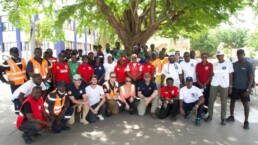
MSARC strengthens maritime mass rescue readiness through training and national live exercise off Dakar, Senegal
Joint MSARC–FHAS programme combines three days of SAR training with a national multi-agency live exercise The Maritime Search and Rescue Council ,…
Sogese report deliveries are still being delayed as container freight rates fluctuate
FOR IMPORTERS Spot rates into the Mediterranean are back at January levels, Far East to Europe reliability sits at pandemic lows, and nearly…
Glencore begins trading on Australian Securities Exchange
Glencore has begun trading on the Australian Securities Exchange under the ASX code GLC. Gary Nagle, Glencore’s CEO, said it was an exciting day for…
BIMCO Shipping Number of the Week
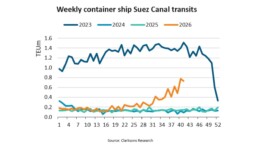
Suez Canal container ship transits exceed 50% of pre-disruption levels "During the first two weeks of October, weekly container ship capacity…
Subscribe to our newsletter!
if you dont want to swim alone in the ocean of news, sign up for the newsletter, and you will receive daily all the important news of world shipping!
