Fertilizer markets suffer from Arabian Gulf Conflict Market Insights

Iran- USA/Israel Conflict impact on fertiliser markets
While global markets are currently preoccupied with the potential impact of escalating Middle East tensions on oil, the crisis also poses a significant, though less discussed, risk to fertiliser supply chains. This disruption could ultimately affect global agriculture and food prices. Given the Arabian Gulf’s crucial role in global fertilizer production and export, it is essential to consider the implications of the current crisis for the agricultural sector, apart from the primary focus on energy.
TSOP waypoints data (Strait of Hormuz EW), for the agriculture cargo type, is already capturing the near standstill of vessel count from the onset of the crisis. If sustained, disruptions to fertiliser exports could create challenges for agricultural producers, potentially influencing crop yields and contributing to upward pressure on food prices in the months ahead.
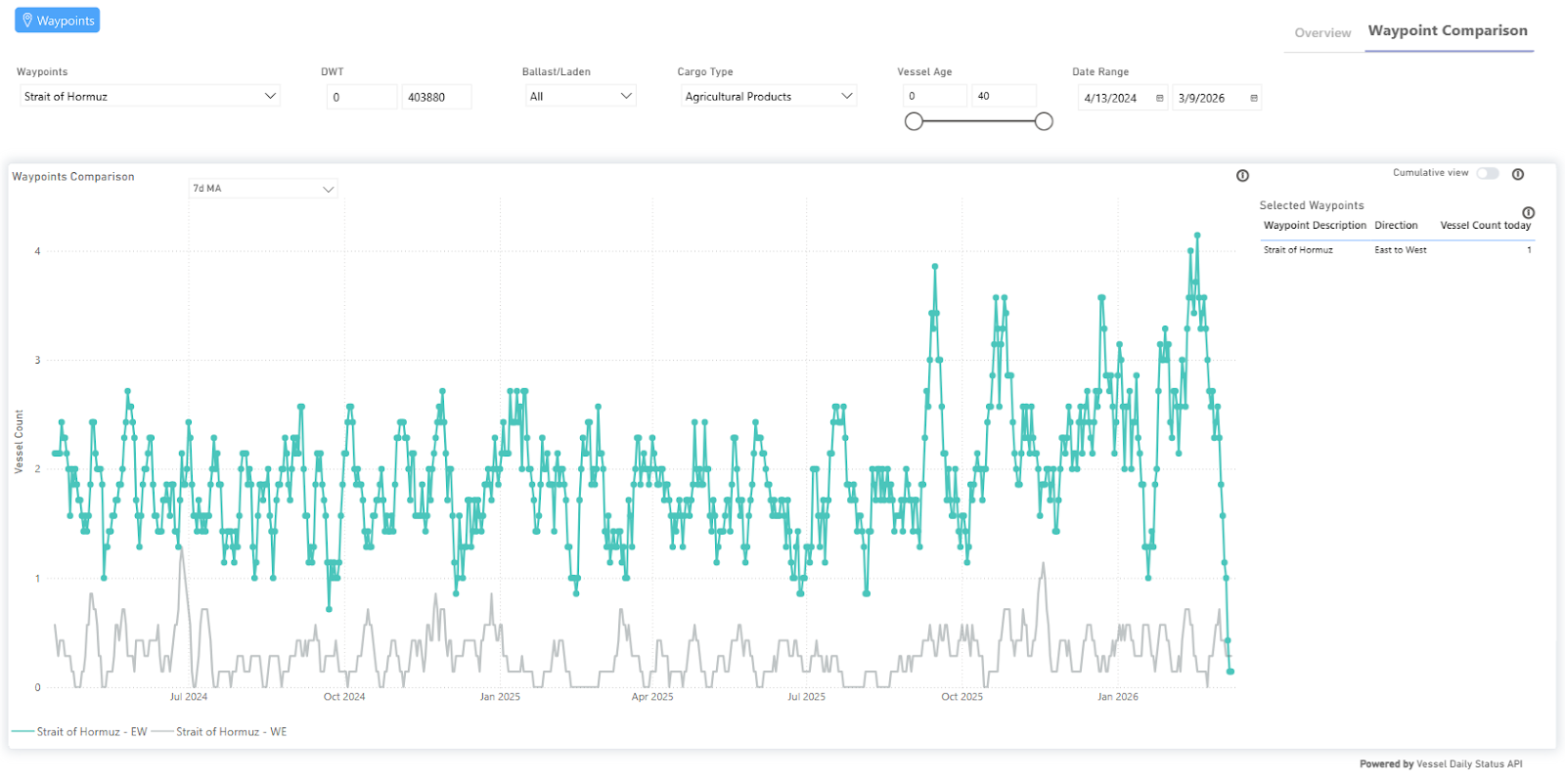
In our analysis below, we take a closer look at what if the conflict persists could mean for the fertiliser supply chain that also depends heavily on the Gulf.
Fertiliser Flows
- ~20% of all fertiliser flows originate from the Arabian Gulf
- ~46% of global urea flows from the Arabian Gulf

The Arabian Gulf is one of the most important regions for global fertiliser production and trade. Countries including Saudi Arabia, Qatar, Oman, and the United Arab Emirates host major facilities producing key inputs such as urea, sulphur, and ammonia. Iran is also a notable producer of ammonia, an essential component used in nitrogen-based fertilizers.
Given the region’s central role in fertiliser production and exports, developments affecting logistics and maritime transit in the Gulf are closely monitored by agricultural and commodity markets.
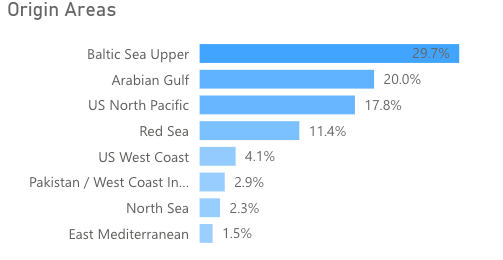
Signal Ocean recorded that 20% of all fertiliser flows originated from the Arabian Gulf in 2025. This proportionality increases to 46% when considering only urea, the most widely used nitrogen fertiliser globally.
As a result, with the Iran-US/Israel war effectively closing the Strait of Hormuz, the market could lose between 3-4mt of fertiliser a month, with the two most populated countries in the world, India and China, being the most exposed.
Exposure of Major Importers
- India and China are most exposed to limited fertilizer flows from the Arabian Gulf, as the region accounts for 23% and 20% of all fertiliser imports, respectively.

Potential Agricultural Effects of Reduced Fertiliser Flows from the Arabian Gulf
A reduced flow of fertiliser from the Arabian Gulf will have substantial knock-on effects for agricultural yields in the coming year. In situations like this, there tends to be a chain of events that farmers use to mitigate the impact.
Lower fertiliser application
The first is that producers use less fertiliser. There is evidence that most producers use more fertiliser than needed as an insurance policy. However, less fertilizer does make crops less robust against challenging weather conditions such as drought or intense heat. This would likely lead to smaller crop yields, with the weather being the swing factor in terms of how much they fall.
Shifts in crop selection
The second is that farmers switch to crops that require less nitrogen, opting for legumes such as soybeans rather than corn. The obvious outcome of this is that there is a glut of a certain crop and a lack of another. Corn, for instance, is nitrogen-intensive to produce; if enough producers swapped out of producing this, animal feed prices would likely rise, impacting the cost of meat or farmed fish.
Reduced planting on marginal land
The third is that farmers reduce planting in marginal areas. This cuts initial costs and increases efficiency as less profitable land, which requires more fertiliser, is not used. The outcomes for farmers are a better return per acre planted. The issues arise from a compounding effect of multiple farmers following this, with a global decrease in yields. The effect of higher food prices comes later.
Takeaway
Overall, the disruption of fertiliser flows from the Arabian Gulf is likely to tighten global agricultural supply, particularly for nitrogen-intensive crops such as corn and wheat. While farmers may partially mitigate the impact through reduced fertilizer use, crop switching, and focusing on higher-yield areas, these measures cannot fully offset the loss of inputs. The result is likely to be smaller global harvests, higher feed and food prices, and increased volatility in agricultural commodity markets, with major importers like India and China feeling the effects most acutely. Markets will closely watch alternative exporters, such as the United States and Brazil, as they may step in to fill supply gaps, but the timing and scale of such responses will determine the severity of the impact.
Source:Signal



Related News.

Navigating the Multi-Orbit Era: In Conversation with Intellian’s Jon Harrison at SMM 2026
At SMM 2026 in Hamburg, the rapid evolution of maritime satellite communications took centre stage. Across the exhibition halls, discussions among…
Cyprus ports need joint energy and investment strategy, shipping agents chief says
Cyprus needs a coordinated strategy for shipping, energy and environmental protection to support port investment and modernisation, Cyprus shipping…

MASO Public Affairs introduces MASO Regulatory Intelligence
A new subscription service helping businesses understand what is changing and what it means for them MASO Public Affairs introduces MASO Regulatory…
Anglo-Eastern helps turn CMBTECH’s ammonia ambition into an operational reality
From early feasibility study and risk-based design to newbuilding supervision, crew readiness and technical management, Anglo-Eastern drew on its…

Escalation of attacks threatens to derail recovery in Middle East oil exports
World oil demand is forecast to fall by 2.5 mb/d y-o-y in 4Q26 and 2.6 mb/d on average in 2026. As the Iran war manifests itself through restricted…
New study finds shipping pays twice its share to EU ETS earmarked revenues should triple to help build market for sustainable fuels and technologies
Shipping is responsible for around 10% of EU ETS emissions but pays almost 20% of the ETS bill. Unlike other sectors, it has never received free…

MSARC strengthens maritime mass rescue readiness through training and national live exercise off Dakar, Senegal
Joint MSARC–FHAS programme combines three days of SAR training with a national multi-agency live exercise The Maritime Search and Rescue Council ,…
Sogese report deliveries are still being delayed as container freight rates fluctuate
FOR IMPORTERS Spot rates into the Mediterranean are back at January levels, Far East to Europe reliability sits at pandemic lows, and nearly…

Glencore begins trading on Australian Securities Exchange
Glencore has begun trading on the Australian Securities Exchange under the ASX code GLC. Gary Nagle, Glencore’s CEO, said it was an exciting day for…
BIMCO Shipping Number of the Week
Suez Canal container ship transits exceed 50% of pre-disruption levels "During the first two weeks of October, weekly container ship capacity…
Subscribe to our newsletter!
if you dont want to swim alone in the ocean of news, sign up for the newsletter, and you will receive daily all the important news of world shipping!
