
War, China and tariffs
The eurozone economy is one of the most vulnerable to the Middle East war among the major economies. Although we anticipate that rising energy prices will be a temporary phenomenon, their negative impact is undeniable. At the same time, it’s important to remember that other structural challenges, such as strong competition from China and ongoing US trade tariffs, persist. And while the European Parliament has suspended ratification of the US trade deal following the Supreme Court’s move to strike down parts of Trump’s tariff package, we see little reason to expect a meaningful easing of tariffs anytime soon.
Slowing, but not halting the recovery
For Europe, higher energy prices essentially act as a foreign tax on households and businesses. Thanks to a high savings ratio, European consumers should generally be able to absorb these increased costs. However, the risk remains that diminished confidence could prompt households to save even more, rather than less.
The manufacturing sector faces renewed difficulties, having already endured higher energy costs compared to the US and China. Despite these challenges, manufacturing entered the year with some momentum, supported by relatively low inventory levels. Additionally, Germany’s fiscal stimulus is expected to gradually bolster the economy. As a result, we believe the current crisis will temporarily slow the recovery but not halt it altogether. We are forecasting weaker growth in the first half of the year, followed by a rebound in the second half, culminating in 1.1% GDP growth for 2026, after 1.5% in 2025.
Higher inflation
Of course, elevated energy prices will also push headline inflation higher. Moreover, February’s HICP reading was somewhat disappointing: headline inflation rose to 1.9%, still below the 2% target, but core inflation increased to 2.4%. With energy and food prices likely to add further upward pressure in the coming months, we expect second-quarter inflation to average 2.5%, raising our annual inflation forecast to 2.1%. This is still relatively low, but it is based on the assumption that there will be only a temporary surge in energy prices. Needless to say, the risk is skewed to the upside.
ECB still on hold
Since the high inflation episode in 2022, the ECB has exercised caution in labelling inflation increases as temporary. At this point, however, we do not believe a short-lived spike in energy prices will trigger significant second-round effects. Meanwhile, calls for further rate cuts, which were widespread during the dollar’s weakening earlier this year, have likely been muted by recent events. In our view, the ECB will conclude that maintaining stable interest rates is the prudent course for the foreseeable future.
Source: ING



Related News.

Navigating the Multi-Orbit Era: In Conversation with Intellian’s Jon Harrison at SMM 2026
At SMM 2026 in Hamburg, the rapid evolution of maritime satellite communications took centre stage. Across the exhibition halls, discussions among…
Cyprus ports need joint energy and investment strategy, shipping agents chief says
Cyprus needs a coordinated strategy for shipping, energy and environmental protection to support port investment and modernisation, Cyprus shipping…

MASO Public Affairs introduces MASO Regulatory Intelligence
A new subscription service helping businesses understand what is changing and what it means for them MASO Public Affairs introduces MASO Regulatory…
Anglo-Eastern helps turn CMBTECH’s ammonia ambition into an operational reality
From early feasibility study and risk-based design to newbuilding supervision, crew readiness and technical management, Anglo-Eastern drew on its…

Escalation of attacks threatens to derail recovery in Middle East oil exports
World oil demand is forecast to fall by 2.5 mb/d y-o-y in 4Q26 and 2.6 mb/d on average in 2026. As the Iran war manifests itself through restricted…
New study finds shipping pays twice its share to EU ETS earmarked revenues should triple to help build market for sustainable fuels and technologies
Shipping is responsible for around 10% of EU ETS emissions but pays almost 20% of the ETS bill. Unlike other sectors, it has never received free…

MSARC strengthens maritime mass rescue readiness through training and national live exercise off Dakar, Senegal
Joint MSARC–FHAS programme combines three days of SAR training with a national multi-agency live exercise The Maritime Search and Rescue Council ,…
Sogese report deliveries are still being delayed as container freight rates fluctuate
FOR IMPORTERS Spot rates into the Mediterranean are back at January levels, Far East to Europe reliability sits at pandemic lows, and nearly…
Glencore begins trading on Australian Securities Exchange
Glencore has begun trading on the Australian Securities Exchange under the ASX code GLC. Gary Nagle, Glencore’s CEO, said it was an exciting day for…
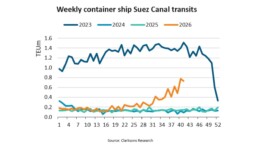
BIMCO Shipping Number of the Week
Suez Canal container ship transits exceed 50% of pre-disruption levels "During the first two weeks of October, weekly container ship capacity…
Subscribe to our newsletter!
if you dont want to swim alone in the ocean of news, sign up for the newsletter, and you will receive daily all the important news of world shipping!
