DNV verifies updated numbers for avoided CO₂ emissions for Jotun-coated vessels


Jotun, the global leading manufacturer of marine coatings, reports an estimated 11.8 million tonnes of avoided CO₂ emissions for vessels coated with its products in 2025 – an increase from 11.1 million tonnes from the year before. The result is verified based on an independent technical evaluation conducted by DNV.

The verified avoided emissions is based on the average speed loss of the vessels included in the evaluation, compared to an industry benchmark referenced in ISO 19030. The evaluation uses the DNV MASTERv2 emission prediction model combined with AIS data and Jotun-provided data on average speed loss over a five-year drydocking cycle.
“This evaluation reflects a year‑on‑year increase in the verified avoided emissions estimate, and helps quantify the link between hull performance, speed loss, and emissions. We are pleased to have an independent verification of the avoided emissions estimate based on documented speed loss performance. As the market leader in marine coatings, we are committed to delivering value to our customers that is backed up by third-party technical evaluations,” said Morten Sten Johansen, Global Category Director Hull Performance at Jotun.

In 2024 Jotun presented their avoided emissions to be 11.1 million tonnes CO₂ in avoided emissions for vessels coated by Jotun products, based on the same approach and DNV verification methodology.
“In addition to the avoided emissions estimate, we estimate this level of performance to correspond to fuel cost savings of approximately USD 2 billion. To bring the number into perspective, 11.8 million tonnes CO₂ is comparable to the annual greenhouse gas emissions of approximately 2.5 million gasoline-powered cars, based on calculations from the US EPA. These results underline the scale of potential operational value associated with hull performance,” said Johansen in Jotun.
The 2025 figure is verified on the same premises as Jotun presented for its 2024 numbers, with a margin of +2.5 million tonnes and -2.0 million tonnes CO₂. The assessment follows ISO 19030 principles by measuring average speed loss over the final four years in a 5‑year drydocking interval.

“We are pleased to support Jotun on this project. This verification quantifies an avoided CO₂ emissions estimate for the vessels included in the evaluation and provides a documented basis for discussing the potential emissions effect associated with hull performance,” said Olav Rognebakke, Head of Section Hydrodynamics and Stability at DNV.
Morten Sten Johansen in Jotun adds: “As the Home of hull performance, we will continue to focus on delivering quantifiable value to the maritime industry through our products and solutions. These verified results highlight the role hull performance can play in improving energy efficiency. Our investments into R&D and industry collaboration are part of our Clean shipping commitment – helping the industry to cut carbon emissions, preserve fuel and protect biodiversity.”



Related News.

Navigating the Multi-Orbit Era: In Conversation with Intellian’s Jon Harrison at SMM 2026
At SMM 2026 in Hamburg, the rapid evolution of maritime satellite communications took centre stage. Across the exhibition halls, discussions among…
Cyprus ports need joint energy and investment strategy, shipping agents chief says
Cyprus needs a coordinated strategy for shipping, energy and environmental protection to support port investment and modernisation, Cyprus shipping…

MASO Public Affairs introduces MASO Regulatory Intelligence
A new subscription service helping businesses understand what is changing and what it means for them MASO Public Affairs introduces MASO Regulatory…
Anglo-Eastern helps turn CMBTECH’s ammonia ambition into an operational reality
From early feasibility study and risk-based design to newbuilding supervision, crew readiness and technical management, Anglo-Eastern drew on its…

Escalation of attacks threatens to derail recovery in Middle East oil exports
World oil demand is forecast to fall by 2.5 mb/d y-o-y in 4Q26 and 2.6 mb/d on average in 2026. As the Iran war manifests itself through restricted…
New study finds shipping pays twice its share to EU ETS earmarked revenues should triple to help build market for sustainable fuels and technologies
Shipping is responsible for around 10% of EU ETS emissions but pays almost 20% of the ETS bill. Unlike other sectors, it has never received free…

MSARC strengthens maritime mass rescue readiness through training and national live exercise off Dakar, Senegal
Joint MSARC–FHAS programme combines three days of SAR training with a national multi-agency live exercise The Maritime Search and Rescue Council ,…
Sogese report deliveries are still being delayed as container freight rates fluctuate
FOR IMPORTERS Spot rates into the Mediterranean are back at January levels, Far East to Europe reliability sits at pandemic lows, and nearly…

Glencore begins trading on Australian Securities Exchange
Glencore has begun trading on the Australian Securities Exchange under the ASX code GLC. Gary Nagle, Glencore’s CEO, said it was an exciting day for…
BIMCO Shipping Number of the Week
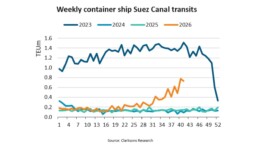
Suez Canal container ship transits exceed 50% of pre-disruption levels "During the first two weeks of October, weekly container ship capacity…
Subscribe to our newsletter!
if you dont want to swim alone in the ocean of news, sign up for the newsletter, and you will receive daily all the important news of world shipping!
