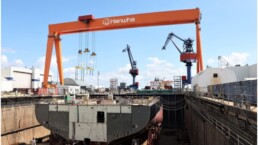

The Center Focuses on Workforce Development, Technology Exchange, and Local Investment to Implement MASGA Project
According to industry sources on Feb. 12, the governments of both countries are conducting behind-the-scenes negotiations to establish a local U.S. base for Korean shipbuilding companies’ investment in the U.S., local market entry, and personnel and technology exchanges.
The most likely plan is to complete the comprehensive center in Washington, U.S., which aims to materialize the MASGA project that served as a key element in Korea-U.S. tariff negotiations last year. The center, expected to be completed as early as June-July this year, will carry out work to materialize local construction of U.S. vessels, technology transfer, and workforce development.
First, the center will fully launch workforce development programs to improve the fundamentals of the U.S. shipbuilding industry. The government has allocated 6.644 billion won in this year’s Ministry of Trade, Industry and Energy budget for projects related to the “Korea-U.S. Shipbuilding and Maritime Industry Technology Cooperation Center.” This is aimed at training shipbuilding workers who will collaborate with Korean skilled workers and engineers. Half of the total budget, 3.45 billion won, will be invested in the MASGA Academy operation project to conduct technical education programs including practical training in U.S. vessel design, yard production consulting, and expert dispatch. Korea’s three major shipbuilders—HD Korea Shipbuilding & Offshore Engineering, Hanwha Ocean, and Samsung Heavy Industries—are also expected to join this program and lend their support.
Joint research and development (R&D) projects will also be carried out to introduce ship process automation systems and establish production lines to improve the fundamentals of the U.S. shipbuilding industry. Major government-funded shipbuilding and maritime research institutes, public institutions, and associations are expected to participate in this project.
However, obstacles remain to be overcome. First, procedures such as FCL must ultimately be followed to build U.S. naval vessels. FCL is a certification essential for participating in U.S. naval vessel construction and Maintenance, Repair, and Overhaul (MRO) projects, and is granted by the U.S. Defense Counterintelligence and Security Agency (DCSA) after evaluating a company’s or facility’s capability to handle classified information. In addition, ITAR (International Traffic in Arms Regulations), which controls munitions and defense technology, must be relaxed for joint construction and design of naval vessels to be possible.
An industry insider said, “The shipbuilding industry has a structure where production is customized according to customers’ demands based on orders, making it difficult for companies to proactively determine the scale of local U.S. investment or specific schedules,” adding, “We are considering areas where inter-company negotiations can take place even before the government-to-government negotiation process or the passage of related laws.”
Source: BusinessKorea



Related News.

Navigating the Multi-Orbit Era: In Conversation with Intellian’s Jon Harrison at SMM 2026
At SMM 2026 in Hamburg, the rapid evolution of maritime satellite communications took centre stage. Across the exhibition halls, discussions among…
Cyprus ports need joint energy and investment strategy, shipping agents chief says
Cyprus needs a coordinated strategy for shipping, energy and environmental protection to support port investment and modernisation, Cyprus shipping…

MASO Public Affairs introduces MASO Regulatory Intelligence
A new subscription service helping businesses understand what is changing and what it means for them MASO Public Affairs introduces MASO Regulatory…
Anglo-Eastern helps turn CMBTECH’s ammonia ambition into an operational reality
From early feasibility study and risk-based design to newbuilding supervision, crew readiness and technical management, Anglo-Eastern drew on its…

Escalation of attacks threatens to derail recovery in Middle East oil exports
World oil demand is forecast to fall by 2.5 mb/d y-o-y in 4Q26 and 2.6 mb/d on average in 2026. As the Iran war manifests itself through restricted…
New study finds shipping pays twice its share to EU ETS earmarked revenues should triple to help build market for sustainable fuels and technologies
Shipping is responsible for around 10% of EU ETS emissions but pays almost 20% of the ETS bill. Unlike other sectors, it has never received free…

MSARC strengthens maritime mass rescue readiness through training and national live exercise off Dakar, Senegal
Joint MSARC–FHAS programme combines three days of SAR training with a national multi-agency live exercise The Maritime Search and Rescue Council ,…

Sogese report deliveries are still being delayed as container freight rates fluctuate
FOR IMPORTERS Spot rates into the Mediterranean are back at January levels, Far East to Europe reliability sits at pandemic lows, and nearly…
Glencore begins trading on Australian Securities Exchange
Glencore has begun trading on the Australian Securities Exchange under the ASX code GLC. Gary Nagle, Glencore’s CEO, said it was an exciting day for…
BIMCO Shipping Number of the Week
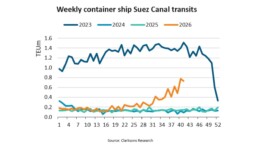
Suez Canal container ship transits exceed 50% of pre-disruption levels "During the first two weeks of October, weekly container ship capacity…
Subscribe to our newsletter!
if you dont want to swim alone in the ocean of news, sign up for the newsletter, and you will receive daily all the important news of world shipping!
