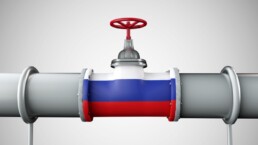

Yesterday, the 27 EU member states formally adopted the regulation on phasing out Russian imports of both pipeline gas and liquified natural gas (LNG) into the EU. The new rules also include measures on effective monitoring and diversification of energy supply.
The regulation is a key milestone in delivering the REPowerEU objective of ending the EU’s reliance on Russian energy.
‘’As of today, the EU energy market will be stronger, more resilient and more diversified. We are breaking away from detrimental reliance on Russian gas and taking a major step, in a spirit of solidarity and cooperation, towards an autonomous Energy Union.’’
Michael Damianos, Minister for Energy, Commerce and Industry of the Republic of Cyprus
Stepwise ban, strict monitoring and diversification
According to the regulation, importing Russian pipeline gas and LNG into the EU will be prohibited. The ban will start to apply six weeks after the regulation enters into force. Existing contracts will have a transition period. This stepwise approach will limit the impact on prices and markets. A full ban will take effect for LNG imports from the beginning of 2027 and for pipeline gas imports from autumn 2027.
Before authorising entry of gas imports into the Union, EU countries will verify the country where gas was produced.
Non-compliance with the new rules may result in maximum penalties of at least € 2,5 million for individuals and at least € 40 million for companies, at least 3,5 % the company’s total worldwide annual turnover, or 300 % of the estimated transaction turnover.
By 1 March 2026, EU countries must prepare national plans to diversify gas supplies and identify potential challenges in replacing Russian gas. To that end, companies will be required to notify authorities and the Commission of any remaining Russian gas contracts. EU countries still importing Russian oil will also have to submit diversification plans.
Security of supply in emergencies
In the event of a declared emergency, and if security of supply is seriously threatened in one or more EU countries, the Commission may suspend the import ban for up to four weeks.
Next steps
The regulation will now be published in the Official Journal of the EU. It will enter into force one day after publication and will apply directly in all EU countries.
The Commission also plans to propose legislation to phase out Russian oil imports by the end of 2027.
Background
Following Russia’s war of aggression against Ukraine and the use of energy as a weapon, EU leaders agreed, in the Versailles Declaration of March 2022, to phase out dependence on Russian fossil fuels as soon as possible.
Consequently, gas and oil imports from Russia to the EU have both decreased significantly in recent years. However, while imports of oil have dropped to below 3% in 2025 as a result of the current sanctions regime, Russian gas still accounts for an estimated 13% of EU imports in 2025, worth over €15 billion annually. This leaves the EU exposed to significant risks in terms of its trade and energy security.
Source: European Council



Related News.

Navigating the Multi-Orbit Era: In Conversation with Intellian’s Jon Harrison at SMM 2026
At SMM 2026 in Hamburg, the rapid evolution of maritime satellite communications took centre stage. Across the exhibition halls, discussions among…
Cyprus ports need joint energy and investment strategy, shipping agents chief says
Cyprus needs a coordinated strategy for shipping, energy and environmental protection to support port investment and modernisation, Cyprus shipping…

MASO Public Affairs introduces MASO Regulatory Intelligence
A new subscription service helping businesses understand what is changing and what it means for them MASO Public Affairs introduces MASO Regulatory…
Anglo-Eastern helps turn CMBTECH’s ammonia ambition into an operational reality
From early feasibility study and risk-based design to newbuilding supervision, crew readiness and technical management, Anglo-Eastern drew on its…

Escalation of attacks threatens to derail recovery in Middle East oil exports
World oil demand is forecast to fall by 2.5 mb/d y-o-y in 4Q26 and 2.6 mb/d on average in 2026. As the Iran war manifests itself through restricted…

New study finds shipping pays twice its share to EU ETS earmarked revenues should triple to help build market for sustainable fuels and technologies
Shipping is responsible for around 10% of EU ETS emissions but pays almost 20% of the ETS bill. Unlike other sectors, it has never received free…

MSARC strengthens maritime mass rescue readiness through training and national live exercise off Dakar, Senegal
Joint MSARC–FHAS programme combines three days of SAR training with a national multi-agency live exercise The Maritime Search and Rescue Council ,…
Sogese report deliveries are still being delayed as container freight rates fluctuate
FOR IMPORTERS Spot rates into the Mediterranean are back at January levels, Far East to Europe reliability sits at pandemic lows, and nearly…

Glencore begins trading on Australian Securities Exchange
Glencore has begun trading on the Australian Securities Exchange under the ASX code GLC. Gary Nagle, Glencore’s CEO, said it was an exciting day for…
BIMCO Shipping Number of the Week
Suez Canal container ship transits exceed 50% of pre-disruption levels "During the first two weeks of October, weekly container ship capacity…
Subscribe to our newsletter!
if you dont want to swim alone in the ocean of news, sign up for the newsletter, and you will receive daily all the important news of world shipping!
