Korea’s renewed shipbuilding boom reignites grievances over subcontractor bonuses
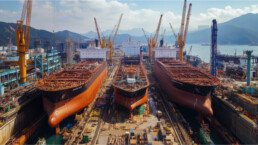

As profits return to Korea’s shipyards after years of stagnation, so has an old fault line. A dispute over performance bonuses is exposing persistent inequalities between full-time workers and the subcontracted labor that underpins much of the industry.
Korea’s shipbuilders have reclaimed a global order share above 20 percent, signaling a return to a boom cycle as new contracts flow in and shipbuilding cooperation with the United States gathers momentum under the bilateral “Make American Shipbuilding Great Again” initiative.
As of Monday, major shipbuilders, including HD Hyundai, Samsung Heavy Industries and Hanwha Ocean, were finalizing their 2025 business results while weighing the size and timing of performance bonus payments, industry insiders said.
The combined operating profit of HD Korea Shipbuilding & Offshore Engineering, Samsung Heavy Industries and Hanwha Ocean is expected to reach 6.21 trillion won ($4.3 billion) in 2025, an increase of about 35 percent from the previous year, according to financial data provider FnGuide.
HD Hyundai, which has typically paid bonuses in December, delayed payments until February. A company official said the move was intended to “accurately reflect last year’s management performance when determining compensation.” But industry observers say the delay also reflects growing pressure to reassess bonus structures as calls for equal treatment of regular and subcontracted workers gain traction.
Samsung Heavy Industries is expected to pay bonuses under its excess profit incentive (OPI) system after completing its annual settlement. Under the OPI program, employees receive up to 20 percent of profits exceeding annual targets, capped at 50 percent of their annual salary.
The debate over bonuses has highlighted the shipbuilding industry’s complex labor structure. Shipyards rely on large numbers of workers across welding, piping, assembly and outfitting, but the industry’s exposure to economic cycles has made companies reluctant to expand permanent payrolls. Instead, they have long depended on extensive networks of in-house subcontractors.
According to the Ministry of Employment and Labor’s 2025 employment-type disclosure, subcontracted workers account for 63 percent of the shipbuilding work force, or roughly 71,000 people — nearly four times the average across all industries.
That structure has entrenched disparities between regular employees and subcontracted workers, particularly in pay and benefits. Shipbuilders typically allocate a total bonus pool to subcontracting firms based on annual performance indicators, leaving each firm to distribute payments according to its own standards, such as individual performance and length of service. Samsung Heavy Industries has been a notable exception, applying the same bonus criteria to both groups.
The Korean Metal Workers’ Union said subcontracted shipyard workers received year-end bonuses last year that were between 11.39 percent and 47.5 percent lower than those paid to regular employees. At Hanwha Ocean, for example, regular employees received bonuses equivalent to 150 percent of base pay in 2024, while subcontracted workers received just 75 percent.
The issue took on new significance after a court ruling in July last year recognized Hanwha Ocean’s user responsibility — when it operated as Daewoo Shipbuilding & Marine Engineering — for bonuses and tuition support. The company subsequently agreed to pay equal bonuses to regular and subcontracted workers, a decision that sent ripples across the industry.
President Lee Jae Myung referenced the case during a Ministry of Employment and Labor briefing last December, calling it “a desirable corporate culture.” The shipbuilding subcontractor branch of the metalworkers’ union has since called for equal bonus rates to be extended across all major shipyards.
Tensions have intensified ahead of the March implementation of revisions to Article 2 of the Trade Union and Labor Relations Adjustment Act, widely known as the “Yellow Envelope Act.” Until now, compensation systems at subcontracting firms were largely viewed as internal matters. Under the revised law, however, subcontracted workers gain the right to bargain directly with prime contractors if those companies exercise substantial control over their working conditions.
“Each subcontractor operates under a different wage system, and applying the same bonus rate would require [companies] to closely examine how those systems work,” a business insider said. Such an approach could “undermine subcontractors’ managerial independence or be interpreted as recognizing the prime contractor as the actual employer,” the insider added.
Lee Young-myon, a professor of business administration at Dongguk University, said Hanwha Ocean’s decision to effectively guarantee subcontractor bonuses could strengthen the case for direct bargaining under the revised law.
Still, he noted that “once the Yellow Envelope Act is fully implemented, courts will determine employer responsibility on a case-by-case basis.”
“Given the level of social attention the issue has drawn, companies and labor groups will need to reach agreements from a cooperative standpoint,” he said.
Source: Korea JoongAng Daily



Related News.
Hong Kong Global Maritime Trade Summit to return for third edition
The International Chamber of Shipping, in collaboration with the Transport and Logistics Bureau of the Government of Hong Kong and the Hong Kong…

Appetite for US crude oil exports climbs despite high freight
South Korea tops US crude destinations at 568,600 b/d VLCC rates to Asia double, closing arbitrage window European refining margins…

Shipping stocks Rally as Hormuz Traffic plunges 75%
Ship traffic through the Strait of Hormuz — a critical chokepoint handling about 20% of global crude oil and liquefied natural gas shipments — has…
Diana Shipping announces Time Charter Contract for m/v G P Zafirakis with Classic Maritime
Diana Shipping, a global shipping company specializing in the ownership and bareboat charter-in of dry bulk vessels, announced that, through a…
New IMO ESP Code framework for Remote Inspection Techniques
The International Maritime Organisation, through Resolution MSC.584(111) , has adopted amendments to the International Code on the Enhanced…

ABS opens Offshore & Marine Support Center in Bergen
ABS has expanded its capabilities in the Norwegian maritime market with the opening of a cutting-edge support center in Bergen, bringing advanced…
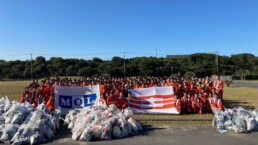
MOL holds giant step memorial ceremony and beach cleanup at Kashima Coast
Memorial and Reflection 20 Years After the Accident: Learning from the Past to Foster an Even Stronger Safety Culture Mitsui O.S.K. Lines, announced…

KEZAD-based Arabian Gulf Steel Industries achieves lowest verified Carbon Footprint for Rebar
CARES UK verified Environmental Product Declaration confirms 139 kg CO₂e per tonne for rebar produced at AGSI’s KEZAD Abu Dhabi facility Arabian…
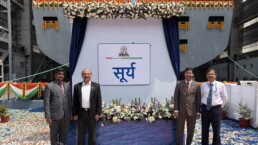
Indian Register of Shipping announces launch of first fleet support ship INS Surya
Indian Register of Shipping continues to strengthen its role in supporting the Indian Navy and India’s naval shipbuilding capabilities through the…
VLCCs Climbing the Record Charts
LR2 The TC1 75kt MEG/Japan index decreased by only a single point this week to WS928. The corresponding Baltic round-trip TCE fell by $2,000 to…
Subscribe to our newsletter!
if you dont want to swim alone in the ocean of news, sign up for the newsletter, and you will receive daily all the important news of world shipping!
