Korea boosts ship engine sales to China as boom lifts dual-fuel demand
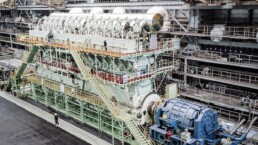

Korean engine makers win more Chinese orders as trust in dual‑fuel tech grows
As the shipbuilding industry enters a super-boom phase, China-bound exports by Korea’s ship engine manufacturers are increasing. The trend is expected to continue this year.
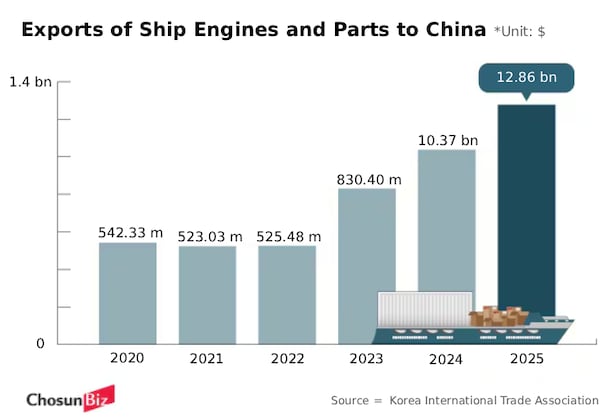
According to trade statistics from the Korea International Trade Association on the 19th, Korea’s exports of ship engines and parts to China last year totaled $1,286,020,000 (about 1.8945 trillion won), up 24% from a year earlier.
Compared with 2023 and 2022, this represents sharp increases of 54.8% and 144.7%, respectively. China’s shipbuilding industry, which holds an overwhelming No. 1 position with 63% of global ship orders, is continuing to increase orders for Korean-made engines.
Following last year, orders for ship engines from China to Korean corporations are continuing this year as well. Hanwha Engine on the 14th signed a contract to supply ship engines worth 433.9 billion won with a Chinese shipowner.
HD Hyundai Marine Engine also on the 8th signed a ship engine supply contract worth 24.259 billion won with Jiangsu New Yangzi Shipbuilding, China’s largest private shipyard, and on the 9th signed a ship engine supply contract worth 62.15 billion won with Taizhou Sanfu Ship Engineering Co. (TSSE).
Chinese sales account for a large share of Korean engine manufacturers’ revenue. Of Hanwha Engine’s orders, which cover about three years’ worth of volume, 47% were placed by Chinese shipyards. Of last year’s third-quarter revenue of 258.2 billion won, 50.4 billion won, or 19.5%, came from China.
Orders from Chinese shipyards are expected to continue increasing. Orders for container ships stalled last year due to the impact of U.S. Trade Representative restrictions on the entry of Chinese vessels, but as the sanctions were deferred, orders are expected to rise again.
Engines widely used in container ships recently are dual-fuel engines (engines equipped with both heavy fuel oil and eco-friendly fuel and able to switch between them), a segment where Korean companies have an edge over China.
An industry official said, “Given the conservative nature of the industry, shipowners tend to prefer Korean-made engines with high technological reliability when ordering dual-fuel engines,” adding, “If orders for container ships in China increase, it could benefit Korean companies.”
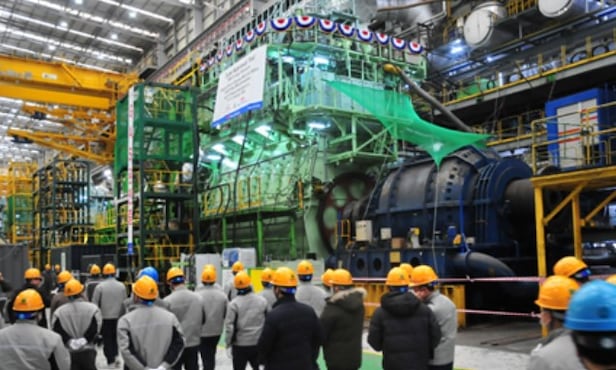
Meanwhile, engine makers are also increasing eco-friendly investments amid the boom. Hanwha Engine late last year acquired SEAM, a Norwegian specialist in electric propulsion and power automation systems, for about 290 billion won.
HD Hyundai Heavy Industries in 2024 developed an eco-friendly ammonia dual-fuel engine. HD Hyundai Marine Engine also plans to maximize production efficiency by improving gas-engine production facilities, repairing aging facilities, and upgrading processes in preparation for a higher share of eco-friendly engines. Among dual-fuel engines, methanol and ammonia dual engines emit less carbon than the currently most widely used LNG (liquefied natural gas) dual engines.
Source: Chosun Biz



Related News.

Poland’s additional national requirements distort competition says Danish Shipping
Poland has introduced a national survey requirement for smaller foreign-flagged vessels operating in Polish waters. This creates significant…

Battery Vessels could help electrify most of Global Shipping Emissions
Battery-electric ships are economical only if the pack is cycled frequently, so they have been confined to short-sea, ferry and harbour vessels…

Mintra and Ledgid explore collaboration to connect Maritime digital identity, learning and workforce development
Mintra® and LEDGID are exploring opportunities to bring together complementary capabilities in digital learning, maritime training, professional…

World Shipping Council calls for global agreement on shipping emissions as industry investment surpasses $200 billion USD
The World Shipping Council (WSC) is calling on governments to agree on binding global greenhouse gas regulations for international shipping without…

What happened to the ITF whistleblower’s complaint?
In January 2026, a whistleblower complained that International Transport Workers’ Federation (ITF) General Secretary Stephen Cotton had manipulated…

Growing regulatory scrutiny puts seafarer wellbeing firmly on maritime safety agenda, VIKAND warns
Seafarer wellbeing is coming under greater regulatory scrutiny as international rules and guidance increasingly recognise crew health and welfare as…

Good Times Bad Times the Premium Stays with the Strait
In October, we wrote that if the transfer network off Oman kept pace, Gulf crude would carry China's refill and keep drawing tonnage east,…

Allied Weekly Market Review Week 47
Pls find below the Allied - Weekly Market Review - Week 47 ALLIED - Weekly Market Report- Week 47


Climate TRACE releases September 2026 Emissions Data
Climate TRACE reported that global greenhouse gas (GHG) emissions for the month of September 2026 totaled 4.7 billion tonnes CO₂e. This remains…
Subscribe to our newsletter!
if you dont want to swim alone in the ocean of news, sign up for the newsletter, and you will receive daily all the important news of world shipping!
