HD Hyundai invest up to 3 trillion won to build major shipyard in India
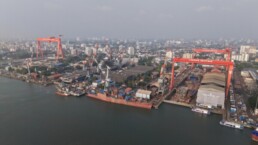

HD Hyundai is embarking on its first major shipyard construction project in India. The company announced on Dec. 8 that it signed an “Exclusive Memorandum of Understanding for New Shipyard Construction” in Madurai, Tamil Nadu, southern India, with Tamil Nadu Chief Minister M. K. Stalin and Industry Minister T. R. B. Rajaa in attendance. Indian media reported that up to $2 billion will be invested in the construction of the new shipyard, which is expected to be located in the Thoothukudi region of Tamil Nadu. If the actual investment is made, it is expected to become India’s largest shipyard. However, HD Hyundai explained that since specific details such as the shipyard site have not yet been finalized, the investment scale cannot be estimated at this point.
The Indian government had initially proposed five candidate sites including Tamil Nadu, Gujarat, and Andhra Pradesh for the new shipyard site and had been advocating for support. Among these, HD Hyundai partnered with the Tamil Nadu state government, which was the most proactive in presenting shipyard attraction as a regional growth strategy and offering various incentives, subsidies, and infrastructure expansion.
Additionally, HD Hyundai signed an “MOU for Expanding Crane Business Cooperation” with BEML, a state-owned enterprise under India’s Ministry of Defense, thereby establishing a supply chain for equipment and materials alongside the shipyard establishment. Through this cooperation, they plan to collaborate in all processes from crane design to production to strengthen shipbuilding capabilities within India. An HD Hyundai official said, “India is a market with great growth potential due to the government’s strong willingness to foster the shipbuilding industry,” adding, “We will continuously expand cooperation in the shipbuilding and marine sectors to make it a long-term growth engine.”
HD Hyundai’s decision to pursue new shipyard construction in India stems from forecasting significant growth potential in India’s shipbuilding industry. With the Indian government promoting shipbuilding revival as a national strategic industry, large-scale orders for both naval vessels and general commercial ships are expected in the future.
According to HD Hyundai and the industry on Dec. 8, the Indian government is pursuing shipbuilding industry promotion policies such as the “Maritime Amrit Kaal Vision 2047 (MAKV 2047)” with the goal of becoming one of the world’s top 5 shipbuilding powers by 2047. This ambitious plan includes establishing an annual production system of over 500,000 GT (gross tonnage), raising the oil tanker localization rate from just 5% in 2023 to 69% by 2047, and expanding the current fleet of 1,500 commercial vessels to 2,500 ships.
The background for the Indian government’s intensive development of shipbuilding as a national strategic industry is that the competitiveness of the shipbuilding industry has significantly weakened compared to the past, reducing India’s competitiveness in defense and economic aspects. In fact, India’s ship construction volume maintained a world top-10 position with over 300,000 GT annually in the early 2000s, but fell to 16th place last year with 40,000 GT, accounting for 0.06% of global ship construction.
Nearly half (46%) of India’s commercial vessels are over 20 years old and outdated, and shipyards are also too small in scale to handle new ship demand. Even Cochin Shipyard, which can be considered the largest in India, is known to be capable of building only ships under 250m in length, making it impossible to even consider constructing ultra-large vessels such as oil tankers.
HD Hyundai’s pursuit of new shipyard construction in Thoothukudi, Tamil Nadu, southern India, is a strategic choice that simultaneously targets India’s shipbuilding industry situation and the Indian government’s promotion policies. In India, large-scale new construction orders are already pouring out, mainly from state-owned enterprises. Shipping Corporation of India (SCI) announced a $2.3 billion ship construction plan by 2030 for fleet replacement and expansion, and state-owned oil companies are also preparing large-scale ship orders.
HD Hyundai has also been maintaining close relationships with the Indian government and shipbuilding industry, having identified this Indian shipbuilding industry environment and established cooperation with India’s Cochin Shipyard in design, procurement, productivity improvement, and naval landing craft projects. An industry insider said, “India has a strong will to develop the shipbuilding industry for naval power enhancement and energy logistics internalization,” adding, “This aligns with the needs of Korean shipbuilders seeking to secure long-term growth engines through new market development.”
Additionally, the fact that Chinese shipyards cannot enter the Indian market due to the influence of U.S.-China trade conflicts is cited as one of the reasons HD Hyundai decided to pursue Indian shipyard construction. India’s state-owned energy company ONGC excluded Chinese shipbuilding companies when ordering 100,000 cubic meter ethane carriers in May. HD Hyundai gained confidence in local market entry as India supported the movement to exclude Chinese companies.
Although HD Hyundai has decided to partner with the Tamil Nadu state government to establish a local shipyard, approval from the Indian central government remains before actual construction can begin. Currently, the Indian government has been reviewing new shipyard sites among five candidate locations including Tamil Nadu, Gujarat, and Andhra Pradesh. HD Hyundai sees a high possibility of being selected as the shipyard site given Tamil Nadu’s competitive location and climate.
Tamil Nadu’s average annual temperature is about 28 degrees Celsius, which is not as hot compared to other regions in India, and during the monsoon season that begins after September, it rains for only about 15 days, making it suitable for operating shipyards that require extensive outdoor work. Additionally, it has similar topography to Ulsan, where HD Hyundai Heavy Industries’ shipyard is located, and Thoothukudi has a large port, making it advantageous for ship entry and exit.
If HD Hyundai completes the Thoothukudi shipyard, it is expected to become India’s largest private shipyard. Locally, the investment scale is expected to reach $2 billion (approximately 2.9 trillion won), and the industry expects that this level of investment could build 2-3 large docks. An HD Hyundai official said, “Although the central government’s site selection remains, we judge the possibility to be high given our competitiveness compared to other regions.”
Source:Business Korea



Related News.

Navigating the Multi-Orbit Era: In Conversation with Intellian’s Jon Harrison at SMM 2026
At SMM 2026 in Hamburg, the rapid evolution of maritime satellite communications took centre stage. Across the exhibition halls, discussions among…

Cyprus ports need joint energy and investment strategy, shipping agents chief says
Cyprus needs a coordinated strategy for shipping, energy and environmental protection to support port investment and modernisation, Cyprus shipping…

MASO Public Affairs introduces MASO Regulatory Intelligence
A new subscription service helping businesses understand what is changing and what it means for them MASO Public Affairs introduces MASO Regulatory…

Anglo-Eastern helps turn CMBTECH’s ammonia ambition into an operational reality
From early feasibility study and risk-based design to newbuilding supervision, crew readiness and technical management, Anglo-Eastern drew on its…

Escalation of attacks threatens to derail recovery in Middle East oil exports
World oil demand is forecast to fall by 2.5 mb/d y-o-y in 4Q26 and 2.6 mb/d on average in 2026. As the Iran war manifests itself through restricted…

New study finds shipping pays twice its share to EU ETS earmarked revenues should triple to help build market for sustainable fuels and technologies
Shipping is responsible for around 10% of EU ETS emissions but pays almost 20% of the ETS bill. Unlike other sectors, it has never received free…

MSARC strengthens maritime mass rescue readiness through training and national live exercise off Dakar, Senegal
Joint MSARC–FHAS programme combines three days of SAR training with a national multi-agency live exercise The Maritime Search and Rescue Council ,…

Sogese report deliveries are still being delayed as container freight rates fluctuate
FOR IMPORTERS Spot rates into the Mediterranean are back at January levels, Far East to Europe reliability sits at pandemic lows, and nearly…

Glencore begins trading on Australian Securities Exchange
Glencore has begun trading on the Australian Securities Exchange under the ASX code GLC. Gary Nagle, Glencore’s CEO, said it was an exciting day for…

BIMCO Shipping Number of the Week
Suez Canal container ship transits exceed 50% of pre-disruption levels "During the first two weeks of October, weekly container ship capacity…
Subscribe to our newsletter!
if you dont want to swim alone in the ocean of news, sign up for the newsletter, and you will receive daily all the important news of world shipping!
