Commission unveils nearly €3bn to scale up green fuels for aviation and maritime transport
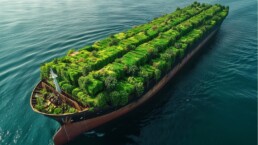

The plan to step up financing for sustainable fuels in shipping and aviation by 2027 comes as the bloc is falling short of decarbonising heavy transport by 2050.
The European Commission announced a €2.9 billion plan to scale up investments in green fuels by 2027 to curb carbon dioxide emissions from aviation and maritime transport, which together account for roughly 26.4% of EU transport-sector emissions.
With the EU’s binding climate goal of achieving climate-neutrality by 2050, compared to 1990 levels, slashing emissions in aviation and maritime transport is both essential and challenging for the EU27.
Commercial planes and ships are the hardest transports to decarbonise, and to this day they are still powered mainly by fossil fuels, despite EU legislation meant to help the shipping and aviation sectors to become climate-neutral.
“The package is about strengthening Europe’s competitiveness while moving decisively towards a net-zero future. By investing in scaling up renewable and low-carbon fuels, we are making Europe’s transport system cleaner, more resilient and more affordable for citizens,” said Commissioner for Sustainable Transport and Tourism Apostolos Tzitzikostas.
The EU executive estimates that around 20 million tonnes of sustainable fuels, including biofuels and e-fuels, will be needed by 2035 to meet green fuel targets for aviation and maritime transport. Achieving this will require an estimated €100 billion in investment, the Commission stated.
The nearly €3 billion announced on Wednesday is expected to be disbursed from the EU’s multiannual budget, running until 2027, to be invested in renewable and low-carbon fuel technologies.
Under existing EU law, the maritime sector must reduce its greenhouse gas (GHG) emissions by 2% from 2025, compared to 2020 levels. By 2050, shipping is expected to reduce its GHG intensity by 80%.
The aviation sector is expected to have 20% of sustainable aviation fuel (SAF) — feedstocks like used cooking oil, agricultural waste and captured carbon — supplied at EU airports from 2035. Five per cent needs to be e-SAF — a type of synthetic jet fuel made from carbon dioxide, water, and renewable electricity.
By 2050, green fuels for aviation must account for 70%, of which 35% must be eSAF.
However, available and estimated volumes of bio and e-SAF are far from meeting the post-2030 green fuel needs for aviation, according to the Commission.
“Mandates alone do not create a functioning SAF market, and it is high time we collectively admit that and take action to accelerate affordable SAF,” Ourania Georgoutsakou, managing director of the aviation lobby group Airlines for Europe (A4E), said in a statement.
“Ultimately, reducing SAF costs is essential to ensuring air travel remains accessible to all while reinforcing the competitiveness of European airlines,” A4E stated.
e-fuels and biofuels
More than 40 e-fuel production projects are at a planning stage in the EU, but none have yet reached a final investment decision, the Commission said.
Challenges in scaling up e-fuels are hampered by the availability, cost and maturity of renewable energy, eligible carbon storage and capture technologies and the energy intensity linked to generating green hydrogen.
Antony Froggatt, senior director for aviation, shipping and energy at the campaign group T&E, welcomed the Commission’s plan and the inclusion of e-fuels.
“For the first time, the EU will develop an effective financial instrument to kickstart production. The EU must now follow through on these commitments if it is to help preserve Europe’s technological leadership in e-fuels,” Froggatt said.
Concerns were raised about the use of biofuels, which Froggatt said would only “detract from” commitments to e-fuels.
“It is crucial that only e-fuels be eligible for the auctions as there are no market barriers for biofuels production”, T&E stated, in reference to the European Hydrogen Bank auction due by the end of the year with a €300 million window for aviation and maritime projects. This is part of the €2.9 billion unveiled by the Commission.
Jim Corbett, World Shipping Council’s (WSC) environmental director, said the Commission’s plan was a “promising first step” to accelerate the energy transition in shipping in Europe.
“WSC is eager to work with the Commission to ensure the Sustainable Transport Investment Plan translates to concrete measures that bridge the cost gap between renewable marine fuels and conventional bunkers. Without this, production and uptake will stall despite significant fleet investments already made by the liner shipping sector,” read the statement.
Source: Euronews



Related News.

Navigating the Multi-Orbit Era: In Conversation with Intellian’s Jon Harrison at SMM 2026
At SMM 2026 in Hamburg, the rapid evolution of maritime satellite communications took centre stage. Across the exhibition halls, discussions among…
Cyprus ports need joint energy and investment strategy, shipping agents chief says
Cyprus needs a coordinated strategy for shipping, energy and environmental protection to support port investment and modernisation, Cyprus shipping…

MASO Public Affairs introduces MASO Regulatory Intelligence
A new subscription service helping businesses understand what is changing and what it means for them MASO Public Affairs introduces MASO Regulatory…
Anglo-Eastern helps turn CMBTECH’s ammonia ambition into an operational reality
From early feasibility study and risk-based design to newbuilding supervision, crew readiness and technical management, Anglo-Eastern drew on its…

Escalation of attacks threatens to derail recovery in Middle East oil exports
World oil demand is forecast to fall by 2.5 mb/d y-o-y in 4Q26 and 2.6 mb/d on average in 2026. As the Iran war manifests itself through restricted…
New study finds shipping pays twice its share to EU ETS earmarked revenues should triple to help build market for sustainable fuels and technologies
Shipping is responsible for around 10% of EU ETS emissions but pays almost 20% of the ETS bill. Unlike other sectors, it has never received free…

MSARC strengthens maritime mass rescue readiness through training and national live exercise off Dakar, Senegal
Joint MSARC–FHAS programme combines three days of SAR training with a national multi-agency live exercise The Maritime Search and Rescue Council ,…
Sogese report deliveries are still being delayed as container freight rates fluctuate
FOR IMPORTERS Spot rates into the Mediterranean are back at January levels, Far East to Europe reliability sits at pandemic lows, and nearly…
Glencore begins trading on Australian Securities Exchange
Glencore has begun trading on the Australian Securities Exchange under the ASX code GLC. Gary Nagle, Glencore’s CEO, said it was an exciting day for…
BIMCO Shipping Number of the Week
Suez Canal container ship transits exceed 50% of pre-disruption levels "During the first two weeks of October, weekly container ship capacity…
Subscribe to our newsletter!
if you dont want to swim alone in the ocean of news, sign up for the newsletter, and you will receive daily all the important news of world shipping!
