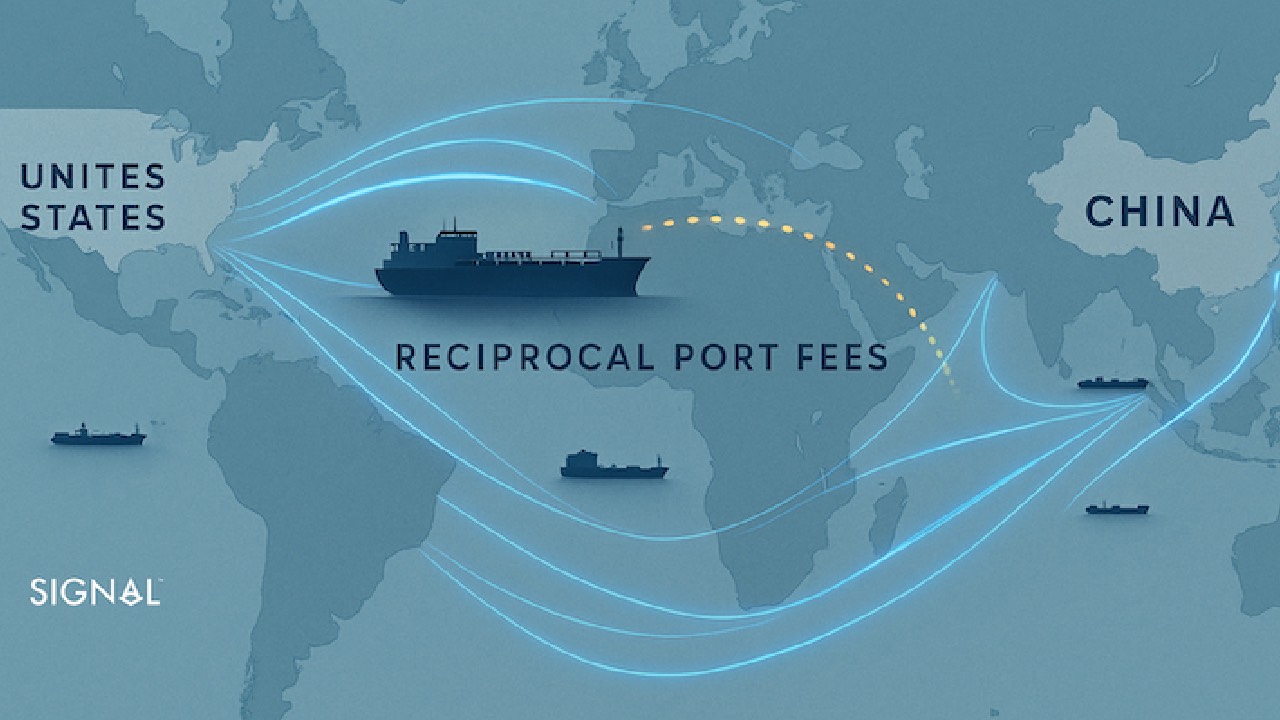

China’s special port feeChina’s new port-fee regulation, effective 14 October 2025, marks a targeted response to escalating U.S.–China trade frictions. The measure applies to vessels with a defined U.S. nexus, encompassing ownership, operational control, or equity participation of at least 25%, as well as vessels flagged or built in the United States. The fee structure introduces a variable levy starting at RMB 400 per net ton in 2025, rising to RMB 1,120 by 2028, and applied at the first Chinese port of call per voyage. Each vessel is capped at five chargeable voyages annually. Owners or their agents must report vessel and ownership details seven days before arrival, with penalties for non-compliance including denial of port entry or clearance. A critical feature of the policy is the exemption for Chinese-built vessels, even if they are owned or controlled by U.S. interests. This carve-out reinforces Beijing’s dual objective: to penalize U.S. maritime interests while incentivizing construction in Chinese yards and consolidating domestic industrial competitiveness. From an operational perspective, the regulation introduces a structural cost asymmetry in the global shipping industry. U.S.-linked tonnage faces higher port costs and potential route adjustments, while non-U.S. or Asian-built vessels retain a relative advantage in China-bound trades. The policy thus sharpens the commercial segmentation of the fleet and may accelerate reflagging, corporate restructuring, or the redirection of vessel investments toward non-U.S. entities to preserve market access. Exemptions Update Following the “Announcement on Charging Special Port Fees for Ships to US Ships”, the Chinese Ministry of Transport announced implementation measures regarding the special port fees, including several critical exemptions. According to the Notice, the following ships are exempt from paying the special port fees:
No further elaboration has been provided at this time on the meaning of “Other ships that are recognised and approved for exemption”. Limited Exposure: Few US-Linked or Non-Chinese-Built Tankers Trade Into China Based on the below graph, Signal Ocean voyage data for the year-to-date 2025 indicate that US-linked vessels account for roughly 7% of all oil tanker voyages to China, underscoring that any proposed Chinese fees on US-affiliated shipping would have a limited overall impact on crude and product tanker flows. Within this subset, only about 5% of voyages involve non-Chinese-built tonnage, largely constructed in South Korea or Japan. These estimates are based on US-linked commercial operators with a minimum equity threshold of 25%, excluding US-flagged or US-built vessels, both negligible within this trade flow. As a result, roughly 88% of China-bound oil voyages would remain unaffected by such measures. |
 |
|
Even when breaking down the data by vessel class, the exposure remains limited across all segments, with only minor differences between the crude and product fleets:
Emerging Exposure: Non-Chinese-Built Tanker Orderbook Points to Gradual Upturn in Potential Risk While the current exposure of US-linked or non-Chinese-built tankers trading into China remains limited, the forward outlook points to a gradual structural increase as new capacity enters the global fleet. This assessment focuses on the non-Chinese-built portion of the tanker orderbook, as these vessels could theoretically fall within the scope of China’s proposed measures if they are also US-linked, combining both foreign construction and commercial affiliation criteria. According to Signal Ocean fleet data, about 39% of the global tanker orderbook is non-Chinese-built, with the remaining 61% under construction at Chinese shipyards. Within the non-Chinese segment, the largest shipbuilding centers are South Korea (16%), Japan (5%), and Vietnam (4%). These shipyards dominate foreign construction, meaning a large share of forthcoming deliveries could, by extension, fall under potential scrutiny if China’s policy targets foreign-built, US-linked tonnage.  At the same time, the scheduled deliveries-to-fleet ratio, calculated for the non-Chinese-built portion of the global orderbook, highlights where upcoming exposure may concentrate. Suezmaxes show the highest renewal rate (15%), followed by MR2s (10%), MR1s (9%), VLCCs (8%), Aframaxes (7%), and Panamaxes (6%). At the same time, the scheduled deliveries-to-fleet ratio, calculated for the non-Chinese-built portion of the global orderbook, highlights where upcoming exposure may concentrate. Suezmaxes show the highest renewal rate (15%), followed by MR2s (10%), MR1s (9%), VLCCs (8%), Aframaxes (7%), and Panamaxes (6%).
The recent exemptions, particularly for Chinese-built vessels, offer a practical relief from the initial measures, alleviating concerns about widespread cost increases. This suggests that for most fleet operators, the overall financial exposure should remain manageable. However, this is contingent on careful oversight of vessel ownership structures and limiting direct U.S. affiliations. Consequently, the long-term impact of this policy is likely to be more administrative, emphasizing prudent compliance rather than fundamentally altering trade flows. |
 Looking ahead
Source: Signal Ocean



Related News.

ISLAND OIL: Unveiling of the Sculpture “Cyprus’s Journey Through the Ages” in Protaras – A Tribute and Landmark to Cyprus’s Historical Memory and Cultural Heritage
In a modest ceremony marked by a moving atmosphere, the sculpture “Cyprus’s Journey Through the Ages”, created by acclaimed Cypriot sculptor…

World Maritime Day 2026 from Policy to Practice – powering Maritime Excellence
Global regulations will deliver safer, more resilient shipping when they are implemented worldwide. The international maritime community marks…

Diana Shipping announces Time Charter Contract for m/v DSI Polaris with Dai An Ocean Shipping
Diana Shipping , a global shipping company specializing in the ownership and bareboat charter-in of dry bulk vessels, announced that, through a…

Chief Economists Expect Global Economy to Stabilize, but Fiscal Constraints, Rising Living Costs and AI Investment Uncertainty Threaten Growth
The global economy is stabilizing, but the fiscal support that cushioned successive shocks since 2020 is unlikely to play the same role in the year…

V. welcomes its new graduate cohort as programme expands across the group
Twelve graduates from nine nationalities join 11th year of V.’s expanded international management programme. V., the global ship manager and marine…

From Policy to Practice: Why Seafarers Are the Key to Maritime Excellence
The shipping industry is no stranger to regulation. Seafarers and ship operators work within a vast framework of international conventions, national…

Intermodal Report – Week 38 2026
Please find below the Intermodal market report for week 38 2026. Intermodal Report Week 38 2026 Market Insight By Nikos Tagoulis, Head of…

Allied – Weekly Market Review – Week 38
Please find below the Allied Weekly Report for Week 38 | 2026 ALLIED - Weekly Market Report- Week 38

Record year on the Northeast Passage but Arctic shipping remains very limited
In 2025, a record 103 transit voyages were made via the Northeast Passage. However, this is still equivalent to only around a day and a half of…

[xclusiv] S&P Report 21th September 2026
Please find below the [xclusiv] latest Weekly S&P Report [xclusiv] 2026_09_21 Market Commentary: VLCCs: Freight Boom Reprices the Fleet The VLCC…
Subscribe to our newsletter!
if you dont want to swim alone in the ocean of news, sign up for the newsletter, and you will receive daily all the important news of world shipping!
