Last year’s U.S.-Canada energy trade was valued around $150 billion


The value of energy trade between the United States and Canada remained steady in 2024 at an estimated $151 billion compared with $154 billion in 2023, according to data from the U.S. Census Bureau. Energy trade value is the total value of energy imports and exports between two countries and is driven by commodity volumes and prices. Most of the U.S.-Canada trade value is U.S. energy imports from Canada—$124 billion in 2024—rather than from U.S. energy exports to Canada, which totaled $27 billion last year.
The volume of crude oil and natural gas traded between the two countries increased in 2024, but the value was relatively unchanged because prices for these commodities were lower on average than in 2023.
More recently, crude oil trade volumes across the U.S.-Canada border have decreased. As of March 6, 2025, Canada’s energy exports to the United States are subject to a 10% tariff. Crude oil accounts for the largest component of U.S.-Canada energy trade, and in March and April of this year, the volume of U.S. crude oil imports from Canada and U.S. crude oil exports to Canada fell by about 5% and 28%, respectively, compared with the same period in 2024, according to data from our Petroleum Supply Monthly.

Although we expect any future changes to tariff policy could also affect cross-border energy trade volumes, the United States is likely to remain the preferred destination for Canada’s crude oil given the existing pipeline infrastructure connecting the two markets. Relatively complex U.S. petroleum refineries tend to prefer heavy (dense) crude oils, such as those produced in Canada.
Crude oil. Canada is a key source of U.S. crude oil imports, and Canada was the primary source of U.S. crude oil imports in 2024. U.S. crude oil imports from Canada in 2024 averaged 4.1 million barrels per day (b/d), 5% more than in 2023, partly because the Trans Mountain Expansion pipeline project was placed in service. Canada sends crude oil from production centers in Alberta to the Pacific Coast in British Columbia for export by oil tanker to foreign markets, including those in the U.S. West Coast region.
U.S crude oil exports to Canada are small by comparison, averaging 360,000 b/d in 2024. U.S. crude oil exports to Canada are typically low-density and low-sulfur crude oil grades shipped to eastern Canada.
Petroleum products. Petroleum products trade between the United States and Canada declined slightly in 2024 because U.S. petroleum product imports increased by 5% and exports decreased by 8%. The decline in U.S. petroleum product exports to Canada was driven in part by increased motor gasoline supplies in Canada that reduced the need for imports.
Natural gas. The value of natural gas trade fell significantly in 2024 due to lower natural gas prices. U.S. natural gas imports from Canada in 2024 averaged 8.5 billion cubic feet per day (Bcf/d), 7% more than in 2023, but the value of these imports fell 43% in 2024. Similarly, U.S. natural gas exports to Canada fell by 3% in 2024 to an average of 2.7 Bcf/d, and their value fell by 37%.

Most natural gas traded between the United States and Canada is sent by pipeline. Most U.S. natural gas imports from Canada arrive at the western and central portions of the border, and U.S. natural gas exports are more often sent from northeastern states into Ontario.
Electricity. Electricity trade between the two countries is relatively small compared with trade of other energy sources, but these trade volumes remain a key source of supply under certain market conditions. The value of U.S. electricity imports from Canada accounted for 72% of the total electricity value traded between the two countries.
A previous Today in Energy article explored U.S.-Canada electricity trade in detail. Earlier this year, in response to U.S. tariffs, the Canadian province of Ontario proposed and then retracted a 25% tariff on electricity imports from Canada to Michigan, Minnesota, and New York.
Source: EIA



Related News.

Navigating the Multi-Orbit Era: In Conversation with Intellian’s Jon Harrison at SMM 2026
At SMM 2026 in Hamburg, the rapid evolution of maritime satellite communications took centre stage. Across the exhibition halls, discussions among…

Cyprus ports need joint energy and investment strategy, shipping agents chief says
Cyprus needs a coordinated strategy for shipping, energy and environmental protection to support port investment and modernisation, Cyprus shipping…

MASO Public Affairs introduces MASO Regulatory Intelligence
A new subscription service helping businesses understand what is changing and what it means for them MASO Public Affairs introduces MASO Regulatory…

Anglo-Eastern helps turn CMBTECH’s ammonia ambition into an operational reality
From early feasibility study and risk-based design to newbuilding supervision, crew readiness and technical management, Anglo-Eastern drew on its…

Escalation of attacks threatens to derail recovery in Middle East oil exports
World oil demand is forecast to fall by 2.5 mb/d y-o-y in 4Q26 and 2.6 mb/d on average in 2026. As the Iran war manifests itself through restricted…

New study finds shipping pays twice its share to EU ETS earmarked revenues should triple to help build market for sustainable fuels and technologies
Shipping is responsible for around 10% of EU ETS emissions but pays almost 20% of the ETS bill. Unlike other sectors, it has never received free…

MSARC strengthens maritime mass rescue readiness through training and national live exercise off Dakar, Senegal
Joint MSARC–FHAS programme combines three days of SAR training with a national multi-agency live exercise The Maritime Search and Rescue Council ,…

Sogese report deliveries are still being delayed as container freight rates fluctuate
FOR IMPORTERS Spot rates into the Mediterranean are back at January levels, Far East to Europe reliability sits at pandemic lows, and nearly…

Glencore begins trading on Australian Securities Exchange
Glencore has begun trading on the Australian Securities Exchange under the ASX code GLC. Gary Nagle, Glencore’s CEO, said it was an exciting day for…
BIMCO Shipping Number of the Week
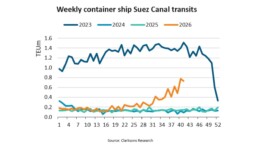
Suez Canal container ship transits exceed 50% of pre-disruption levels "During the first two weeks of October, weekly container ship capacity…
Subscribe to our newsletter!
if you dont want to swim alone in the ocean of news, sign up for the newsletter, and you will receive daily all the important news of world shipping!
