Eastern U.S. natural gas increasingly meets LNG-fueled demand growth in AEO2025

In our Annual Energy Outlook 2025 (AEO2025), we project regional differences in natural gas markets will encourage increased natural gas flows from the mid-Atlantic to the southern Gulf Coast in the coming decades. Across the cases we explored, we project production from the Appalachian Basin in the mid-Atlantic and Ohio region will increasingly meet growing demand on the Gulf Coast in the South Central region, driven largely by increasing liquefied natural gas (LNG) exports. The economics of increased production in the Appalachian Basin are more favorable by 2030, and our model shows natural gas transiting through the Eastern Midwest region on the way to the Gulf Coast.
We froze assumptions for AEO2025 in December 2024, and we did not include market changes, recently passed legislation, regulations, executive actions, or court rulings after that date.

Nearly all existing U.S. LNG export capacity is on the U.S. Gulf Coast, and all new capacity built in AEO2025 is on the Gulf Coast in Texas and Louisiana. We project natural gas converted to LNG for export will increase to 9.8 trillion cubic feet (Tcf), or almost 27 billion cubic feet per day, in 2037 in our Reference case compared with 4.4 Tcf in 2024. Of this new capacity, we assume the five LNG export projects already under construction enter service by 2028 and account for almost 60% of the projected growth. The remaining 40% results from additional LNG export capacity the model projects will be economical to build later in the projection period. After the mid-2030s, we expect exports to remain essentially flat through 2050.
We project natural gas production in the East region, where the Appalachian Basin is located, will increase across almost all our cases. For the Reference case, this volume grows from 12.6 Tcf in 2024 to over 19.6 Tcf by 2050. The Appalachian Basin contains the most abundant and economical-to-access natural gas resources in the United States.

In contrast, production in regions closest to the Gulf Coast decreases over the projection period. In our Reference case, natural gas production decreases by a combined 3.3 Tcf in 2050 compared with 2024 in:
Declining natural gas production can be attributed to several play-specific factors. Natural gas production from the Permian Basin is largely a byproduct of crude oil drilling activities. We project it will decrease as crude oil production declines. The Haynesville formation is much deeper than other natural gas formations, making it more expensive to drill. Its proximity to LNG export terminals has led to drilling and infrastructure investments that result in natural gas production increases midway through the projection period. Projects in the Offshore Gulf of America tend to be more capital-intensive and require longer lead times than onshore projects. Natural gas production has decreased over the last decade, a trend we project will continue.

Most U.S. natural gas market hubs are priced relative to the Henry Hub in southern Louisiana, the national benchmark price used both in futures contracts and to price U.S. LNG exports overseas. Regional differences in natural gas prices relative to Henry Hub reflect local supply-demand dynamics, and they indicate incentives to transport natural gas from low-price to high-price markets.
In the AEO2025 Reference case, the Henry Hub natural gas spot price increases to $4.80 per million British thermal units (MMBtu) in 2050, denominated in 2024 dollars, compared with $2.19/MMBtu in 2024. In 2024, natural gas prices averaged $0.75/MMBtu more on the Gulf Coast than in the East region, indicating that resources in the East are more economical to produce even when including the costs to transport natural gas to consumers in Texas and Louisiana on the Gulf Coast. We project this regional price differential will persist and widen across the AEO2025 cases, increasing to more than $2.00/MMBtu by 2050 in the Reference case. This gap encourages infrastructure builds, such as pipelines, that facilitate increased natural gas flows out of the East and to the Gulf Coast.

Our AEO2025 was released on April 15, 2025, and reflects laws and regulations as of December 2024. Previous Today in Energy articles for the AEO2025 presented key findings for energy consumption, hydrocarbon production and exports, and data centers.
Source: EIA



Related News.

Navigating the Multi-Orbit Era: In Conversation with Intellian’s Jon Harrison at SMM 2026
At SMM 2026 in Hamburg, the rapid evolution of maritime satellite communications took centre stage. Across the exhibition halls, discussions among…
Cyprus ports need joint energy and investment strategy, shipping agents chief says
Cyprus needs a coordinated strategy for shipping, energy and environmental protection to support port investment and modernisation, Cyprus shipping…

MASO Public Affairs introduces MASO Regulatory Intelligence
A new subscription service helping businesses understand what is changing and what it means for them MASO Public Affairs introduces MASO Regulatory…
Anglo-Eastern helps turn CMBTECH’s ammonia ambition into an operational reality
From early feasibility study and risk-based design to newbuilding supervision, crew readiness and technical management, Anglo-Eastern drew on its…

Escalation of attacks threatens to derail recovery in Middle East oil exports
World oil demand is forecast to fall by 2.5 mb/d y-o-y in 4Q26 and 2.6 mb/d on average in 2026. As the Iran war manifests itself through restricted…
New study finds shipping pays twice its share to EU ETS earmarked revenues should triple to help build market for sustainable fuels and technologies
Shipping is responsible for around 10% of EU ETS emissions but pays almost 20% of the ETS bill. Unlike other sectors, it has never received free…

MSARC strengthens maritime mass rescue readiness through training and national live exercise off Dakar, Senegal
Joint MSARC–FHAS programme combines three days of SAR training with a national multi-agency live exercise The Maritime Search and Rescue Council ,…
Sogese report deliveries are still being delayed as container freight rates fluctuate
FOR IMPORTERS Spot rates into the Mediterranean are back at January levels, Far East to Europe reliability sits at pandemic lows, and nearly…
Glencore begins trading on Australian Securities Exchange
Glencore has begun trading on the Australian Securities Exchange under the ASX code GLC. Gary Nagle, Glencore’s CEO, said it was an exciting day for…
BIMCO Shipping Number of the Week
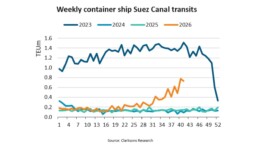
Suez Canal container ship transits exceed 50% of pre-disruption levels "During the first two weeks of October, weekly container ship capacity…
Subscribe to our newsletter!
if you dont want to swim alone in the ocean of news, sign up for the newsletter, and you will receive daily all the important news of world shipping!
